




Pronunciation: AK-ro-CAN-tho-SOR-us
Meaning: High-spined lizard
Author/s: Stoval and Langston (1950)
Synonyms: Acracanthus atokaensis
First Discovery: Atoka, Oklahoma, USA
Acta Ordinal: #194
Acrocanthosaurus atokensis
Initially tagged "Acracanthus atokaensis" and assigned to the now-defunct Antrodemidae in the thesis of Wann Langston in 1947, Acrocanthosaurus, as it became known after an official scientific description and a move to Carcharodontosauridae three years later, means "high-spined lizard from Atoka County". However, it isn't unique to Atoka County. Its bones have been found in Oklahoma and Arizona, and what may or may not be its teeth have been collected in Maryland and far-flung places right across North America. But the largest and best-represented specimen, which just happens to be attached to the most interesting story, was discovered in McCurtain County in 1983.
Whilst snooping around on private land, Cephis Hall (an Arkansas Hillbilly) and Sid Love (a Choctaw Indian) found a thigh bone, turned jet black by minerals, in a waste pit, and after four years of toiling in muck, the "Mountain Fork Monster" was out of the ground. It was at this point that Weyerhaeuser, one of America's largest corporations and owners of the land, realised the dinosaur's value and tried to stake their claim. Long story short, the "production-minded, profits-driven, cost-conscious, efficiency-obsessed, timber magnates" lost their case despite the intervention of academia, the police, the courts, and the Oklahoma State Legislature. Now NCSM 14345, affectionately known as "Fran" (after Fran Graffham of Geological Enterprises, who bought it and funded its restoration), can be seen in North Carolina's Museum of Natural Sciences in Raleigh. Well, a cast can. The real fossils are far too valuable to go on display.
As well as physical remains, fossilised footprints discovered at Fort Worth and tagged the "Glen Rose trackway" were attributed to Acrocanthosaurus. They were found alongside sauropod tracks and had an unusual left, right, left, left step pattern, which suggests that their owner had "hopped" onto a potential meal (possibly Astrodon/Pleurocoelus) before slipping off. The sauropod didn't shift gait, which is unusual for a beast under attack and, with no evidence of a struggle, it's possible that the pair just followed the same path at some point, perhaps as hunter and hunted, and the predator tripped or skipped for no apparent reason.
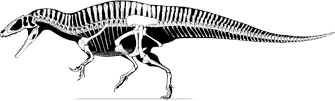
With a twelve-meter long, five-and-a-half-ton rack and a carving knife tooth-packed skull well over a meter long, Acrocanthosaurus was the biggest North American predator of its time, pre-dating Tyrannosaurus rex by some fifty million years. It was a tad shorter than T.rex and around a ton lighter, but its arms were longer and stronger, it had an extra finger, and its name-prompting high spines probably anchored a row of muscle to increase its overall power. You may think these dimensions put it right at the top of the food chain in its ecosystem, but a punctured shoulder blade, several broken ribs and a crocodile-like tooth found embedded in the lower jaw of "Fran" during preparation suggests something in the area didn't agree.
Whilst snooping around on private land, Cephis Hall (an Arkansas Hillbilly) and Sid Love (a Choctaw Indian) found a thigh bone, turned jet black by minerals, in a waste pit, and after four years of toiling in muck, the "Mountain Fork Monster" was out of the ground. It was at this point that Weyerhaeuser, one of America's largest corporations and owners of the land, realised the dinosaur's value and tried to stake their claim. Long story short, the "production-minded, profits-driven, cost-conscious, efficiency-obsessed, timber magnates" lost their case despite the intervention of academia, the police, the courts, and the Oklahoma State Legislature. Now NCSM 14345, affectionately known as "Fran" (after Fran Graffham of Geological Enterprises, who bought it and funded its restoration), can be seen in North Carolina's Museum of Natural Sciences in Raleigh. Well, a cast can. The real fossils are far too valuable to go on display.
As well as physical remains, fossilised footprints discovered at Fort Worth and tagged the "Glen Rose trackway" were attributed to Acrocanthosaurus. They were found alongside sauropod tracks and had an unusual left, right, left, left step pattern, which suggests that their owner had "hopped" onto a potential meal (possibly Astrodon/Pleurocoelus) before slipping off. The sauropod didn't shift gait, which is unusual for a beast under attack and, with no evidence of a struggle, it's possible that the pair just followed the same path at some point, perhaps as hunter and hunted, and the predator tripped or skipped for no apparent reason.
With a twelve-meter long, five-and-a-half-ton rack and a carving knife tooth-packed skull well over a meter long, Acrocanthosaurus was the biggest North American predator of its time, pre-dating Tyrannosaurus rex by some fifty million years. It was a tad shorter than T.rex and around a ton lighter, but its arms were longer and stronger, it had an extra finger, and its name-prompting high spines probably anchored a row of muscle to increase its overall power. You may think these dimensions put it right at the top of the food chain in its ecosystem, but a punctured shoulder blade, several broken ribs and a crocodile-like tooth found embedded in the lower jaw of "Fran" during preparation suggests something in the area didn't agree.
[High-Spined Lizard from Atoka]Etymology
Acrocanthosaurus is derived from the Greek "akros" (high), "akantha" (spine or thorn) and "sauros" (lizard), in reference to its neural spines. The species epithet, atokensis (AY-toh-KEN-sis), means "from Atoka (county)" in Latin. ZooBank registry: urn:lsid:zoobank.org:act:63B8F968-2ACB-476E-83DD-0E1FBC5DA8E4.
Discovery
The first remains of Acrocanthosaurus were discovered in the Antlers Formation at Atoka County, Oklahoma, U.S.A, in 1940. The Holotype (OMNH 10146) is a partial skull and skeleton.


