









Pronunciation: AF-ro-VEN-uh-tuh
Meaning: African Hunter
Author/s: Sereno, Wilson, et al. (1994)
Synonyms: None known
First Discovery: Abaka, Niger
Acta Ordinal: #403
Afrovenator abakensis
When Paul Sereno coined Afrovenator in 1994 he described it as "the most complete Cretaceous period predatory dinosaur ever discovered in Africa" and assigned to Torvosauroidea. A couple of things have changed since then.
First of all, the rocks in which it was discovered—initially thought to be from the Hauterivian of the Early Cretaceous—were recently redated and pushed way back into the Middle Jurassic, a time more befitting its rather primitive features. Secondly, when the earlier-named Spinosaurus was found to belong to the same group, Torvosauroidea became Spinosauroidea, and when all lingering doubts about the validity of the even earlier-named Megalosaurus were put to rest Spinosauroidea became Megalosauroidea! Furthermore, Afrovenator was proven to be a member of the more exclusive Megalosauridae, which was Torvosauridae under the old Torvosaurus stewardship, but whichever way you slice it Afrovenator was well-stacked as far as predators go and probably the king of its eco system.
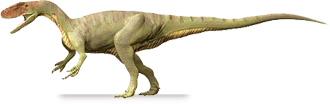
A gracile build with long slender legs and a long counter-balancing tail reinforced with interwoven bony struts suggest Afrovenator was fleet of foot, and when combined with a low profile skull packed with 2" long teeth, and powerful arms with claw-tipped three fingered hands it had enough to put the fear of God into any contemporaneous herbivore. Not that we're condoning creationism. Or dismissing it.
One such herbivore may have been Jobaria, also mis-dated to the Mid-Cretaceous, as a fossilized juvenile specimen sports scars which appear to match the teeth pattern of Afrovenator. Of course, we don't know whether the African hunter actually hunted Jobaria or simply scavenged its carcass, but if it was as fearsome as the name suggests perhaps Sereno's "crouching infant, rearing parent" theory wasn't a particularly effective defensive strategy, at least on this occasion.
First of all, the rocks in which it was discovered—initially thought to be from the Hauterivian of the Early Cretaceous—were recently redated and pushed way back into the Middle Jurassic, a time more befitting its rather primitive features. Secondly, when the earlier-named Spinosaurus was found to belong to the same group, Torvosauroidea became Spinosauroidea, and when all lingering doubts about the validity of the even earlier-named Megalosaurus were put to rest Spinosauroidea became Megalosauroidea! Furthermore, Afrovenator was proven to be a member of the more exclusive Megalosauridae, which was Torvosauridae under the old Torvosaurus stewardship, but whichever way you slice it Afrovenator was well-stacked as far as predators go and probably the king of its eco system.
A gracile build with long slender legs and a long counter-balancing tail reinforced with interwoven bony struts suggest Afrovenator was fleet of foot, and when combined with a low profile skull packed with 2" long teeth, and powerful arms with claw-tipped three fingered hands it had enough to put the fear of God into any contemporaneous herbivore. Not that we're condoning creationism. Or dismissing it.
One such herbivore may have been Jobaria, also mis-dated to the Mid-Cretaceous, as a fossilized juvenile specimen sports scars which appear to match the teeth pattern of Afrovenator. Of course, we don't know whether the African hunter actually hunted Jobaria or simply scavenged its carcass, but if it was as fearsome as the name suggests perhaps Sereno's "crouching infant, rearing parent" theory wasn't a particularly effective defensive strategy, at least on this occasion.
(African hunter from Abaka)
Etymology
Afrovenator is derived from the Latin "Afer" (an inhabitant of Africa) and "venator" (hunter).
The species epithet, abakensis, is a reference to Abaka (Tuareg name for the area in which it was discovered) plus the Latin "ensis" (from).
Discovery
The remains of Afrovenator were discovered in the Tiourarén Formation of Agadez, Niger, in 1993 by Paul Sereno. The Holotype (UC OBA 1, housed at the University of Chicago) is a complete-ish skeleton featuring most of the skull minus its lower jaw, parts of the spinal column, forelimbs and hands, an almost whole pelvis and hind limbs but, most disappointingly, no afro.


