







Pronunciation: AL-a-mo-SOR-us
Meaning: Ojo Alamo lizard
Author/s: Gilmore (1922)
Synonyms: None known
First Discovery: New Mexico, USA
Acta Ordinal: #133
Alamosaurus sanjuanensis
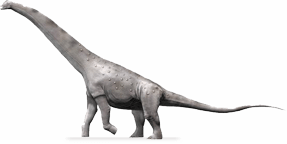
When J.B Reeside discovered Alamosaurus in 1921, it was North America's first Late Cretaceous-aged sauropod dinosaur. Funnily enough, a hip bone and shoulder blade made Alamosaurus North America's best-represented titanosaurian sauropod too, mainly because the land of the free has yet to yield another. But, despite laying claim to a steady stream of fossils since then, the most attention has been drawn through a misinterpretation of its name (see etymology).
After a 2011 review of two enormous vertebrae (SMP VP-1850, collected in 2004 and SMP VP-2104, collected in 2006) from "Willow Wash", and a 30% complete femur (collected in 2003) from "De-na-zin" Wash, Alamosaurus gained some real notoriety by catapulting itself into the big league of dinosaurs. Pound-for-pound, it is genuinely comparable to the likes of Puertasaurus, Futalognkosaurus, and the mighty Argentinosaurus. In fact, the new specimens are so much bigger than the original fossils it seems likely that all studies prior to 2011 had been based on the study of unreliable juveniles. But at least we can now add Alamosaurus to the ever increasing ranks of confirmed armoured titanosaurs.
On June 15th 1937, George B. Pearce discovered a partial Alamosaurus skeleton on the southwest toe of Utah's North Horn Mountain that was catalogued as USNM 15660, and in 2009 Michael Brett-Surman realised that a single armour plate, bearing an identical catalogue number, was hidden away in the Smithsonian. Based on style and hand, it seems likely that the same person created both hand-written labels, and probably at the same time, suggesting the armour and skeleton represent one individual.
Alamosaurus lived in North America in the dying days of the dinosaurs, but there are no confirmed remains to prove they ever ventured north of central Utah, and shared their yard with Tyrannosaurus rex. So it's quite fitting that Alamosaurus remains were eventually discovered in Texas, where General Custer also made his last stand.
After a 2011 review of two enormous vertebrae (SMP VP-1850, collected in 2004 and SMP VP-2104, collected in 2006) from "Willow Wash", and a 30% complete femur (collected in 2003) from "De-na-zin" Wash, Alamosaurus gained some real notoriety by catapulting itself into the big league of dinosaurs. Pound-for-pound, it is genuinely comparable to the likes of Puertasaurus, Futalognkosaurus, and the mighty Argentinosaurus. In fact, the new specimens are so much bigger than the original fossils it seems likely that all studies prior to 2011 had been based on the study of unreliable juveniles. But at least we can now add Alamosaurus to the ever increasing ranks of confirmed armoured titanosaurs.
On June 15th 1937, George B. Pearce discovered a partial Alamosaurus skeleton on the southwest toe of Utah's North Horn Mountain that was catalogued as USNM 15660, and in 2009 Michael Brett-Surman realised that a single armour plate, bearing an identical catalogue number, was hidden away in the Smithsonian. Based on style and hand, it seems likely that the same person created both hand-written labels, and probably at the same time, suggesting the armour and skeleton represent one individual.
Alamosaurus lived in North America in the dying days of the dinosaurs, but there are no confirmed remains to prove they ever ventured north of central Utah, and shared their yard with Tyrannosaurus rex. So it's quite fitting that Alamosaurus remains were eventually discovered in Texas, where General Custer also made his last stand.
(Ojo Alamo Lizard from San Juan)Etymology
Contrary to popular assertions, the name Alamosaurus has nothing to do with the Alamo in San Antonio, Texas, or the battle that was fought there. It was named for the Ojo Alamo formation in New Mexico, which took its name from the Ojo Alamo trading post. The trading post itself was named after a species of cottonwood tree or "poplar" (known as "Alamo" in Spanish) that grew beside a nearby spring.The species epithet, sanjuanensis, is a reference to San Juan, the county in which it was discovered. "Ensis" is a genus of edible saltwater clam (known as "razors" in England and "spoots" in Scotland), and also means "sword" in Latin, but when used as a Latin suffix for a place name it means "pertaining to", "originating in", or just "from". Genus name and epithet were coined by Smithsonian palaeontologist Charles W. Gilmore in 1922. ZooBank registry: urn:lsid:zoobank.org:act:899D66B9-A7DD-43ED-850C-68F677C3A6AF.
Discovery
The first fossils of Alamosaurus were discovered at Barrel Spring Arroyo in the Naashoibito Member of the Ojo Alamo Formation (thought by some to be the Upper Kirtland Formation), San Juan Basin, New Mexico, by geologist John B. Reeside jr. of the US Geological Survey in June 1921.
The Holotype (USNM 10486) is a shoulder blade.


