




Pronunciation: AY-lee-o-RAH-mus
Meaning: Different branch
Author/s: Kurzanov (1976)
Synonyms: None known
First Discovery: Bayankhongor, Mongolia
Acta Ordinal: #257
Alioramus remotus
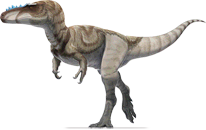
When trying to reconstruct entire dinosaurs from shabby remains, the chances are, it will raise as many questions as it answers. And so it was with Alioramus: identified as a tyrannosauroid in 1976 by Soviet palaeontologist Sergei Kurzanov who left us with a tantalising name that means "different branch" (a previously unknown group of theropod dinosaur), but not a lot else.
The source of Kurzanov's initial assumption was a somewhat flat and long skull, with a strange row of seven hornlets on its snout not dissimilar to those found on juvenile specimens of the contemporaneous, thick-browed, deep-jawed, Asian colossus, Tarbosaurus. And for thirty years, that's what most experts assumed it was. However, the only known specimen of Alioramus remotus is a nine-year-old subadult that would have been significantly smaller than Tarbosaurus even when fully grown, and its skull shape wouldn't have changed much. On top of that, it was of a lighter build with longer legs and had more teeth than any other "tyrant lizard". All things considered, it seems likely that Alioramus and Tarbosaurus are distinct species after all, and they had evolved contrasting anatomical features to tackle different types of prey so they could share the same ecosystem without nicking each other's food.
The 2001 discovery of a better-represented second species, Alioramus altai, and subsequent study and description by Steve Brusatte in 2009, confirmed that Alioramus was a member of the Tyrannosaurus-anchored Tyrannosaurinae. Furthermore, with the discovery of Qianzhousaurus in 2014, the same author resurrected George Olshevsky's long-forgotten Alioramini: a sub-family of long-snouted tyrannosaurines that was pointless when he coined it back in 1995 with Alioramus remotus as the only member. So, as it transpired, Kurzanov and his "different branch" was right all along.
The source of Kurzanov's initial assumption was a somewhat flat and long skull, with a strange row of seven hornlets on its snout not dissimilar to those found on juvenile specimens of the contemporaneous, thick-browed, deep-jawed, Asian colossus, Tarbosaurus. And for thirty years, that's what most experts assumed it was. However, the only known specimen of Alioramus remotus is a nine-year-old subadult that would have been significantly smaller than Tarbosaurus even when fully grown, and its skull shape wouldn't have changed much. On top of that, it was of a lighter build with longer legs and had more teeth than any other "tyrant lizard". All things considered, it seems likely that Alioramus and Tarbosaurus are distinct species after all, and they had evolved contrasting anatomical features to tackle different types of prey so they could share the same ecosystem without nicking each other's food.
The 2001 discovery of a better-represented second species, Alioramus altai, and subsequent study and description by Steve Brusatte in 2009, confirmed that Alioramus was a member of the Tyrannosaurus-anchored Tyrannosaurinae. Furthermore, with the discovery of Qianzhousaurus in 2014, the same author resurrected George Olshevsky's long-forgotten Alioramini: a sub-family of long-snouted tyrannosaurines that was pointless when he coined it back in 1995 with Alioramus remotus as the only member. So, as it transpired, Kurzanov and his "different branch" was right all along.
(Remote Different Branch)Etymology
Alioramus is derived from the Latin "alius" (different, other) and "ramus" (branch). This title was bestowed by Kurzanov who thought it was far removed from the evolutionary branch of other tyrannosaurs because of its snout crests, high tooth count and low skull profile. So convinced was he that it was a "different branch" he also gave it the species epithet, remotus,
meaning "remote" or "removed" in Latin.
Discovery
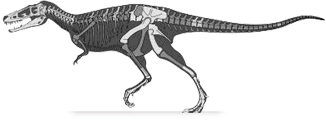 The first fossils of Alioramus were recovered from the beds of Nogon Tsav, 20 km NW of Mount Ongon-Ulan-Ula, Bayankhongor, Mongolia, by a joint Soviet-Mongolian expedition to the Gobi Desert in 1976.
The Holotype (GI 3141/1) is a juvenile skull (700mm long) with lower jaw and a beautifully preserved braincase. Also three foot bones (metatarsals).


