




Pronunciation: ANG-kee-OR-niss
Meaning: Near bird
Author/s: Xu et al. (2009)
Synonyms: ?Aurornis xui (Godefroit et al, 2013)
First Discovery: Jianchang, China
Acta Ordinal: #689
Anchiornis huxleyi
Soft tissue
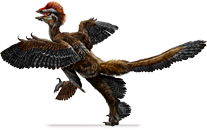
Palaeontologists and Palaeoartists have a tough job trying to discern the exact shape of extinct dinosaurs, mainly because soft tissue—the stuff that adds bulk and form to the fossilised skeletal frame—is rarely found, so reconstructions are arrived at via the study of living dinosaurs (birds) and their distant relatives (crocodilians). Inspired in 2017 by pioneer Tom Kaye, Michael Pittman and crew tried to shed some light on the actual form of extinct dinosaurs, funnily enough, by dragging a dozen stone slabs containing specimens of Anchiornis into a blacked-out room. Then they blasted them with high-powered ultraviolet lasers to agitate any remnants of soft tissue that were invisible to the naked eye and literally made them "glow in the dark". Because of exquisite visible outlines, we already knew that Anchiornis was feathered, and we knew what colour those feathers were because of fossilised pigment cells (melanosomes). But thanks to Kaye's technique—called laser-stimulated fluorescence (or LSF), the results of which were captured using an HD camera with a laser-blocking filter—we now know that Anchoiornis was just as bird-like as expected. It had arms that look just like modern bird wings right down to the patagium (skin flap) in front of the elbow that joins the upper and lower arm, scaley pads on the base of its feet, and even drumstick-shaped legs. Unfortunately, non of the dozen or so specimens revealed any details of the head, neck or thorax or any evidence to suggest whether Anchiornis was, or was not, capable of flapping flight.
(Huxley's near-bird)Etymology
Anchiornis is derived from the Greek "Anchi" (nearby) and "ornis" (bird), referring to its very close relationship to birds.
The species epithet, huxleyi, honours Thomas Henry Huxley aka "Darwin's Bulldog": a pioneer of research into avian origins and the first scientist to suggest a close evolutionary relationship between birds and dinosaurs.
Discovery
 The first fossils of Anchiornis were recovered from the Yaolugou locality in the Tiaojishan Formation at Daxishan village, Linglongta, Jianchang County, western Liaoning, China.
The holotype (IVPP V14378, housed at the Institute of Vertebrate Paleontology and Paleoanthropology in Beijing) is an articulated skeleton complete with feather impressions, but lacking the skull and bits of the tail and right arm.
A second specimen (LPM - B00 169), found by a local farmer at the nearby Daxishan locality and described on 24th September 2009, was larger than the holotype and virtually covered from head to toe in various kinds of feathers.
The first fossils of Anchiornis were recovered from the Yaolugou locality in the Tiaojishan Formation at Daxishan village, Linglongta, Jianchang County, western Liaoning, China.
The holotype (IVPP V14378, housed at the Institute of Vertebrate Paleontology and Paleoanthropology in Beijing) is an articulated skeleton complete with feather impressions, but lacking the skull and bits of the tail and right arm.
A second specimen (LPM - B00 169), found by a local farmer at the nearby Daxishan locality and described on 24th September 2009, was larger than the holotype and virtually covered from head to toe in various kinds of feathers.
An extremely well-preserved third specimen missing only its tail (BMNHC PH828), from the same locality as LPM - B00 169, was scanned in 2010 and became the first Mesozoic dinosaur to have its plumage (almost) fully colour mapped. Another specimen (YTGP-T5199) from the holotype quarry was also colour decoded, but with different results, leading the authors to question whether BMNHC PH828 was actually Anchiornis or another critter entirely.
Four specimens (PKUP V1068, BMNHC PH804, BMNHC PH822, and BMNHC PH823) were described in 2017, but many more reside in private collections and institutions that are waiting for their turn in the limelight.
Preparators
X. Q. Ding (holotype).
T. Yu (2nd specimen).


