









Pronunciation: AHR-kee-OP-tuh-rix
Meaning: Ancient Wing
Author/s: von Meyer (1861)
Synonyms: See below
First Discovery: Solnhofen, Germany
Acta Ordinal: #20
Archaeopteryx lithographica
When Charles Darwin published "On the Origin of Species" in 1859, an outraged public demanded evidence to back up his ludicrous claims when—BANG! A slab of split Solfholfen sandstone landed on Sir Richard Owen's desk in exchange for the princely sum of seven hundred English pounds, and inside was Archaeopteryx: a fossil seemingly caught in the act of evolution.
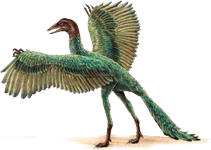
Sharp teeth, clawed, three-fingered hands, a long stiff tail, and other bipedal theropod dinosaur features were obvious. Yet the tunnel-visioned Owen remained unmoved. He unequivocally declared it a bird, citing its wishbone and a clear impression of long, flowing feathers, and enough arm and breast muscle attachment points to suggest it was capable of flap-powered flight.
The earliest definite example of what we now know as Archaeopteryx was originally named Pterodactylus crassipes by Hermann von Meyer in 1857, and was, for years, simply referred to as "Urvogel"—a German term meaning "first bird". It was reclassified as Archaeopteryx crassipes by John Ostrom in 1970 but was suppressed in favour of Archaeopteryx lithographica—a name already entrenched in textbooks, museum labels, and the public imagination—in a rare act of intervention by the International Commission on Zoological Nomenclature (ICZN) in 1977. But as specimens continued to pile up, Archaeopteryx species multiplied like taxonomic rabbits.
The crow-sized Archaeopteryx is known from a dozen or so skeletons and a feather impression, almost all from Bavarian quarries within a 15-mile radius, and somehow associated with at least two dozen names. Many are "forgotten", some are synonyms, others are simple spelling mistakes, and more still are unnecessary emendations of those mistakes. Archaeopteryx siemensii (Dames, 1897), Archaeopteryx recurva (Howgate, 1984) and Archaeopteryx bavarica (Wellnhofer, 1993) continue to linger and may represent valid species. Meanwhile, Wellnhoferia grandis (Elzanowski, 2001) and Jurapteryx recurva (Howgate, 1985) are trying to break out into valid genera—or break back in, depending on which palaeontologist you follow.
Naming fiascos aside, Archy has weathered decades of brouhaha and always emerges with its head held high. It was once accused of being a chimaera—though the antagonists (an astronomer and a physicist!) were never taken seriously. It was briefly shifted to Deinonychosauria along with the newly discovered Xiaotingia in 2011, based on a character matrix that was missing two critical updates. And despite Chatterjee's attempts to dethrone it with a hotch-potch of poorly preserved bones from hither and thither in 1991 (see Protoavis), Archaeopteryx still holds the title of earliest known ancestor of birds. The early bird normally gets the worm, but in this case, it gets the glory.
Archaeopteryx is derived from the Greek "arkhaios" (ancient) and "pteryx"' (wing). Sharp teeth, clawed, three-fingered hands, a long stiff tail, and other bipedal theropod dinosaur features were obvious. Yet the tunnel-visioned Owen remained unmoved. He unequivocally declared it a bird, citing its wishbone and a clear impression of long, flowing feathers, and enough arm and breast muscle attachment points to suggest it was capable of flap-powered flight.
The earliest definite example of what we now know as Archaeopteryx was originally named Pterodactylus crassipes by Hermann von Meyer in 1857, and was, for years, simply referred to as "Urvogel"—a German term meaning "first bird". It was reclassified as Archaeopteryx crassipes by John Ostrom in 1970 but was suppressed in favour of Archaeopteryx lithographica—a name already entrenched in textbooks, museum labels, and the public imagination—in a rare act of intervention by the International Commission on Zoological Nomenclature (ICZN) in 1977. But as specimens continued to pile up, Archaeopteryx species multiplied like taxonomic rabbits.
The crow-sized Archaeopteryx is known from a dozen or so skeletons and a feather impression, almost all from Bavarian quarries within a 15-mile radius, and somehow associated with at least two dozen names. Many are "forgotten", some are synonyms, others are simple spelling mistakes, and more still are unnecessary emendations of those mistakes. Archaeopteryx siemensii (Dames, 1897), Archaeopteryx recurva (Howgate, 1984) and Archaeopteryx bavarica (Wellnhofer, 1993) continue to linger and may represent valid species. Meanwhile, Wellnhoferia grandis (Elzanowski, 2001) and Jurapteryx recurva (Howgate, 1985) are trying to break out into valid genera—or break back in, depending on which palaeontologist you follow.
Naming fiascos aside, Archy has weathered decades of brouhaha and always emerges with its head held high. It was once accused of being a chimaera—though the antagonists (an astronomer and a physicist!) were never taken seriously. It was briefly shifted to Deinonychosauria along with the newly discovered Xiaotingia in 2011, based on a character matrix that was missing two critical updates. And despite Chatterjee's attempts to dethrone it with a hotch-potch of poorly preserved bones from hither and thither in 1991 (see Protoavis), Archaeopteryx still holds the title of earliest known ancestor of birds. The early bird normally gets the worm, but in this case, it gets the glory.
The species epithet, lithographica, refers to the lithographic limestone in which it was buried. Zoobank registry: urn:lsid:zoobank.org:act:66EAED38-BB03-406B-B8A2-F135DFF611FC. Archaeopteryx macrura (Owen, 1862)
Griphosaurus problematicus (Wagner, 1862)
Griphornis longicaudatus (Woodward, 1862)
Archaeornis siemensii (Dames, 1897)
Archaeopteryx owenii (Petronievics, 1917)
Archaeopteryx crassipes (Ostrom, 1972)
Jurapteryx recurva (Howgate, 1985)
Archaeopteryx bavarica (Wellnhofer, 1993)
Possible synonyms
Wellnhoferia grandis? (Elzanowski, 2001)
Ostromia crassipes? (Foth and Rauhut, 2017)
Alcmonavis poeschli? (Rauhut, Tischlinger and Foth, 2019) All but one of the proposed Archaeopteryx specimens hail from limestone quarries in the vicinity of Solnhofen, Germany, which during the Jurassic period was covered by a warm, shallow lagoon with a soft muddy bottom that has proven ideal for preserving ancient fossils in glorious detail.
The original holotype is a single feather (described by Christian Erich Hermann von Meyer, and later misspelled Archaeopterix with an "i" instead on a "y"), which may have been enough to anchor a genus back in 1861, but not since the discovery of other, plumed "early birds".
In 2007, scientists Bock and Bühler proposed BMNH 37001 (the "London specimen")—representing the first skeletal Archaeopteryx to be discovered—be installed as the name-bearing specimen, and it was designated as neotype by the ICZN on October 3, 2011.
The feather may not even belong to Archaeopteryx. But the following thirteen specimens apparently do, though a couple may turn out to be distinct critters in their own right. "The London Specimen" (BMNH 37001) was found in 1861 near Langenaltheim, Germany, and perhaps given to a local physician Karl Häberlein in return for medical services. We're not sure what services he offered, but we're willing to bet they didn't ammount to the £700 he received when he sold it on to London's Natural History Museum. Owen published this specimen as Archeopteryx macrurus in 1863, then Petronievics named it Archaeopteryx oweni in 1917. Both names are uneccessary and invalid. "The Berlin Specimen" (HMN 1880) was found in 1877 on the Blumenberg near Eichstätt, Germany, by farmer Jakob Niemeyer who sold it to innkeeper Johann Dörr so he could buy a cow. In 1897 Dames named this specimen Archaeopteryx siemensii which may (or may not) be a valid species. In 1917 Petronievics erroneously renamed it Archaeornis. "The Maxberg Specimen" (S5) was discovered in 1956 near Langenaltheim. "The Haarlem Specimen" (TM 6428, also known as the Teyler Specimen, since it was kept in the Teylers Museum in Haarlem) was discovered in 1855 near Riedenburg, Germany, and initially described as a Pterodactylus crassipes in 1857 by von Meyer. It was renamed Ostromia crassipes by Foth and Rauhut in 2017, but that has not been universally accepted. "The Eichstätt Specimen" (JM 2257), discovered in 1951 near Workerszell, Germany and described by Peter Wellnhofer in 1974, is the smallest known specimen of Archaeopteryx and may be a separate genus; Jurapteryx recurva. "The Solnhofen Specimen" (BSP 1999) was discovered in the 1970s near Eichstätt, Germany, and described in 1988 by Peter Wellnhofer. It was originally assigned to Compsognathus by Friedrich Müller, and while it may actually be the largest known specimen of Archaeopteryx, it was renamed Wellnhoferia grandis in honor of Welnhofer by Andrzej Elzanowski in 2001 due to distinct features of its tail and toes. "The Munich Specimen" (S6, formerly known as the Solenhofer-Aktien-Verein Specimen), discovered on 3 August 1992 near Langenaltheim and described in 1993 by by Wellnhofer, was sold to the Paläontologisches Museum München in Munich for 1.9 million Deutschmark in 1999. It has been mooted as a distinct species (Archaeopteryx bavarica) but it may belong to Archaeopteryx siemensii, if the latter is indeed a distinct species. "The Daiting Specimen" was found in 1990 but had only been seen briefly in the form of a cast until the original showed up at the 2009 Munich Mineral Show. After that, it disappeared again, hence its nickname—"the Phantom". Discovered in a limestone bed that was a few hundred thousand years younger than the other finds, this may be a new species of Archaeopteryx. "The Bürgermeister-Müller Specimen", affectionately known as "chicken wing" because, well, its remains amount to a single wing fossil, was found in 2000, and, although privately owned, has been on loan to the Bürgermeister-Müller Museum in Solenhofen since 2004. "The Thermopolis Specimen" (WDC CSG 100) was discovered in Bavaria and described December 2, 2005 by Mayr, Pohl, and Peters, after being donated to the Wyoming Dinosaur Center in Thermopolis, Wyoming. It was assigned to Archaeopteryx siemensii in 2007. Three more specimens keep a low profile, one of which is in the hands of a reclusive collector. It has been subjected to scientific scrutiny, and was recently referred to as "The Altmühltal Specimen", referring to both its general area of provenance close to the Altmühltal river and its discovery in the Altmühltal Formation.
Another was found by amateur collectors in 2010 in the Painten Formation at Gerstner Quarry at Schamhaupten (hence "The Schamhaupten Specimen"), making it somewhat older than the other specimens... and the only one that lacks feather impressions.
The thirteenth specimen of Archaeopteryx (SMNK-PAL 10,000, aka "the Karlsruhe specimen", from the Mörnsheim Formation at Mühlheim near Eichstätt) might not even belong to Archaeopteryx: its fossils are so fragmentary that they can't be assigned here with any real confidence. It actually replaced SNSB-BSPG 2017 I 133 ("The Mühlheim specimen"), which was also found in Mühlheim's Mörnsheim Formation, as the "thirteenth specimen", because that turned out to be an entirely different critter that was named Alcmonavis poeschli by Rauhut, Tischlinger and Foth in 2019, but not everyone agrees. "The Chicago Specimen"—the fourteenth and smallest specimen of Archaeopteryx—is an exceptionally preserved fossil acquired by Chicago's Field Museum in 2022 and catalogued as FMNH PA 830. Two years of preparation revealed unprecedented soft-tissue details, including skin, toe pads, and never-before-seen feathers, including specialized inner secondary feathers called tertials, alongside a nearly complete skull with a palatal anatomy intermediate between troodontid theropods and early birds. High-resolution CT scans and UV imaging showed fine skeletal and feather structures that illuminate how early avian flight evolved and why Archaeopteryx could fly while many close dinosaur relatives could not.
It was found near Solnhofen and had been acquired by a private collector in Switzerland in 1990, long before Germany's 2015 ban on exporting Archaeopteryx specimens.
It is one of only two specimens in an institution outside Europe.


