









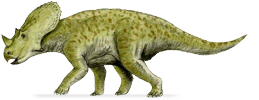
Pronunciation: BRAK-i-SEH-ruh-tops
Meaning: Short horn face
Author/s: Gilmore (1914)
Synonyms: None known
First Discovery: Montana, USA
Acta Ordinal: #117
Brachyceratops montanensis
Brachyceratops was found on a Blackfoot reservation in Teton County in 1913 and named by Charles Gilmore on the strength of a jumble of bones pertaining to five juveniles, possibly nest-fellows that had stayed together after hatching, which has hampered research a tad.
Ceratopsian features change dramatically with age, especially in the shape, size and angle of their horns and frills. So, although palaeontologists suspect Brachyceratops represents an immature version of a critter that is already known from adult material, comparisons are impossible without a series of growth stage specimens showing how one gradually morphed into the other.
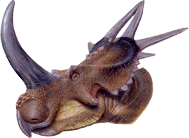 Gilmore referred a larger subadult specimen (USNM 14765), found a mile from the initial quarry, to Brachyceratops
in 1939. However, in 2011, McDonald assigned it to the same area's uber-nose-and frill-horned Rubeosaurus, which had been Styracosaurus ovatus since 1930 until he renamed it himself in 2010. Some experts think the infant specimens, and thus Brachyceratops in its entirety, may belong to Styracosaurus too. But if that is the case, their stumpy infant snout bumps and frill-border pimples had an awful lot of growing to do.
Gilmore referred a larger subadult specimen (USNM 14765), found a mile from the initial quarry, to Brachyceratops
in 1939. However, in 2011, McDonald assigned it to the same area's uber-nose-and frill-horned Rubeosaurus, which had been Styracosaurus ovatus since 1930 until he renamed it himself in 2010. Some experts think the infant specimens, and thus Brachyceratops in its entirety, may belong to Styracosaurus too. But if that is the case, their stumpy infant snout bumps and frill-border pimples had an awful lot of growing to do.
Ceratopsian features change dramatically with age, especially in the shape, size and angle of their horns and frills. So, although palaeontologists suspect Brachyceratops represents an immature version of a critter that is already known from adult material, comparisons are impossible without a series of growth stage specimens showing how one gradually morphed into the other.
Gilmore referred a larger subadult specimen (USNM 14765), found a mile from the initial quarry, to Brachyceratops
in 1939. However, in 2011, McDonald assigned it to the same area's uber-nose-and frill-horned Rubeosaurus, which had been Styracosaurus ovatus since 1930 until he renamed it himself in 2010. Some experts think the infant specimens, and thus Brachyceratops in its entirety, may belong to Styracosaurus too. But if that is the case, their stumpy infant snout bumps and frill-border pimples had an awful lot of growing to do.
Etymology
Brachyceratops is derived from the Greek "brachys" (short), "ceras" (horn) and "ops" (face), alluding to its short snout.
The species epithet, montanensis, means "from Montana" in Latin.
Discovery
The remains of Brachyceratops were discovered in the Two Medicine Formation near Glacier National Park, Teton County, Montana, USA, by Charles Whitney Gilmore and his assistant John Floyd Strayrer, during the summer of 1913.
The holotype (USNM 7951, currently housed at the Smithsonian Institute of Washington DC) is a partial, juvenile skull. Paratypes are USNM 7952 (a snout), USNM 7953 (a pelvic girdle and a complete series of 50 tail vertebrae [the highest count in any ceratopsian tail] and provisionally associated back vertebrae and ribs), and USNM 7957 (a left lower leg and partial foot).
Based on nine ischia (bones of the hip, of which dinosaurs have two), at least five individuals were present at the site in an area roughly 2 metres in diameter. Many more bones, including two more tails, bones from the fore and hindlimbs, hands and feet, vertebrae from the back and hip, pelvic bones, a shoulder blade, ribs and skull fragments, were present, but given their disarticulated and jumbled state, it was impossible to assign any of them to the type specimens.
A larger, subadult specimen (USNM 14765), discovered a mile away from the original site in 1935, was referred here by Gilmore in 1939, but McDonald assigned it to Rubeosaurus in 2011.
Preparators
Mr. Norman Boss, United States National Museum.


