Pronunciation: brak-eye-LOFF-oh-SOR-us
Meaning: Short-crested lizard
Author/s: Sternberg (1953)
Synonyms: None known
First Discovery: Alberta, Canada
Acta Ordinal: #197
Brachylophosaurus canadensis
Every so often, a dinosaur will come along and blow palaeontologists' minds, and Brachylophosaurus was one such dinosaur. It wasn't initially mind-blowing, though. Discovered in 1936, its remains were lumped with fellow Albertan hadrosaurid Gryposaurus (then thought to be the same as Kritosaurus), and it was barely prodded or poked for the next seventeen years. Then Sternberg noticed some weird features in these fossils that were lacking in the critter they had long been assigned to and coined Brachylophosaurus for them in 1953.
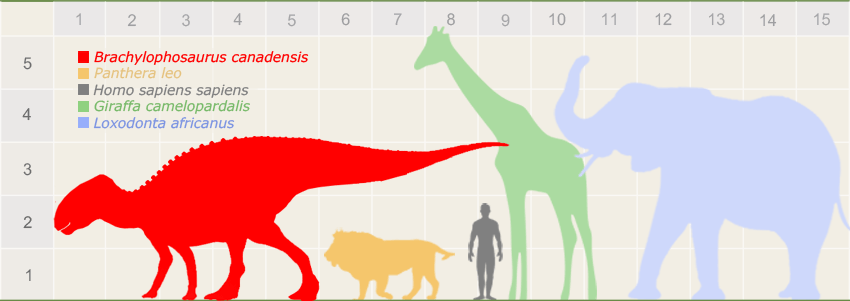
Brachylophosaurus had unusually long forelimbs for a hadrosaurid and a wider bill, but what really stood out was the short, bony crest from which its name derives. The short-crested lizard's short crest was shorter than short. And broad. In fact, it was more like a paddle-like plate that sat flat on the top of its head. Some palaeontologists suspect rival males used it during duels for mating rights, not for head-banging like the modern Muskox but for games of "shuvvy" and shows of strength. It may also have been used for display purposes.
In 1994, Nate Murphy found an immaculate, complete and uncrushed Brachylophosaurus in the Judith River formation that he nicknamed "Elvis". But an even better specimen, and the reason why the "short-crested lizard from Canada" is actually better known from Montana, lay just around the corner. A graffiti-defaced rock with the inscription "Leonard Webb and Geneva Jordan, 1917" marked the spot of one of the most breath-taking finds ever, and when the love-struck pups scribbled their ode on said rock, we're willing to bet the former didn't expect to be immortalized for all time in the form of a dinosaur name, albeit an unofficial one.
"Leonardo", a mummified Brachylophosaurus complete with skin showing patches of different scale patterns, muscle and ligament impressions, evidence of a fleshy crop and some internal organs including possible stomach contents still intact, was discovered by Dr Dan Stephenson during a Nate-led "expedition" in 2000 and hailed as the most complete dinosaur specimen ever found by the Guinness Book of Records, no less. Unfortunately, old Nate has since been done for allegedly acquiring fossils by means not strictly within the bounds of the law and became a bit of an outcast despite some crafty plea-bargaining. However, there were enough palaeontologists involved in the Leonardo project to carry on without him.
Brachylophosaurus had unusually long forelimbs for a hadrosaurid and a wider bill, but what really stood out was the short, bony crest from which its name derives. The short-crested lizard's short crest was shorter than short. And broad. In fact, it was more like a paddle-like plate that sat flat on the top of its head. Some palaeontologists suspect rival males used it during duels for mating rights, not for head-banging like the modern Muskox but for games of "shuvvy" and shows of strength. It may also have been used for display purposes.
In 1994, Nate Murphy found an immaculate, complete and uncrushed Brachylophosaurus in the Judith River formation that he nicknamed "Elvis". But an even better specimen, and the reason why the "short-crested lizard from Canada" is actually better known from Montana, lay just around the corner. A graffiti-defaced rock with the inscription "Leonard Webb and Geneva Jordan, 1917" marked the spot of one of the most breath-taking finds ever, and when the love-struck pups scribbled their ode on said rock, we're willing to bet the former didn't expect to be immortalized for all time in the form of a dinosaur name, albeit an unofficial one.
"Leonardo", a mummified Brachylophosaurus complete with skin showing patches of different scale patterns, muscle and ligament impressions, evidence of a fleshy crop and some internal organs including possible stomach contents still intact, was discovered by Dr Dan Stephenson during a Nate-led "expedition" in 2000 and hailed as the most complete dinosaur specimen ever found by the Guinness Book of Records, no less. Unfortunately, old Nate has since been done for allegedly acquiring fossils by means not strictly within the bounds of the law and became a bit of an outcast despite some crafty plea-bargaining. However, there were enough palaeontologists involved in the Leonardo project to carry on without him.
Leonardo's innards
Coming soon
(Short-crested lizard from Canada)Etymology
Brachylophosaurus is derived from the Greek "brachys" (short), "lophos" (crest) and "sauros" (lizard"), named for the shape of the crest on its skull. The species epithet, canadensis, is derived from "Canada" and the Latin "ensis" (from).
Discovery
The first specimen of Brachylophosaurus was discovered at RTMP Quarry 103 (aka Sternberg Quarry 58) in the Oldman Formation (Belly River Group), Little Sandhill Creek, Alberta, Canada, in 1936 by Charles Mortram Sternberg, who initially assigned it to Kritosaurus. The holotype (NMC 8893) includes a skull and partial skeleton.
A partial skull (FMNH PR 862), discovered in 1922 by an Elmer S. Riggs expedition in the Red Deer River area, north of Medicine Hat, Alberta, was later referred to Brachylophosaurus canadensis, as was a partial skull and skeleton (UCMP 130139), found by preparator Mark Goodwin in 1981 in the Judith River Formation at Skull Crest, Kennedy Coulee, Montana. The latter was initially named Brachylophosaurus goodwini in Goodwin's honour in 1988 and was sunk as a synonym of Brachylophosaurus canadensis by Prieto-Márquez in 2005, but it has since been discredited as non-diagnostic.
Following "Elvis" and its "pristine pelvis" (MOR 794), found on what was later revealed to be federal land on October 14, 1994, and "Leonardo" (JRF 115H), discovered by Dan Stephenson on July 27, 2000, the Montanan discoveries continued when Murphy excavated "Peanut", found by Robert E. Buresh in 2002, which is the smallest and youngest Brachylophosaurus found thus far, and "Roberta", an almost complete skeleton, initially tagged "Bob" (a slang term for Robert) after 12 year old discoverer Bobby Wells, that was renamed "Roberta" (the female equivalent of Robert) because of its more gracile build, suggestive of a female, in 2003, at "Hammond Ranch", North of Malta.
In May 2008, Steven Cowan of the Houston Museum of Natural Science discovered "Marco" in the same area.
Pre-historic protein
Back in 2007, Mary Higby Schweitzer claimed to have isolated three fragments of collagen—the main structural protein found in skin and other connective tissue—from an 80-million-year-old Brachylophosaurus canadensis fossil (MOR 2598) using a machine called a "mass spectrometer", and everyone laughed. There was no way that organic molecules could survive for tens of millions of years, they said, and accused her samples of being contaminated with modern proteins. Wounded, Schweitzer lay low for a while. Then, in 2017, she and her colleagues tweaked the original tests using samples from the same fossil but used a more sensitive machine. And guess what? This time, they had isolated eight fragments of collagen, and the laughing all but stopped. Before the tests, all equipment had been broken down and each bit soaked in methanol to remove any possible contaminants, then the recovered protein sequences were compared to a variety of living critters. The proteins from the original tests were closest to the collagen found in alligators, which are descendants of non-dinosaurian archosaurs. But in the new tests, the collagen was a closer match to that found in our feathered friends—modern birds—which belong to a lineage of dinosaurs called theropods. At around the same time, researchers led by Robert Reisz from the University of Toronto claimed to have found fragments of collagen and iron-rich proteins within the walls of blood vessels running through the rib bones of a dinosaur called Lufengosaurus, which is some 115 million years older than Brachylophosaurus. However, they used different techniques known as Raman Spectroscopy and Synchrotron Radiation Fourier Transform Infrared Microspectroscopy (or SR-FTIR, for short).