









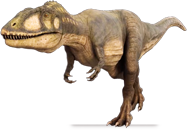
Pronunciation: kar-KA-ro-DON-toe-SOR-us
Meaning: Shark-toothed lizard
Author/s: Stromer (1931)
Synonyms: See below
First Discovery: Bahariya, Egypt
Acta Ordinal: #164
Carcharadontosaurus saharicus
(Shark-toothed lizard from the Sahara)Etymology
Carcharodontosaurus is derived from "Carcharodon" (the shark genus that includes the Great White, Carcharodon carcharias and maybe the extinct Megalodon, Carcharodon megalodon) and the Greek "sauros" (lizard). Carcharodon itself is derived from the Greek "karkharo" (jagged) and "odon" (tooth), and Carcharodontosaurus is named for its similarly jagged, shark-like teeth.The species epithet, saharicus, refers to its discovery in the Sahara desert.
Discovery
The first Carcharodontosaurus saharicus fossils (No.1922 X-46; a partial skull, teeth, vertebrae, and various bones from the hindlimb and hip) were discovered by Richard Markgraf in the Bahariya Formation, 2km from Ain Gedid on the western face of Egypt's Gebel Harra in 1914, and when Ernst Stromer described them in 1931 he noticed the same characteristics in a couple of teeth found by Captain Burté 3km apart in wells that are fed by the "great
foggara" (a subterranean conduit) near Timimoun—a little oasis town in Adrar Province, Algeria—in 1924.
Charles Depéret and Justin Savornin had named those Algerian teeth Megalosaurus saharicus in 1925, and were cock-a-hoop that they held the first "megalosaur" from the African continent, then moved it to Dryptosaurus two years later. However, Stromer realised that all of the fossils mentioned thus far belonged to a hitherto unknown dinosaur that he named Carcharodontosaurus, though he did the honorable thing and retained the previous epithet of saharicus.
Which fossils were discovered or named first and which should represent the holotype are irrelevant points, because Depéret and Savornin's teeth have been lost and the fossils described by Stromer went up in smoke when their Munich Museum home was incinerated by Allied air-strikes during WWII in 1944. But it's not all bad news.
Paul Sereno found a very large, nearly complete skull (SGM Din-1) just east of Er Remlia Oasis in the Kem Kem Formation of Morocco's Sahara Dessert in 1995, not too far from the Algerian border and the site where Burté made his discoveries, and this was designated as neotype (new type) by Steve Brusatte and Sereno in 2007.
At the same time, they assigned remains from the Echkar Formation of Niger to a second species—Carcharodontosaurus iguidensis.


