




Pronunciation: JYAHNG-yoo-RAP-tuh
Meaning: Long-feathered plunderer
Author/s: Han et al. (2014)
Synonyms: Liaoning, China
First Discovery: Liaoning, China
Acta Ordinal: #886
Changyuraptor yangi
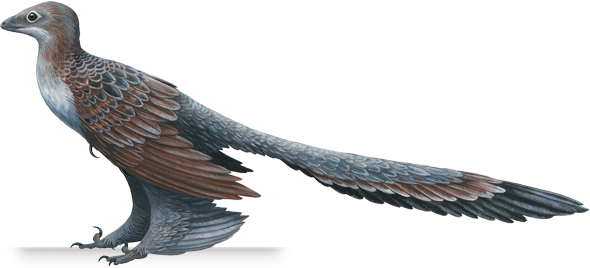
With tail feathers almost a foot long, which is roughly one-third of its total body length, Changyuraptor owns the longest feathers of any known non-bird dinosaur. Furthermore, it's the largest known member of Microraptoria—the previously-midget theropods that sported integument in the form of feathers, and on Changyuraptor (and Microraptor, and a few others) this covering extended to the lower legs where long pennaceous feathers seem to form a second pair of wings. Having mentioned "feathers" four times already you may be thinking that we erred and that Changyuraptor was actually a bird. It wasn't, but it wasn't far off either, though it likely couldn't flap like our modern flying friends nor glide like a bi-plane, because its shoulder and hip joints don't look supple enough.
Han et al. reckon this new discovery explains the role that tail feathers played during aerodynamic behavior, specifically that its long tail—with 30cm feathers, roughly 30% of the total body length and the longest known for any non-bird dinosaur—was also wide (it had a low-aspect-ratio) and provided stability and control during descent. No doubt, the ability to avoid a face-first crash landing would have been amazingly beneficial, but those author's conclusions are based on the assumption that Changyuraptor could get itself airborne in the first place, and the possibility that an ostentatious display to attract a mate may have been the primary (or even sole) reason for its long feathers can't be ruled out at this point.
Han et al. reckon this new discovery explains the role that tail feathers played during aerodynamic behavior, specifically that its long tail—with 30cm feathers, roughly 30% of the total body length and the longest known for any non-bird dinosaur—was also wide (it had a low-aspect-ratio) and provided stability and control during descent.
No doubt, the ability to avoid a face-first crash landing would have been amazingly beneficial, but those author's conclusions are based on the assumption that Changyuraptor could get itself airborne in the first place, and the possibility that an ostentatious display to attract a mate may have been the primary (or even sole) reason for its long feathers can't be ruled out at this point.
(Yang's long-feathered plunderer)Etymology
Changyuraptor is derived from the Chinese "cháng ÿu" (long feather) and the Latin "raptor" (plunderer, snatcher, robber or thief).
The species epithet, yangi (YAHNG-ie), honours Professor Yang Yandong.
ZooBank registry: urn:lsid:zoobank.org:act:0082D604-0F80-45BC-9B37-0C8110F12D2A.
Discovery
The remains of Changyuraptor were discovered at Xijianchang in the Yixian Formation (Jehol Biota), Liaoning Province, China, by local farmers. The holotype (HG B016) is an almost complete skeleton and skull with feather impressions, compressed on a plate and counterplate, the preparation of which revealed a previous attempt to artificially reconstruct the badly preserved neck.
Preparator
Maureen Walsh of the Natural History Museum of Los Angeles County, under the supervision of Luis M. Chiappe.


