









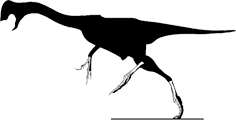
Pronunciation: ki-ROS-tuh-NO-teez
Meaning: Narrow hand
Author/s: Gilmore (1924)
Synonyms: See below
First Discovery: Alberta, Canada
Acta Ordinal: #144
Chirostenotes pergracilis
Chirostenotes was named for a pair of narrow hands (its name means narrow hands) in 1924. Eight years later, a couple of feet became Macrophalangia (broad toes), and 1936 saw the discovery of a set of jaws named... wait for it... Caenagnathus (recent jaw). They were all discovered in Alberta. Thankfully, the naming of dinosaurs after newly discovered body parts was nipped in the bud in 1988 before it got completely out of hand as a specimen stored in an old museum since 1923 was dusted off and studied. It helped link all of these bits into a single dinosaur and, as it was named first, Chirostenotes is the name it was given.
A second set of jaws with strange teeth was assigned here too, but as Chirostenotes was a toothless oviraptorosaur they were used to raise an all-new dinosaur; Richardoestesia instead. It's since lost ownership of the first jaws too, but it received new ones from specimens that were actually attached to feet, and likewise Caenagnathus has been bolstered with better material, which showed that the pair are distinct critters after all.
Chirostenotes had a beak (but it wasn't a bird as originally thought) and while not as robust as those of its Asian relatives it was probably powerful enough to deal with a varied diet of leaves, nuts and shellfish, and even the odd cowering mammal or egg. Its legs were long and powerful with long slender toes, and its head was adorned with a casque-like crest. But its long arms with slender and relatively straight claws have prompted the most speculation. In 2005 Senter and Parrish surmised that the elongated middle digit of Chirostenotes may have been an adaptation for poking crevices and scraping out grubs. But if it possessed large primary feathers, like those found on other oviraptorosaurs such as Caudipteryx, crevice-poking may have been a tad problematic.
Chirostenotes is a member of Elmisaurinae, a group of advanced oviraptorosaurs with an arctometatarsus; a condition where the middle metatarsal is "pinched" between the ones each side of it. Also seen in tyrannosaurs, alvarezsaurs, ornithomimosaurs, and troodontids, this painful-sounding feature is an advantage rather than a handicap, as it seems to be a design for swift running, though no one knows for sure.
Chirostenotes had a beak (but it wasn't a bird as originally thought) and while not as robust as those of its Asian relatives it was probably powerful enough to deal with a varied diet of leaves, nuts and shellfish, and even the odd cowering mammal or egg. Its legs were long and powerful with long slender toes, and its head was adorned with a casque-like crest. But its long arms with slender and relatively straight claws have prompted the most speculation. In 2005 Senter and Parrish surmised that the elongated middle digit of Chirostenotes may have been an adaptation for poking crevices and scraping out grubs. But if it possessed large primary feathers, like those found on other oviraptorosaurs such as Caudipteryx, crevice-poking may have been a tad problematic.
Chirostenotes is a member of Elmisaurinae, a group of advanced oviraptorosaurs with an arctometatarsus; a condition where the middle metatarsal is "pinched" between the ones each side of it. Also seen in tyrannosaurs, alvarezsaurs, ornithomimosaurs, and troodontids, this painful-sounding feature is an advantage rather than a handicap, as it seems to be a design for swift running, though no one knows for sure.
Etymology
Chirostenotes is derived from the Greek "kheir" (hand) and "stenotes" (narrow) because of its... narrow hands. The species epithet, pergracilis, is derived from the Latin "per" (throughout) and "gracilis" (slender), in reference to its slender build.
Synonyms
Macrophalangia canadensis (Sternberg, 1932)Caenagnathus sternbergi? (Cracraft, 1971)
Discovery
The first remains of Chirostenotes were discovered near Little Sandhill Creek in Canada's Dinosaur Park Formation by George Fryer Sternberg in 1914. They were studied by Lawrence Lambe who popped his clogs before he had a chance to officially name them but Charles Whitney Gilmore picked up the baton and named Chirostenotes based on a name mentioned in Sternberg's notes.
The holotype (NMC 2367) is the original pair of "narrow hands".
Referred material includes CMN 8538 (a right foot; Sternberg's "Macrophalangia canadensis"), CMN 2690 (part of a jaw; Cracraft's "Caenagnathus sternbergi"), TMP 1979.020.0001 and UALVP 59400 (partial skeletons), TMP 1985.043.0070, TMP 1992.036.1237 and TMP 1990.056.0006 (dentaries; the tooth-bearing bones of the lower jaw), TMP 2001.012.0012 (complete lower jaws), TMP 1996.036.0181 (partial tarsometatarsus), and TMP 2002.012.0103 (partial ilium; a hip bone). All fossils were found in the Dinosaur Park Formation at Alberta's Dinosaur Provincial Park.


