




Pronunciation: das-PLEE-to-SOR-us
Meaning: Frightful lizard
Author/s: Russell (1970)
Synonyms: None known
First Discovery: Alberta, Canada
Acta Ordinal: #224
Daspletosaurus torosus
Upon discovery near Steveville, Alberta, in 1921, Charles Mortram Sternberg thought Daspletosaurus was a new species of Gorgosaurus which was already known from the same area. However, it turned out to be unique in both features and proportions, which also made it the first known instance of a tyrannosaurid willing to share its backyard with another type of tyrannosaurid. It was renamed by Dale Russell in 1970.
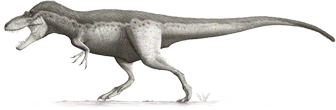
To coexist, these closely related beasts must have had different hunting strategies, and it has been suggested that Daspletosaurus was built to tackle the tough-as-nuts horn-faced herbivores known as ceratopsians. Although a lump smaller than its closest, later-living relative, Tyrannosaurus rex, Dapletosaurus also had a relatively massive and heavily built skull with fused nasal bones for absorbing huge bite-power, long bone-crushing teeth, a snout toughened with rugosities, and bony crests to protect its eyes. Like all other tyrannosaurids, Daspletosaurus bore just two fingers on each hand and walked on three toes, but its legs were shorter and more robust than those of its fellow Tyrant lizards while its arms were proportionately longer... though still pathetically small for a predator of its size. Gorgosaurus was a lightweight by comparison, and probably tackled the far less fortified hadrosaurids.
Notorious lumper Gregory Paul reassigned Daspletosaurus torosus to the genus Tyrannosaurus in 1988, creating the new combination Tyrannosaurus torosus, but palaeontologists didn't take a blind bit of notice.
To coexist, these closely related beasts must have had different hunting strategies, and it has been suggested that Daspletosaurus was built to tackle the tough-as-nuts horn-faced herbivores known as ceratopsians. Although a lump smaller than its closest, later-living relative, Tyrannosaurus rex, Dapletosaurus also had a relatively massive and heavily built skull with fused nasal bones for absorbing huge bite-power, long bone-crushing teeth, a snout toughened with rugosities, and bony crests to protect its eyes. Like all other tyrannosaurids, Daspletosaurus bore just two fingers on each hand and walked on three toes, but its legs were shorter and more robust than those of its fellow Tyrant lizards while its arms were proportionately longer... though still pathetically small for a predator of its size. Gorgosaurus was a lightweight by comparison, and probably tackled the far less fortified hadrosaurids.
Notorious lumper Gregory Paul reassigned Daspletosaurus torosus to the genus Tyrannosaurus in 1988, creating the new combination Tyrannosaurus torosus, but palaeontologists didn't take a blind bit of notice.
Etymology
Daspletosaurus is derived from the Greek stems "daspleto" (frightful) and "sauros" (lizard).
The species epithet, torosus, is Latin for "muscular" or "brawny".
ZooBank registry: urn:lsid:zoobank.org:act:CCD4EA0D-076C-4990-ADE5-BA1F5E329CC4.
Discovery
The first fossils of Daspletosaurus were discovered in the Oldman Formation (Judith River Group) near Steveville, Alberta, Canada, in 1921 by Charles M Sternberg.
The holotype (CMN 8506) is a partial skeleton including the skull, the shoulder, a forelimb, the pelvis, a femur and all of the vertebrae from the neck, torso and hip, as well as the first eleven tail vertebrae. To help define the species, Dale Russel also assigned a paratype (AMNH 5438, parts of the hindleg, the pelvis and some associated vertebrae, found by Barnum Brown in Alberta's Dinosaur Park Formation in 1913) when he coined Daspletosaurus torosus in 1970.
The remains of three or more Daspletosaurus individuals alongside the skeletons of at least five lambeosaurine hadrosaurs, with shed teeth and tooth-marked bones suggesting the former feasted on the latter, were found in Montana's Two Medicine Formation by Bob Kahn in 1997. Apart from suggesting gregarious (social) behaviour, their features differed compared to Daspletosaurus torosus. However, Phil Currie and co-authors resisted the temptation of coining a new Daspletosaurus species when they described these remains in 2005, but Thomas Carr did not when describing fossils from a different quarry of the same area in 2017.


