









Pronunciation: DIEN-o-KIE-rus
Meaning: Terrible hands
Author/s: Osmolska et al. (1970)
Synonyms: None known
First Discovery: Omnogovi, Mongolia
Acta Ordinal: #225
Deinocheirus mirificus
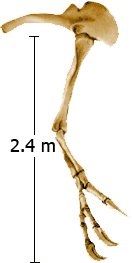 Halszka Osmólska coined Deinocheirus for a pair of never-before-seen eight-foot-long clawed arms that Professor Zofia Kielan-Jaworowska found on the 9th of July, 1965, during a Polish-Mongolian expedition to the Gobi Desert. Further remains were later found strewn around the same site, including bones that had been gnawed on by the area's resident tyrannosaurid, Tarbosaurus bataar. And while the fossils offered little clarity on the creature’s appearance or affinities, their magnitude sparked decades of speculation.
Some imagined the arms belonged to the largest carnivore ever to walk the Earth, while others envisioned a colossal sloth-like beast, wielding its absurdly oversized claws to fend off would-be predators or snag branches and climb trees of a size so far unknown to science. Yet despite their length, its arms were modest in proportion to the shoulder blade to which they were attached; the areas for muscle attachment were relatively small, and features of the wrists suggest low flexibility. Still, subtle quirks of its arms, hands, fingers and claws hinted at a kinship with ornithomimosaurs of a primitive stamp. But a consensus remained elusive.
Indeed, Deinocheirus lacks several hallmark traits of "Ostrich mimics", leading various experts over the years to propose wildly different classifications, from a megalosauroid within its own Deinocheiridae family, a carnosaur, a coelurosaur, and a straddler of both Carnosauria and Coelurosauria. In fact, several scientific analyses by experts in their field were unable to resolve its relationships at all, and until further and more complete remains presented themselves, that wasn't likely to change. However, change things did, as two new specimens from Altan Uul IV and Bugeen Tsav (the former a subadult, the latter even bigger than the holotype with a humerus 998 mm long) shed some much-needed light on this enigmatic critter. Alas, the "new" fossil sites were looted before palaeontologists arrived, and poachers had absconded with the head, hands and feet. But, miraculously, they were spotted in a private collection by French fossil trader François Escuilléat, who procured them and sent them to the Royal Belgian Institute of Natural Sciences.
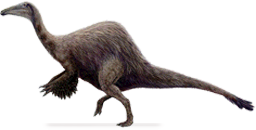
The presence of gastroliths (gizzard stones, intentionally swallowed by herbivores to grind plant matter) showed that Deinocheirus was far from the ferocious meat-shredding carnivore that many had wished for, although scales in its gut proved that it was partial to the odd fish, and with an expanded, backwards-tilting pelvis to anchor wads of muscle and relatively short and heavily-built legs with a longer thigh to shin ratio not unlike a sauropod it was not a swift-running animal. Long spines protruding from its vertebrae show that Deinocheirus may have been sail-backed, or more likely hump-backed, which is already weird enough. But what turned out to be its missing wide and robust feet with hoof-ended toes were repatriated to Mongolia recently, along with an equally unusual meter-long broad-beaked skull that lacks teeth, so we now know that a complete Deinocheirus looked something like a sloth-clawed duck-billed ostrich camel.
With an estimated adult hip height of 3.5 meters, Deinocheirus is the tallest amongst known theropods, though not the longest nor heaviest, and likely towered over everything that looked upon it as lunch.
(Terrible hands that look peculiar)Etymology
Deinocheirus is derived from the Greek "deinos" (terrible) and "kheir" (hand) because of its very large forelimbs and strong claws.
The species epithet (or specific name), mirificus, means "peculiar" in Latin, and rounds things up nicely.
Discovery
The first fossils of Deinocheirus were discovered at Altan Uul III, site 2, in the Nemegt Formation, Omnogovi, Mongolia, by Professor Zofia Kielan-Jaworowska on 9th July 1965, during a joint Polish-Mongolian expedition to the Gobi.
The holotype (ZPal MgD-I/6) includes both forelimbs, shoulder girdle, partial vertebrae and a few ribs.
Numerous large, tridactyl (three-toed) "hadrosaur" footprints that were found alongside those of sauropods at the Nemegt locality in 2007 and described eleven years later, might actually belong to Deinocheirus.


