





Pronunciation: DEL-tuh-DROH-me-us
Meaning: Delta Runner
Author/s: Sereno, Duthiel, Lyon et al. (1996)
Synonyms: None known
First Discovery: Kasr-es-Souk, Morocco
Acta Ordinal: #423
Deltadromeus agilis
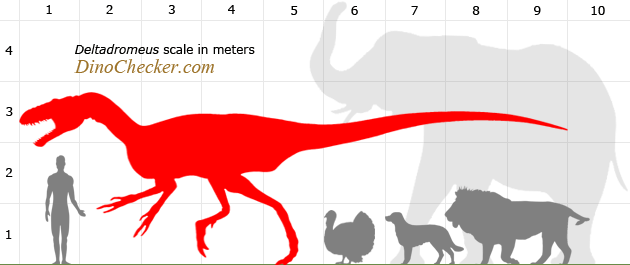
Before Deltadromeus was officially named, rumours had begun to circulate about the "longest ever theropod" discovered in the Kem Kem region of Morocco's Sahara Desert by Gabrielle Lyon in 1995. With a total length of just over eight meters, it turns out that those rumours were a little wide of the mark. But when Deltadromeus inherited some wrongly-assigned remains from Ernst Stromer's Bahariasaurus and palaeontologists performed a like-for-like upscale based on a new 75% bigger thighbone, it was catapulted into the big league.
However, the new bones show marked differences from the Deltadromeus holotype. And they don't belong to the same area's powerhouse theropods Carcharodontosaurus or Spinosaurus, either. Furthermore, some palaeontologists strongly suspect Deltadromeus may be synonymous with Bahariasaurus, which leaves an excess of bones that none of the area's currently named predatory dinosaurs can lay claim to, suggesting there is another huge carnivorous dinosaur lurking in the deserts of Northern Africa.
Supersized or not, Deltadromeus was slight of build, with a gracile frame and extremely long and slender legs that gave it an edge, speed-wise. It would have been a fearsome hunter in its ecosystem, more than capable of chasing down the most elusive of prey. But it's also been a tad elusive itself and given taxonomists a royal run-a-round. Deltadromeus was initially thought to be a coelurosaur and then a gigantic noasaurid. But the latest research has it pegged as a primitive ceratosaur, possibly forming a not-yet-formally-named clade along with Elaphrosaurus, Limusaurus and Spinostropheus: the "Elaphrosaurs".
Deltadromeus is represented by tail vertebrae, hind limbs and arms (minus the hands) but precious little in the way of anything to join them together, so length estimates are a bit sketchy. A skull has so far evaded discovery too, so it's one of life's great mysteries how internet fossil shops, perhaps privy to info that experts are not, have a never ending supply of Deltadromeus teeth available at rock bottom prices.
However, the new bones show marked differences from the Deltadromeus holotype. And they don't belong to the same area's powerhouse theropods Carcharodontosaurus or Spinosaurus, either. Furthermore, some palaeontologists strongly suspect Deltadromeus may be synonymous with Bahariasaurus, which leaves an excess of bones that none of the area's currently named predatory dinosaurs can lay claim to, suggesting there is another huge carnivorous dinosaur lurking in the deserts of Northern Africa.
Supersized or not, Deltadromeus was slight of build, with a gracile frame and extremely long and slender legs that gave it an edge, speed-wise. It would have been a fearsome hunter in its ecosystem, more than capable of chasing down the most elusive of prey. But it's also been a tad elusive itself and given taxonomists a royal run-a-round. Deltadromeus was initially thought to be a coelurosaur and then a gigantic noasaurid. But the latest research has it pegged as a primitive ceratosaur, possibly forming a not-yet-formally-named clade along with Elaphrosaurus, Limusaurus and Spinostropheus: the "Elaphrosaurs".
Deltadromeus is represented by tail vertebrae, hind limbs and arms (minus the hands) but precious little in the way of anything to join them together, so length estimates are a bit sketchy. A skull has so far evaded discovery too, so it's one of life's great mysteries how internet fossil shops, perhaps privy to info that experts are not, have a never ending supply of Deltadromeus teeth available at rock bottom prices.
(Agile Delta Runner)Etymology
Deltadromeus agilis is derived from the Greek "delta" (alluding to the deltaic facies in which it was found) and "dromeus" (runner), and the Latin "agilis" (agile).



