
DROMAEOSAURUS
a meat-eating dromaeosaurid theropod dinosaur from the Late Cretaceous of Canada.
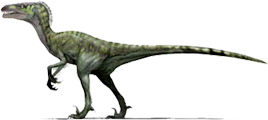
Pronunciation: DROH-mee-o-SOR-us
Meaning: Running lizard
Author/s: Matthew and Brown (
1922)
Synonyms: None known
First Discovery: Alberta, Canada
Acta Ordinal: #131
Dromaeosaurus albertensis
Although nominated to anchor its own family of dinosaurs — Dromaeosauridae — precious little is known of
Dromaeosaurus, at least compared to some of its subordinate relatives. Aside from a few foot bones, the holotype amounts to parts of a skull, lower jaws and 22 teeth that had been fudged into a complete display so magnificently by AMNH preparators that it was hard to tell bone from detail-obscuring plaster and glue in places. Nevertheless, if Barnum Brown hadn't lost Marion, the love of his life, on April 8th, 1910, he might not have headed for the picturesque solitude of Canada's Red Deer River, and perhaps we wouldn't know
Dromaeosaurus at all.
Etymology
Dromaeosaurus is derived from the Greek "dromeus" (runner) and "sauros" (lizard).
The
specific epithet,
albertensis, is derived from "Alberta" (for Alberta, Canada) and the Latin "-ensis" (from, place of origin).
Discovery
The first fossils of
Dromaeosaurus were discovered at "Little Sandhill Creek" (aka Sand Creek) in the Oldman Formation (Belly River Group), Red Deer River, Dinosaur Provincial Park, Alberta, Canada, by Barnum Brown in 1914.
The
Holotype (AMNH 5356) consists of a partial skull 24 cm long, and some foot bones.
Estimations
Timeline:
Era: Mesozoic
Epoch: Late Cretaceous
Stage: Campanian
Age range: 80-73 mya
Stats:
Est. max. length: 1.8 meters
Est. max. hip height: 0.6 meters
Est. max. weight: 35 Kg
Diet: Carnivore
Dromaeosaurus
albertensis
Other Species
Dromaeosaurus has claimed eight other species since 1922, but they're mostly based on teeth that were initially assigned elsewhere. Given their fragmentary nature, it comes as little surprise that the only species still classed as valid is the name-bearing
Dromaeosaurus albertensis, but, as historical curiosities, here are the others in all their, ahem, glory...
1. Dromaeosaurus explanatus (Matthew & Brown 1922), originally
Laelaps explanatus (Cope 1876), is known from a few teeth.
2. Dromaeosaurus falculus (Matthew & Brown 1922), originally
Laelaps falculus (Cope 1876), is known from a few teeth that have been linked to
Aublysodon mirandus (Leidy 1868)... which Oliver Perry Hay renamed
Ornithomimus mirandus in 1928.
3. Dromaeosaurus cristatus (Matthew & Brown 1922), originally
Laelaps cristatus (Cope 1876), is known only from teeth.
4. Dromaeosaurus laevifrons (Matthew & Brown 1922), originally
Laelaps laevifrons (Cope 1876), is known only from teeth that may belong to
Dromaeosaurus cristatus.
5. Dromaeosaurus? gracilis (Matthew & Brown 1922), originally
Coelurus gracilis (Marsh 1888), is known only from a tooth.
6. Dromaeosaurus? i.s. (Matthew and Brown 1922), originally
Zapsalis abradens (Cope 1877), is known from a single tooth that may belong to
Paronychodon lacustris... or maybe
Richardoestesia.
7. Dromaeosaurus minutus (?), originally
Ornithomimus minutus (Marsh 1892), is based on a metatarsus that Russell recognized as the property of an alvarezsaurid in 1972.
It may belong to
Mononykus.
8. Dromaeosaurus mongoliensis (Paul 1988) was originally known as
Adasaurus mongoliensis (Barsbold 1983), and to most paleontologists it still is.
References
• Brown B (May, 1919) "
Hunting Big Game of Other Days: A Boating Expedition in Search of Fossils in Alberta, Canada".
The National Geographic Magazine, 35(5): 407–429.
• Matthew WD and Brown B (1922) "
The family Deinodontidae, with notice of a new genus from the Cretaceous of Alberta".
Bulletin of the AMNH; v. 46, article 6
• Colbert EH and Russell DA (1969) "
The small Cretaceous dinosaur Dromaeosaurus".
American Museum novitates, 2380.
• Ostrom JH (1969) "
Osteology of Deinonychus antirrhopus, an unusual theropod from the Lower Cretaceous of Montana".
Peabody Museum of Natural History, Bulletin 30: 1-165.
• Paul GS (1988) "The Wonderful and Spectacular Dromaeosaurian Sickle-Claws" in "
Predatory Dinosaurs of the World".
• Ostrom JH (1970) "
Stratigraphy and Paleontology of the Cloverly Formation (Lower Cretaceous) of the Bighorn Basin Area, Wyoming and Montana".
Volume 9. Fiftieth anniversary edition.
• Norell MA and Makovicky PJ (2004) "Dromaeosauridae". In Weishampel, Dodson and Osmólska (eds.) "
The Dinosauria: Second Edition".
• Currie PJ and Koppelhus EB (1995) "New information on the anatomy and relationships of
Dromaeosaurus albertensis (Dinosauria: Theropoda)".
Journal of Vertebrate Paleontology, 15(3): 576-591. DOI: 10.1080/02724634.1995.10011250
• Paul GS (2010) "
The Princeton Field Guide to Dinosaurs".
• Tanke DH (2002a) "
The hunt for Mary Jane: Search for the lost leet of the 1910–1915 AMNH palaeontological expeditions
to Alberta, Canada".
Alberta Palaeontological Society, Sixth Annual Symposium, Abstracts Volume. Mount Royal
College, Calgary, Alberta. January 26–27, 2002, page 56–62.
• Tanke DH (2002b) "
Search for the American Museum of Natural History scows Mary Jane and Mary Ann: Project update".
Alberta Palaeontological Society Bulletin, 17(4): 7–16.
• Tanke DH (2007)
"The upcoming 100th anniversary of the irst palaeontological scow-based expedition to Alberta, Canada:
Planned 2010 scow reconstruction and commemorative trip".
Alberta Palaeontological Society, Eleventh Annual
Symposium, Abstracts. Mount Royal College, Calgary, Alberta. March 17, 2007, page 50–59.
• Tanke DH (2009) "
Hunting for dinosaurs by boat on the Red Deer River, Alberta, Canada: A Centennial expedition".
Alberta Palaeontological Society, Thirteenth Annual Symposium, page 41-43.
Time stands still for no man, and research is ongoing. If you spot an error, or want to expand, edit or add a dinosaur, please use
this form. Go
here to contribute to our FAQ.
All dinos are GM free, and no herbivores were eaten during site construction!
To cite this page:
Atkinson, L.
"
DROMAEOSAURUS :: from DinoChecker's dinosaur archive".
‹
http://www.dinochecker.com/dinosaurs/DROMAEOSAURUS›. Web access: 25th Oct 2026.









