




Pronunciation: ji-GAN-to-RAP-tor
Meaning: Gigantic plunderer
Author/s: Xu (2007)
Synonyms: None known
First Discovery: Nei Mongol, China
Acta Ordinal: #625
Gigantoraptor erlianensis
By an extraordinary twist of fate, Gigantoraptor was unearthed while making a TV documentary in which a sauropod called Sonidosaurus was supposed to be the star of the show. As Chinese paleontologist Xu Xing re-enacted the discovery, and brushed the muck from a randomly-pulled bone, he realised that it actually belonged to a hitherto unknown theropod, then he got all excited and lost focus, at which point filming stopped. Sonidosaurus just can't catch a break.
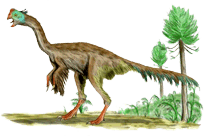
One of the strange things about Gigantoraptor, which can be garnered from the name, is its sheer size. With vital statistics of 8, 3.5, 2 (length, height and weight... in meters and tons) it was almost as big as the contemporaneous sauropod Xu was researching, and is one of the largest Asian theropods to boot. But, stranger still, it belongs to a lineage of theropod dinosaurs that paleontologists believed got progressively smaller as they became more bird-like.
Gigantoraptor is far and away the largest member of Oviraptorosauria (a family anchored by Oviraptor; the "egg plunderer" that did no such thing) and boasts longer arms compared to body size than any of its clan. Despite its considerable size, its legs were proportionately long and skinny too (longer and skinnier than any theropod known from anywhere, in fact, with thighs and shins both over a metre in length), and these features combined mean it was actually more bird-like than its smaller, feathered relatives.
Unfortunately, no feather impressions were preserved with the skeleton, but creatures of such mass don't need them, not for insulation, at least. They tend to maintain a constant and relatively high body temperature through a phenomenon known as "gigantothermy": they absorb heat from their surroundings and give less back than smaller animals because of a lower surface area to body volume ratio.
That said, they may have had feathers on their tail and head for displays of machismo and mate-finding. They may have had feathers on their wings for incubatory purposes too, as gigantic theropod nests from the Late Cretaceous of China and Mongolia, complete with enormous eggs (assigned to the oospecies Macroelongatoolithus xixiaensis)—some up to 53cm in length—may have been made and laid by Gigantoraptor. Imagine boiling one of those for breakfast.
One of the strange things about Gigantoraptor, which can be garnered from the name, is its sheer size. With vital statistics of 8, 3.5, 2 (length, height and weight... in meters and tons) it was almost as big as the contemporaneous sauropod Xu was researching, and is one of the largest Asian theropods to boot. But, stranger still, it belongs to a lineage of theropod dinosaurs that paleontologists believed got progressively smaller as they became more bird-like.
Gigantoraptor is far and away the largest member of Oviraptorosauria (a family anchored by Oviraptor; the "egg plunderer" that did no such thing) and boasts longer arms compared to body size than any of its clan. Despite its considerable size, its legs were proportionately long and skinny too (longer and skinnier than any theropod known from anywhere, in fact, with thighs and shins both over a metre in length), and these features combined mean it was actually more bird-like than its smaller, feathered relatives.
Unfortunately, no feather impressions were preserved with the skeleton, but creatures of such mass don't need them, not for insulation, at least. They tend to maintain a constant and relatively high body temperature through a phenomenon known as "gigantothermy": they absorb heat from their surroundings and give less back than smaller animals because of a lower surface area to body volume ratio.
That said, they may have had feathers on their tail and head for displays of machismo and mate-finding. They may have had feathers on their wings for incubatory purposes too, as gigantic theropod nests from the Late Cretaceous of China and Mongolia, complete with enormous eggs (assigned to the oospecies Macroelongatoolithus xixiaensis)—some up to 53cm in length—may have been made and laid by Gigantoraptor. Imagine boiling one of those for breakfast.
Etymology
Gigantoraptor is derived from the Latin gigant- (from the Greek gigas), "giant" and the Latin raptor, "plunderer" or "thief". The species epithet, erlianensis, refers to the Erlian Basin.
Discovery
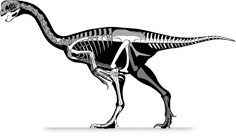 The first fossils of Gigantoraptor were discovered in the Iren Dabasu Formation (Erlian basin) at Saihangaobi, Sonid Zuoqi, Inner Mongolia, China, in 2005.
 The holotype (LH V0011, housed at the Long Hao Geologic and Paleontological Research Center) is the partial skeleton of a subadult including the lower jaws, a neck vertebra, most of the back, tail and frontlimbs, and bits of hindlimb.
Preparators
Technicians of the Long Hao Institute of Geology and Paleontology.


