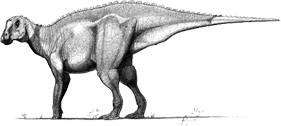
GRYPOSAURUS
a plant-eating saurolophine hadrosauroid dinosaur from the Late Cretaceous of Canada.
Pronunciation: GRIP-o-SOR-us
Meaning: Hook-nosed lizard
Author/s: Lambe (
1914)
Synonyms: Hadrosauravus
First Discovery: Alberta, Canada
Acta Ordinal: #116
Gryposaurus notabilis
Just over a year after its discovery by George Sternberg along the Red Deer River and subsequent description by Lawrence Lambe in 1914, Barnum Brown snaffled the arched snout design of
Gryposaurus to replace the
Anatotitan-like flat and ducky one that he had used to reconstruct
Kritosaurus in 1910. On top of that, both Brown and later Charles Gilmore opined that
Gryposaurus and
Kritosaurus were two specimens of the same type of critter, with the latter having priority, of course. Unfortunately for
Gryposaurus, Lull and Wright agreed, cementing the synonymy in favour of
Kritosaurus in their 1942 hadrosaur masterpiece, and so it remained for over half a century.
By the 1990s, questions were being asked about that arrangement because (a) the skull of
Kritosaurus lacks a snout for direct comparison with
Gryposaurus and (2) it's light on diagnostic fossils for comparison to other duck-billed dinosaurs.
Thus, for now, at least,
Gryposaurus is
Gryposaurus again, despite a brief stint in 1979 as Jack Horner's
Hadrosaurus [Kritosaurus] notabilis, and is gaining momentum, thanks to dozens of specimens, including at least ten complete skulls.
Etymology
Gryposaurus is derived from the Greek "grypos" (crooked, curved, hook-nosed) and "sauros" (lizard) alluding to its most prominent feature; a hooked "Roman nose", which is actually an arch on its snout formed by two nasal bones.
The
species epithet,
notabilis (no-TAY-bi-lis), means "remarkable" (in Latin) and refers to its remarkably well preserved skull.
ZooBank registry:
urn:lsid:zoobank.org:act:469C5A6B-5665-4662-86D8-4D75781C6C9F.
Discovery
The first fossils of
Gryposaurus were discovered along the Red Deer River in the Dinosaur Park Formation of Alberta, Canada, by George F. Sternberg in 1913.
The
holotype (NMC 2278) is a skull and partial skeleton.
Estimations
Timeline:
Era: Mesozoic
Epoch: Late Cretaceous
Stage: Campanian
Age range: 84-73 mya
Stats:
Est. max. length: 8.5 meters
Est. max. hip height: ?
Est. max. weight: 2 tons
Diet: Herbivore
Other Species
Gryposaurus latidens
Collected from the Lower Two Medicine Formation of Pondera County, Montana, for the American Museum of Natural History in 1916, the remains that would become
Gryposaurus latidens—partial skulls and skeletons from several individuals—were studied and informally tagged "Hadrosauravus" in 1990 by David Lambert. An official description never materialised, presumably because he had second thoughts about its validity, and Jack Horner assigned it to
Gryposaurus in 1992.
Gryposaurus monumentensis
Described as "the Arnold Schwarzenegger of duck-billed dinosaurs"
Gryposaurus monumentensis was discovered in the Kaiparowits Formation of Utah, in Grand Staircase-Escalante National Monument in 2002. Known from a partial skeleton with skin impressions, its skull was massive and robust with a huge, relatively short jaw compared to other species of
Gryposaurus, which could only mean increased chewing power. Not only did the discovery of
Gryposaurus monumentensis stretch the geographic range of this genus from Alberta to Utah, but it also expanded its timespan to more than five million years.
Gryposaurus incurvimanus
Originally named
Kritosaurus incurvimanus by William Parks in 1920,
Gryposaurus incurvimanus was discovered in the same formation as
Gryposaurus notabilis and turned out to
be Gryposaurus notabilis. It is the best specimen, with preserved skin impressions showing limpet-shaped scutes on its flank and tail, polygonal scales on its neck and sides of the body, and short, fluted pyramid-like "spines" along the midline of its back.
Gryposaurus alsatei
Gryposaurus alsatei was unearthed in the Maastrichtian-aged Javelina Formation along with an unnamed species of
Kritosaurus and an undescribed saurolophine which closely resembles Saurolophus, but with a more solid crest. Its holotype (TMM 46033-1) includes significant parts of the
skull and jaws, along with parts of the skeleton and
skin impressions.
References
• Brown B (1910) "
The Cretaceous Ojo Alamo beds of New Mexico with description of the new dinosaur genus Kritosaurus".
Bulletin of the American Museum of Natural History, 28 (24): 267–274.
• Lambe LM (February, 1914) "
On Gryposaurus notabilis, a new genus and species of trachodont dinosaur from the Belly River Formation of Alberta, with a description of the skull of Chasmosaurus belli".
The Ottawa Naturalist, 27(11): 145–155.
• Brown B (September 15, 1914) "
Cretaceous Eocene correlation in New Mexico, Wyoming, Montana, Alberta".
Geological Society of America Bulletin, 25 (1): 355-380. DOI: 10.1130/gsab-25-355 [Page 380]
• Sinclair WJ and Granger W (June 3, 1914) "
Paleocene deposits of the San Juan Basin, New Mexico".
Bulletin of the American Museum of Natural History, 33(3): 297–316. DOI: 10.1086/622336
• Gilmore CW (1916) "
Contributions to the geology and paleontology of San Juan County, New Mexico. 2. Vertebrate faunas of the Ojo Alamo, Kirtland and Fruitland Formations".
United States Geological Survey Professional Paper. 98-Q: 279–302.
• Horner JR, Weishampel DB and Forster CA (2004) "Hadrosauridae" in Weishampel, Dodson and Osmólska (eds.) "
The Dinosauria: Second Edition".
• Parks WA (1919) "Preliminary description of a new species of trachodont dinosaur of the genus
Kritosaurus,
Kritosaurus incurvimanus".
Transactions of the Royal Society of Canada. Series 3. 13(4): 51–59.
• Parks WA (1920) "The osteology of the trachodont dinosaur
Kritosaurus incurvimanus". University of Toronto Studies, Geology Series. 11: 1–76.
• Philip J. Currie and Eva B. Koppelhus (2005) "
Dinosaur Provincial Park: A Spectacular Ancient Ecosystem Revealed".
• Lull RS and Wright NE (1942) "Hadrosaurian Dinosaurs of North America".
Geological Society of America Special Paper 40. p. 21.
• Lambert D (1990) "
The Dinosaur Data Book".
•
Horner JR (1979) "Upper Cretaceous dinosaurs from the Bearpaw Shale (marine) of south-central Montana with a checklist of Upper Cretaceous dinosaur remains from marine sediments in North America".
Journal of Paleontology, 53(3): 566–577.
• Creisler BS (2007) "Deciphering duckbills". In Carpenter (ed.) "
Horns and Beaks: Ceratopsian and Ornithopod Dinosaurs".
• Prieto-Márquez A, Weishampel DB and Horner JR (2006) "
The dinosaur Hadrosaurus foulkii, from the Campanian of the East Coast of North America, with a reevaluation of the genus".
 Acta Palaeontologica Polonica, 51(1): 77-98.
• Gates TA and Sampson SD (2007) "A new species of
Gryposaurus (Dinosauria: Hadrosauridae) from the late Campanian Kaiparowits Formation, southern Utah, USA".
Zoological Journal of the Linnean Society, 151(2): 351–376. DOI: 10.1111/j.1096-3642.2007.00349.x
• Prieto–Marquez A (2010) "The braincase and skull roof of Gryposaurus notabilis (Dinosauria, Hadrosauridae), with a taxonomic revision of the genus". Journal of Vertebrate Paleontology, 30(3): 838-854. DOI: 10.1080/02724631003762971
• Lehman TM, Wick SL and Wagner JR (2016) "Hadrosaurian dinosaurs from the Maastrichtian Javelina Formation, Big Bend National Park, Texas". Journal of Paleontology, 1(2): 333–356. DOI: 10.1017/jpa.2016.48
• Mallon JC, Evans DC, Zhang Y and Xing H (2022) "Rare juvenile material constrains estimation of skeletal allometry in Gryposaurus notabilis (Dinosauria: Hadrosauridae)". The Anatomical Record (advance online publication)
DOI: 10.1002/ar.25021
• Dudgeon TW and Evans DC (2025) "Disparate feeding mechanics between two hadrosaurid dinosaurs support the potential for resource partitioning". Proceedings of the Royal Society B: Biological Sciences, 292(2056): 20250921.
DOI: 10.1098/rspb.2025.0921.
Time stands still for no man, and research is ongoing. If you spot an error, or want to expand, edit or add a dinosaur, please use
this form. Go
here to contribute to our FAQ.
All dinos are GM free, and no herbivores were eaten during site construction!
To cite this page:
Atkinson, L.
"
GRYPOSAURUS :: from DinoChecker's dinosaur archive".
‹
http://www.dinochecker.com/dinosaurs/GRYPOSAURUS›. Web access: 21st Oct 2026.