









Pronunciation: hip-sih-LO-fo-don
Meaning: Hypsilophus (Iguana) tooth
Author/s: Huxley (1869)
Synonyms: None known
First Discovery: Isle of Wight, England
Acta Ordinal: #31
Hypsilophodon foxii
Hypsilophodon was coined by Thomas Huxley in the minutes of a 1869 lecture that was stretched to a full article the following year after further research, during the course of which he realised that members of Ornithischia — the dinosaurian counterpart to Saurischia, both of which were still some ways from being named — had a pubic bone which pointed backwards, just like birds. So far so good, but then it all went haywire. Owen was not convinced by Huxley's conclusions and renamed the species Iguanodon foxii in 1874, but this was immediately rejected by John Whitaker Hulke, who had obtained some additional specimens from Reverend William Fox, and was convinced that Hypsilophodon was not only a valid standalone critter based on features of its feet but also armoured. By 1882, Hulke thought Hypsilophodon was quadrupedal (moved on four legs) and able to climb rocks and trees, two years later artist Joseph Smit was painting Hypsilophodon in both reptilian and kangaroo-like postures, and Othenio Abel (1912) and Gerhard Heilmann (following Abel's lead in 1916) went to great lengths to convince the world that this critter fully lived in trees, much like Matschie's tree kangaroos. The latter view was mostly accepted for over half a century.
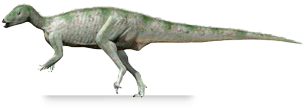
To deal with a life in forest canopies, tree kangaroos evolved shorter back legs, longer arms and a flexible, tree wrapping tail, whereas Hypsilophodon had a stiff tail, short arms and a shoulder girdle ill-equipped for climbing. By 1971, Peter Galton had thoroughly debunked Abel's theory by pointing out that the toes of Hypsilophodon had been reconstructed incorrectly, its claws were all wrong for climbing no matter which direction its toes were pointing, and its long hind legs with longer shins than thighs were adaptations for tearing around the lightly wooded plains and shores of Wight bipedally (on two legs) at a rate of knots during the Early Cretaceous.
To deal with a life in forest canopies, tree kangaroos evolved shorter back legs, longer arms and a flexible, tree wrapping tail, whereas Hypsilophodon had a stiff tail, short arms and a shoulder girdle ill-equipped for climbing. By 1971, Peter Galton had thoroughly debunked Abel's theory by pointing out that the toes of Hypsilophodon had been reconstructed incorrectly, its claws were all wrong for climbing no matter which direction its toes were pointing, and its long hind legs with longer shins than thighs were adaptations for tearing around the lightly wooded plains and shores of Wight bipedally (on two legs) at a rate of knots during the Early Cretaceous.
(Fox's Hypsilophus tooth Tooth)Etymology
Hypsilophodon is derived from "Hypsilophus" (a name proposed by Fitzinger for a type of Iguana with a hypsi (high) lophos (crest) running down its back), and the Greek "odon" (tooth).
Contrary to popular belief, Huxley didn't intend the name to read as "high crested tooth" because its teeth weren't actually "high-crested". Rather, he constructed the name in the same manner as Mantell's Iguanodon (Iguana tooth), to highlight the then-thought close relationship between the two species.
The species epithet, foxii, honours Reverend William Fox.
Discovery
The first remains of what turned out to be Hypsilophodon were discovered in the so-called "Mantell-Bowerbank block" (NHM 28707 and NHM 39560-1)—a mass of Wealden rock that was broken in half during extraction, with Gideon Mantell and naturalist James Scott Bowerbank aquiring a part each—in the Wessex Formation by workers at Cowleaze Chine on the Isle of White in 1849. Having
examined the block independently in 1849 and 1855,
both Mantell and Richard Owen thought the bones represented a juvenile specimen of Iguanodon. However, the Hypsilophodon holotype (NHM R197) is actually a skull that was found in the same area by Reverend William Fox in January 1868.


