









Pronunciation: ing-GAY-nee-a
Meaning: for Ingeni-Khobur
Author/s: Barsbold (1981)
Synonyms: None known
First Discovery: Khermin Tsav, Mongolia
Acta Ordinal: #295
Ingenia yanshini
Despite the name, so often mistranslated, "Ingenia" was not "ingenius", no more so than any other dinosaur of its time and place, although it did boast a few unique features that were lacking in its closest relatives.
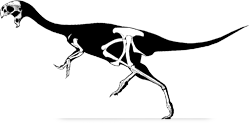
"Ingenia" was very Oviraptor-like, but much smaller, with shorter arms and very stout and strong three-fingered hands. Its second and third fingers are thin and short but almost equal in length while its first (thumb) was twice as long, massive and wide with a large, curved claw. These specialized features suggest "Ingenia" was doing something with its hands that the rest of its family were not, but no one has any idea what that something was.
It's possible that the only specimen discovered thus far was a female. It was sat on a nest and the remains of its skull, such as they are, appear to lack any kind of head crest (in most walks of life it's the males who like to strut their stuff with showy-off accessories on their noggin). But the strangest thing about "Ingenia" has nothing to do with its appearance or its habits.
The name "Ingenia" belongs to the marine roundworm Ingenia mirabilis (hence the dinosaur name is enclosed in quotes) and has for over fifty years, and because of International Commission on Zoological Nomenclature rules of priority, a change was surely on the cards. In the scientific community (as well as being listed in the ICZN's "Code of Ethics"), it is considered right and proper to allow the original author first dibs on a new name. But Rinchen Barsbold, although well aware of the situation, was in no rush to choose one.
In the meantime, Jesse Easter coined Ajancingenia as a replacement in 2013, but the fanfare and rapturous applause were conspicuous by their absence because this wasn't ingenius either. Allegedly, Easter indulged in a spot of "taxonomic claim-jumping" by not consulting with Barsbold in advance, and committed a scientific faux-pas by "borrowing" large chunks of data from a fellow author without so much as a sniff of due credit. A citation for the latter was, apparently, removed by editors without Easter's knowledge prior to publication. But still, given the brouhaha Drs Ivie, Slipinski and Wegrzynowicz caused when their Megapnosaurus ousted Mike Raath's Syntarsus from the roll call of dinosaurs in a similar manner in 2001, we weren't convinced that this new name would be accepted by palaeontologists. Lo and behold, Gregory Funston et al. (with Barsbold in tow) classified Ajancingenia as a species of Heyuannia, creating the new combination Heyuannia yanshini in 2017, simply to avoid an "ethical dilemma" which is already causing its own problems. The Barsbold-named family "Ingeniinae" was renamed Heyuanninae by Chan-Gyu Yun in 2019.
It's possible that the only specimen discovered thus far was a female. It was sat on a nest and the remains of its skull, such as they are, appear to lack any kind of head crest (in most walks of life it's the males who like to strut their stuff with showy-off accessories on their noggin). But the strangest thing about "Ingenia" has nothing to do with its appearance or its habits.
The name "Ingenia" belongs to the marine roundworm Ingenia mirabilis (hence the dinosaur name is enclosed in quotes) and has for over fifty years, and because of International Commission on Zoological Nomenclature rules of priority, a change was surely on the cards. In the scientific community (as well as being listed in the ICZN's "Code of Ethics"), it is considered right and proper to allow the original author first dibs on a new name. But Rinchen Barsbold, although well aware of the situation, was in no rush to choose one.
In the meantime, Jesse Easter coined Ajancingenia as a replacement in 2013, but the fanfare and rapturous applause were conspicuous by their absence because this wasn't ingenius either. Allegedly, Easter indulged in a spot of "taxonomic claim-jumping" by not consulting with Barsbold in advance, and committed a scientific faux-pas by "borrowing" large chunks of data from a fellow author without so much as a sniff of due credit. A citation for the latter was, apparently, removed by editors without Easter's knowledge prior to publication. But still, given the brouhaha Drs Ivie, Slipinski and Wegrzynowicz caused when their Megapnosaurus ousted Mike Raath's Syntarsus from the roll call of dinosaurs in a similar manner in 2001, we weren't convinced that this new name would be accepted by palaeontologists. Lo and behold, Gregory Funston et al. (with Barsbold in tow) classified Ajancingenia as a species of Heyuannia, creating the new combination Heyuannia yanshini in 2017, simply to avoid an "ethical dilemma" which is already causing its own problems. The Barsbold-named family "Ingeniinae" was renamed Heyuanninae by Chan-Gyu Yun in 2019.
Etymology
"Ingenia" is derived from Ingeni-Khoboor, near which the type specimen was discovered. It doesn't mean genius or even ingenius.The species epithet, yanshini, honors Aleksandr Leonidovich Yanshin (1911-1999), who was adviser and mentor to Barbsold during his time at the Paleontological Institute in St. Petersburg, Russia. The proposed replacement name, Ajancingenia, suffixes the original "Ingenia" with the Mongolian "ajanc" (traveller) as a Western allusion of sticking one's thumb out ("Ingenia" has huge thumbs!) when hitchhiking.
Discovery
The first remains of "Ingenia" (the dinosaur) were discovered in the Barun Goyot Formation at Khermin Tsav, Ingeni-Khoboor, Bayanhongor Aimak (Province), Omnogovi, Southwestern Mongolia by Barsbold Rinchen.The holotype (MPC-D 100/30) is a partial skeleton consisting of a partial lower jaw, nine cervical (neck) vertebrae, some ribs, all eight sacral (hip) vertebrae, 30 caudal (tail) vertebrae, chevrons, a complete pectoral girdle, left and right humeri (upper arm bones), left and right ulnae (lower arm bones), a right hand, left and right tibiae (shin bones), left and right fibulae (calf bones), and the left metatarsus. A partial skull (referred to as MPC-D 100/30 by Barsbold in 1983), plus a couple of skull bones (referred to as MPC-D 100/31 by Osmolska in 2004), have since been lost. Referred material includes two partial skeletons, MPC-D 100/31 and MPC-D 100/32. The "holotype" mount on display at the Institute of Paleontology and Geology in Ulaanbaatar is a chimera of four different specimens: elements of MPC-D 100/30, 31 and 32, plus a skull that actually belongs to Conchoraptor gracilis! The oviraptorid now known as Khaan mckennai was initially, and tentatively, referred to "Ingenia" by Dingus et al. in 1995.


