dinochecker
Welcome to our KRITOSAURUS entry...
Archived dinosaurs: 1221
fb twit g+ feed
Dinosaurs from A to Z
Click a letter to view...
A B C D E F G
H I J K L M N
O P Q R S T U
V W X Y Z ?

KRITOSAURUS

a plant-eating saurolophine iguanodont dinosaur from the Late Cretaceous of North America.
Pronunciation: KRIT-oh-SOR-us
Meaning: Separated lizard
Author/s: Brown (1910)
Synonyms: See below
First Discovery: New Mexico, USA
Discovery Chart Position: #95

Kritosaurus navajovius

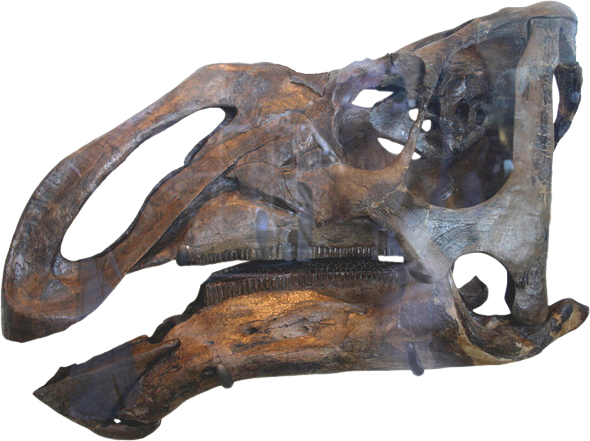
When Barnum Brown first described the remains of Kritosaurus, he chose the name Nectosaurus and rebuilt its missing snout in the flat, ducky vision of what would become known as Anatotitan. As it happens, Nectosaurus was already occupied by a marine reptile (named by John C. Merriam, 1905) so Brown coined Kritosaurus as a replacement name in 1910 and six years later it received a facelift. Literally.

In 1916 Kritosaurus was restored with an arched snout, an idea Brown had nicked from Gilmore's Gryposaurus, and both palaeontologists suspected they may be the same creature. After the 1942 publication of Lull and Wright's monograph on hadrosaurs, Gryposaurus was sunk into Kritosaurus under the first name stands rule, and there it spent the next fifty odd years.

By the 1990s the validity of Kritosaurus was being called into question, and the "separated lizard" was separated again, from Gryposaurus, due mainly to its shabby remains and the whiff of uncertainty that surrounded them. At least for now, the slightly younger and primarily Canadian Gryposaurus is Gryposaurus again and gaining momentum, while Kritosaurus is fading into obscurity and receives only passing mention, mainly because of the dinosaurs that it has been historically entangled with.
(Separated lizard of the Navajo) Etymology
Kritosaurus is derived from the Greek "kritos" (separated, referring to the separation of its "weathered out" skull bones) and "sauros" (lizard). The species epithet, navajovius, honors the Navajo Indians who inhabited the area.
Synonyms
Anasazisaurus horneri? (Hunt and Lucas, 1993)
Naashoibitosaurus ostromi? (Hunt and Lucas, 1993)
Discovery
The remains of Kritosaurus were discovered in the De-na-zin Member of the Kirtland Formation, near Ojo Alamo, San Juan County, New Mexico, USA, by Barnum Brown on August 27th 1904, after the report of "numerous fossils" in the area by George Hubbard Pepper of the Hyde Exploring Expeditions in 1902. The holotype (AMNH 5799) is a partial and poorly-preserved skull.
Estimations
Timeline:
Era: Mesozoic
Epoch: Late Cretaceous
Stage: Campanian
Age range: 80-73 mya
Stats:
Est. max. length: 9 meters
Est. max. hip height: ?
Est. max. weight: 2.5 tons
Diet: Herbivore
Other Species
"Kritosaurus australis" (Bonaparte et al., 1984) was sunk into Secernosaurus koerneri—one of the few South American hadrosaurids—as a junior synonym by Albert Prieto-Marquez and Guillermo C. Salinas in 2010. It was given its own name—Huallasaurus australis—in 2022 by Rozadilla et al. when it turned out to be not particularly Kritosaurus or Secernosaurus-like.
"Kritosaurus incurvimanus" (Brown, 1919) is considered a junior synonym of Gryposaurus notabilis.
Kritosaurus horneri (Prieto-Marquez, 2014) is based on a skull from New Mexico that Jack Horner initially assigned to Kritosaurus navajovius in 1992. It was renamed Anasazisaurus by Hunt and Lucas the following year, then Alberto Prieto-Marquez moved it back to Kritosaurus, but as a second species, taking the epithet "horneri" with it. Not everyone agrees that it's a second species of Kritosaurus and continue to call it Anasazisaurus.
References
• Brown B (1910) "The Cretaceous Ojo Alamo beds of New Mexico with description of the new dinosaur genus Kritosaurus". Bulletin of the American Museum of Natural History, 28(24): 267-274.
• Brown B (September 15, 1914) "Cretaceous Eocene correlation in New Mexico, Wyoming, Montana, Alberta". Geological Society of America Bulletin, 25 (1): 355-380. DOI: 10.1130/gsab-25-355 [Page 380]
• Sinclair WJ and Granger W (June 3, 1914) "Paleocene deposits of the San Juan Basin, New Mexico". Bulletin of the American Museum of Natural History, 33(3): 297-316. DOI: 10.1086/622336
• Gilmore CW (1916) "Contributions to the geology and paleontology of San Juan County, New Mexico. 2. Vertebrate faunas of the Ojo Alamo, Kirtland and Fruitland Formations". United States Geological Survey Professional Paper. 98-Q: 279-302.
• Bonaparte JF, Franchi MR, Powell JE and Sepulveda EG (1984) "La Formación Los Alamitos (Campaniano-Maastrichtiano) del sudeste de Rio Negro, con descripcion de Kritosaurus australis n. sp. (Hadrosauridae). Significado paleogeografico de los vertebrados". Revista de la Asociación Geológica Argentina, 39 (3-4): 284-299. [names Kritosaurus australis.]
• Horner JR (1992) "Cranial morphology of Prosaurolophus (Ornithischia: Hadrosauridae) with descriptions of two new hadrosaurid species and an evaluation of hadrosaurid phylogenetic relationships". Museum of the Rockies Occasional Paper, 2: 1-119.
• Hunt AP and Lucas SG (1992) "Stratigraphy, paleontology, and age of the Fruitland and Kirtland Formations (Upper Cretaceous) San Juan Basin, New Mexico". Page 217-239 in Lucas, Kues, Williamson and Hunt (eds.). New Mexico Geological Society Guidebook, No. 43. New Mexico Geological Society.
• Horner JR, Weishampel DB and Forster CA (2004) "Hadrosauridae" in Weishampel, Dodson and Osmólska (eds.) "The Dinosauria: Second Edition".
• Prieto-Márquez A, Weishampel DB and Horner JR (2006) "The dinosaur Hadrosaurus foulkii, from the Campanian of the East Coast of North America, with a reevaluation of the genus". Acta Palaeontologica Polonica, 51(1): 77-98.
• Prieto-Marquez A and Salinas GC (2010) "A re-evaluation of Secernosaurus koerneri and Kritosaurus australis (Dinosauria, Hadrosauridae) from the Late Cretaceous of Argentina". Journal of Vertebrate Paleontology, 30(3): 813-837. DOI: 10.1080/02724631003763508
• Lowell Dingus and Mark Norell (2011) "Barnum Brown: The Man Who Discovered Tyrannosaurus rex".
• Prieto-Marquez A (2014) "Skeletal morphology of Kritosaurus navajovius (Dinosauria:Hadrosauridae) from the Late Cretaceous of the North American south-west, with an evaluation of the phylogenetic systematics and biogeography of Kritosaurini". Journal of Systematic Palaeontology, 12(2): 133-175.
• Rozadilla S, Brissón-Egli F, Agnolín L, Aranciaga-Rolando F, Mauro A and Novas FE (2022) "A new hadrosaurid (Dinosauria: Ornithischia) from the Late Cretaceous of northern Patagonia and the radiation of South American hadrosaurids". Journal of Systematic Palaeontology, 19(17): 1207-1235. DOI: 10.1080/14772019.2021.2020917.
Email    Facebook    Twitter    Reddit    Pinterest
Time stands still for no man, and research is ongoing. If you spot an error, or want to expand, edit or add a dinosaur, please use this form. Go here to contribute to our FAQ.
All dinos are GM free, and no herbivores were eaten during site construction!
To cite this page:
Atkinson, L. "KRITOSAURUS :: from DinoChecker's dinosaur archive".
›. Web access: 06th Mar 2026.
  top