









Pronunciation: CRIP-tops
Meaning: Hidden face
Author/s: Sereno and Brusatte (2008)
Synonyms: None known
First Discovery: Ténéré Desert, Niger
Acta Ordinal: #665
Kryptops palaios
Kryptops hails from Gadoufaoua, a stretch of Niger's Ténéré Desert known locally as "the place where camels fear to go". Fortunately, Paul Sereno's 2008 expedition members were not camels, and as they ventured into this forbidding landscape and found the relics of an archaic abelisaurid, two things became apparent: (1) this particular family of theropod dinosaurs were blessed with fugliness from the get-go, because (2) this representative of that family was ancient.
Vessel tracks and pockmarks on the face of Kryptops hint at the presence of a tight-fitting, gnarly keratin "mask", and given the modestly-sized teeth, some experts have proposed that it may have been more suited to gnawing on a real predator's rotting cast-offs than hunting for itself. However, few carnivorous scavengers don't also hunt, and even fewer hunters won't also scavenge. Meat that doesn't fight back is as good as any other kind, and if it's already dead, so much the better.
For many years, the absence of abelisaurid fossils in Africa, in contrast to their presence in other fragments of former Gondwana-land (South America, India and Madagascar), was held up as proof that these land masses began to separate around 140 million years ago, with Africa becoming completely isolated in a seaway by 120 mya. Kryptops could have revised that timeline, having been discovered in African Cretaceous deposits dated to roughly 112 mya. But the presence of fellow abelisaurid Rugops primus in Africa during the Cenomanian (ca. 95 mya), alongside its closest relatives in coeval South American deposits—and ditto for crocodylians—had already shaved 17 million years off that estimate.
So, Kryptops didn’t rewrite the story of Gondwana's fragmentation. But it took solace from being the most basal bona fide abelisaurid known from any continent... until Matt Carrano accused it of being a chimaera: a hotchpotch of several different critters jumbled together. The skeletal remains were found roughly 15 metres from anything resembling skull bones, and the pelvic fragments are suspiciously carcharodontosaurid-like, with the sympatric Eocarcharia the obvious candidate for ownership. Yet crucially, Kryptops and Eocarcharia share no overlapping bones, making direct comparisons impossible and any reassignment speculative at best. For now, old hidden face clings to its holotype maxilla like a limpet, while Eocarcharia—in a twist worthy of the fossil record's theatrical flair—was later accused by Cau and Paterna of being a chimaera too, leaving both taxa in a haze of anatomical ambiguity.
Vessel tracks and pockmarks on the face of Kryptops hint at the presence of a tight-fitting, gnarly keratin "mask", and given the modestly-sized teeth, some experts have proposed that it may have been more suited to gnawing on a real predator's rotting cast-offs than hunting for itself. However, few carnivorous scavengers don't also hunt, and even fewer hunters won't also scavenge. Meat that doesn't fight back is as good as any other kind, and if it's already dead, so much the better.
For many years, the absence of abelisaurid fossils in Africa, in contrast to their presence in other fragments of former Gondwana-land (South America, India and Madagascar), was held up as proof that these land masses began to separate around 140 million years ago, with Africa becoming completely isolated in a seaway by 120 mya. Kryptops could have revised that timeline, having been discovered in African Cretaceous deposits dated to roughly 112 mya. But the presence of fellow abelisaurid Rugops primus in Africa during the Cenomanian (ca. 95 mya), alongside its closest relatives in coeval South American deposits—and ditto for crocodylians—had already shaved 17 million years off that estimate.
So, Kryptops didn’t rewrite the story of Gondwana's fragmentation. But it took solace from being the most basal bona fide abelisaurid known from any continent... until Matt Carrano accused it of being a chimaera: a hotchpotch of several different critters jumbled together. The skeletal remains were found roughly 15 metres from anything resembling skull bones, and the pelvic fragments are suspiciously carcharodontosaurid-like, with the sympatric Eocarcharia the obvious candidate for ownership. Yet crucially, Kryptops and Eocarcharia share no overlapping bones, making direct comparisons impossible and any reassignment speculative at best. For now, old hidden face clings to its holotype maxilla like a limpet, while Eocarcharia—in a twist worthy of the fossil record's theatrical flair—was later accused by Cau and Paterna of being a chimaera too, leaving both taxa in a haze of anatomical ambiguity.
(Old hidden face)Etymology
Kryptops is derived from the Greek "krypto" (hidden) and "ops" (face), which refers to the possibility of its face being completely hidden behind a keratin "mask". The species epithet, palaios, literally means "old" in Greek, referring to its Early Cretaceous age.
Discovery
The remains of Kryptops were discovered during a Paul Sereno-led expedition in the Elrhaz Formation at "Gadoufaoua" ("the place where camels fear to go"), on the western edge of the Ténéré Desert, Niger, in 2000.
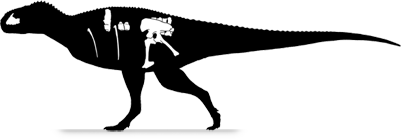
The holotype (MNN GAD1-1) is a tooth-bearing bone (maxilla) from the left side of the upper jaw. All tooth crowns were broken off and nowhere to be seen, but, based on the contents in the "crypt" of socket number 8, each tooth had a column of three replacements, the largest of which was edged with fifteen small serrations every 5mm. The assignment of several other specimens to Kryptops — a partial pelvic girdle and sacrum (MNN GAD1-2), and some vertebrae and ribs (MNN GAD1-3 to MNN GAD1-8), which were found 15 meters from the holotype — has been called into question.
Preparators
Andrew Gray, Ray Vodden, Hannah Moots, Sara Burch, and Caitlin Wylie (University of Chicago).
 • Sereno PC and Brusatte SL (2008) "


