









Pronunciation: LIH-moo-SOR-us
Meaning: Mud lizard
Author/s: Xu et al. (2009)
Synonyms: None known
First Discovery: Xinjiang, China
Acta Ordinal: #678
Limusaurus inextricabilis
Not to be outdone by its trail-blazing "dino death trap" bedfellows Guanlong (Asia's oldest tyrannosaur), Yinlong (the oldest ceratopsian) and Jiangjunosaurus (the first Jurassic representative of Stegosauridae from the Shishugou Fm. of Xinjiang), Limusaurus is the first definitive member of its family known from Eastern Asia and one of the earliest known from anywhere. It's a ceratosaur, but choc-a-bloc with weird features.
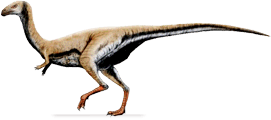
Typically, ceratosaurs are large-headed, long-toothed, stocky-legged critters with fused ankles and short arms, and most have a fondness for anything made of flesh, even members of their own kind. By comparison, Limusaurus had a small head and long slender legs, and it lacked claws and teeth but preserved evidence of a beak and gastroliths which all point to a plant-based diet. In a nutshell, Limusaurus appears to be the only beaked, herbivorous theropod known from the Jurassic. But it's superficially similar to (and sandwiched between) the Triassic shuvosaurids and the Cretaceous ornithomimids which is a remarkable case of convergent evolution among three distinct groups of archosaurs that are separated by an enormous chunk of time. However, it's the hands of Limusaurus that get all the attention.
Based on fossil evidence, paleontologists knew that tetanurans — the branch of theropod dinosaurs closest to birds — arrived at tridactyl (three-fingered) hands from five fingered ancestors, but assumed that they lost digits 4 and 5 (ring finger and pinky) because digit one looked like a thumb. However, super speed "evolution" witnessed by a chosen few in the embryos of modern birds showed that they began with five fingers then lost digits one and five (the thumb and pinky). This difference in hand form has long been the last holdout for the "birds are not dinosaurs, their hands are different" brigade. But Limusaurus has all but lost digits one and five too: its thumb has shrunk to a mere nub, and the pinky is gone completely.
Because of its position way down on the theropod family tree, some experts now suspect that ceratosaurs such as Limusaurus may be ancestral to Tetanurae rather than a sister group, which would demolish the discrepancy between theropod and bird hands but also mean that tetanuran digits have been misnumbered for a century and a half! Of course, it's equally plausible that Limusaurus just started a trend of "finger shrinking" that culminated in the Cretaceous abelisaurid ceratosaur Carnotaurus whose fingers were all shrunk to fused, virtually useless, unclawed stumps. Or that it was closer to the slender-footed noasaurid abelisauroid ceratosaurs and evolved bird-like fingers to exploit a niche. Heck, it may just be an oddball that did its own thing and its weird hands, perhaps undergoing a "frameshift" whereby digits two, three and four took over the identities of one, two and three (index finger became thumb, and so on), had no bearing on the design of any other dinosaur.
Typically, ceratosaurs are large-headed, long-toothed, stocky-legged critters with fused ankles and short arms, and most have a fondness for anything made of flesh, even members of their own kind. By comparison, Limusaurus had a small head and long slender legs, and it lacked claws and teeth but preserved evidence of a beak and gastroliths which all point to a plant-based diet. In a nutshell, Limusaurus appears to be the only beaked, herbivorous theropod known from the Jurassic. But it's superficially similar to (and sandwiched between) the Triassic shuvosaurids and the Cretaceous ornithomimids which is a remarkable case of convergent evolution among three distinct groups of archosaurs that are separated by an enormous chunk of time. However, it's the hands of Limusaurus that get all the attention.
Based on fossil evidence, paleontologists knew that tetanurans — the branch of theropod dinosaurs closest to birds — arrived at tridactyl (three-fingered) hands from five fingered ancestors, but assumed that they lost digits 4 and 5 (ring finger and pinky) because digit one looked like a thumb. However, super speed "evolution" witnessed by a chosen few in the embryos of modern birds showed that they began with five fingers then lost digits one and five (the thumb and pinky). This difference in hand form has long been the last holdout for the "birds are not dinosaurs, their hands are different" brigade. But Limusaurus has all but lost digits one and five too: its thumb has shrunk to a mere nub, and the pinky is gone completely.
Because of its position way down on the theropod family tree, some experts now suspect that ceratosaurs such as Limusaurus may be ancestral to Tetanurae rather than a sister group, which would demolish the discrepancy between theropod and bird hands but also mean that tetanuran digits have been misnumbered for a century and a half! Of course, it's equally plausible that Limusaurus just started a trend of "finger shrinking" that culminated in the Cretaceous abelisaurid ceratosaur Carnotaurus whose fingers were all shrunk to fused, virtually useless, unclawed stumps. Or that it was closer to the slender-footed noasaurid abelisauroid ceratosaurs and evolved bird-like fingers to exploit a niche. Heck, it may just be an oddball that did its own thing and its weird hands, perhaps undergoing a "frameshift" whereby digits two, three and four took over the identities of one, two and three (index finger became thumb, and so on), had no bearing on the design of any other dinosaur.
(Mud lizard who could not escape)Etymology
Limusaurus is derived from the Latin "limus" (mud or mire) and the Greek "sauros" (lizard). The species epithet, inextricabilis, also Latin, means "impossible to extricate" (impossible to escape or free oneself from a constraint or difficulty). Simply put, they were stuck in mud and couldn't escape.
Discovery
The remains of Limusaurus were discovered in the Shishugou Formation (Qigu Group) at Wucaiwan, Junggar Basin, Xinjiang, China in 2004.
They were removed in blocks that were interpreted as 1-2-meter-deep pits: not natural depressions, but liquefaction pockets created when huge sauropods trampled through saturated sediments and their footprints then filled with mud.
Small dinosaurs were highly susceptible to becoming mired in these "death traps", their bodies rapidly buried and stacked atop earlier victims like a prehistoric mega-gateaux.
The holotype (IVPP V 15923—found in block TBB 2005) is an almost complete sub-adult skeleton (including gastroliths) that was snuggling up to a crocodile ancestor, perhaps Junggarsuchus sloani.
A referred sub-adult specimen missing its skull (IVPP V 15304, also erroneously numbered as IVPP V 15924), discovered in block TBB 2002, is 15% larger than the holotype.
Both specimens were described by Xu et al. in 2009. Seventeen additional specimens—six juveniles, ten subadults and one adult—have been excavated from blocks TBB 2001, TBB 2002, and TBB 2005. The toothless-but-beaked adults and toothed juveniles were initially thought to be two different kinds of dinosaur and were pencilled in to be studied separately, until the 2017, when Wang, Stiegler, Amiot, Wang, Du, Clark and Xu realised that they were all the same species. Block TBB 2001 has yielded 4 sub-adult Limusaurus (IVPP V 15297, V 15298, V 15299, V 15300) and a juvenile (V 15301). Block TBB 2002 has yielded one sub-adult Limusaurus (IVPP V 15303), plus two specimens of Guanlong wucaii, and a third, unidentified theropod that is neither tyrannosauroid nor ceratosaur.
[This block also yielded the referred sub-adult IVPP V 15304.] Block TBB 2005 has yielded five juvenile Limusaurus, five sub-adults, and one adult, plus the tail of a small ornithischian dinosaur and skeleton remains of two small crocodyliforms, two small mammals, a turtle, and three tritylodonts.
[This block also yielded the holotype sub-adult IVPP V 15923.]
To beak, or not to beak
In 2017, Shuo Wang and colleagues analysed 19 specimens of the Jurassic ceratosaur Limusaurus inextricabilis, spanning six growth stages determined by body size and bone histology — the microspcopic study of thin bone slices to count LAGs (lines of arrested growth), much like the growth rings found in trees. Of the 78 changes that were observed across development, the most surprising was that young Limusaurus had fully toothed jaws, whereas older individuals had lost all their teeth and developed a beak, which represents the first known fossil example of what is known as 'ontogenetic edentulism' — tooth loss as an animal matures, but not because of old age — among jawed vertebrates.


