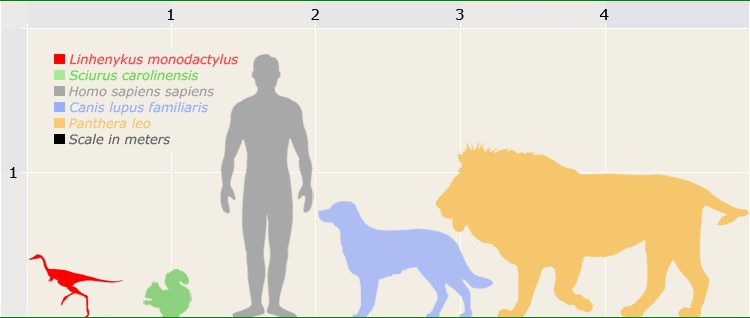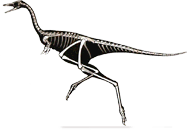
Pronunciation: LIN-huh-NYE-kuss
Meaning: Linhe claw
Author/s: Xu et al. (2011)
Synonyms: None known
First Discovery: Linhe, China
Acta Ordinal: #767
Linhenykus monodactylus
Most theropod dinosaurs had three fingers on each hand. Even some specimens of Tyrannosaurus rex, who are famed for having diddy arms and just two fingers, sport what appears to be the faintest whiff of a third. Most alvarezsaurids had three fingers too, but only the middle one (digit II) was of any use because the outer two had shrunk to tiny, apparently useless structures; mere vestiges (like hindleg bones found in some whales and snakes) from a time long passed when their ancestor was fully three-fingered. Or so we thought.
Linhenykus had lost the outer stumps completely and is the only dinosaur known to have a truly one-fingered hand. But this was not the result of evolution in progress as it was closer to the base of the alvarezsaurid family tree than its later-living relatives that still retained the remnants of digits I and III. What this means is that Linhenykus evolved its stout forearms with fused wrists, downwards-pointing palms and heavy-duty claw-tipped mono-fingered hands to do a unique job. Unfortunately, no one knows for sure what that job was. However, most palaeontologists suspect it was ripping into termite mounds and raking out the inhabitants, much like modern anteaters and pangolins.
In what would be a cruel twist, Linhenykus may not be the first dinosaur known to sport single-fingered hands, as it has been suggested that Xu Xing's analysis failed to sufficiently distinguish its comparable parts from those belonging to a similar-aged Mongolian alvarezsaurid called Parvicursor. If the two turn out to be the same critter, then Linhenykus will be sunk as a junior synonym because Parvicursor was named 15 years earlier and thus has priority in the name game.
Linhenykus had lost the outer stumps completely and is the only dinosaur known to have a truly one-fingered hand. But this was not the result of evolution in progress as it was closer to the base of the alvarezsaurid family tree than its later-living relatives that still retained the remnants of digits I and III. What this means is that Linhenykus evolved its stout forearms with fused wrists, downwards-pointing palms and heavy-duty claw-tipped mono-fingered hands to do a unique job. Unfortunately, no one knows for sure what that job was. However, most palaeontologists suspect it was ripping into termite mounds and raking out the inhabitants, much like modern anteaters and pangolins.
In what would be a cruel twist, Linhenykus may not be the first dinosaur known to sport single-fingered hands, as it has been suggested that Xu Xing's analysis failed to sufficiently distinguish its comparable parts from those belonging to a similar-aged Mongolian alvarezsaurid called Parvicursor. If the two turn out to be the same critter, then Linhenykus will be sunk as a junior synonym because Parvicursor was named 15 years earlier and thus has priority in the name game.
(Single-Fingered Linhe Claw)
Etymology
Linhenykus is derived from "Linhe" (the district of Inner Mongolia where the specimen was discovered), and
the Greek "onyx" (claw).
The species epithet, monodactylus—from the Greek "mono" (one, alone, single) and "daktylos" (finger)—refers to the presence of only a single finger on each hand.
Discovery
The remains of Linhenykus were discovered in the "Gate area" of the Wulansuhai Formation, Bayan Mandahu Village, north of the city of Linhe, Inner Mongolia, China, by Jonah Choiniere in 2008. The holotype (V17608), prepared by Yu Tao and Ding Xiaoqin, is a partial skeleton including cervical (neck), dorsal (back), sacral (hip), and caudal (tail) vertebrae, the left scapulocoracoid (blade and a bone from the shoulder), a nearly complete sternum (breastbone), much of the forelimbs, a partial pelvis,
nearly complete hindlimbs, and some unidentified fragments.