









Pronunciation: LIN-huh-RAP-tor
Meaning: Linhe plunderer
Author/s: Xu, Choinere, Pittman, et al. (2010)
Synonyms: None known
First Discovery: Linhe, China
Acta Ordinal: #722
Linheraptor exquisitus
In 2008, Jonah Choiniere was peeing against an elements-battered "red cliff" in the Gobi Desert when he noticed a single claw sticking out. Thanks to his hawk-like vision, a potential disaster was avoided, as these cliffs are constantly eroding, especially when they're being used as toilets, and their exposed fossils weather quickly. But luckily, this tiny fingertip was just the tip of the iceberg.
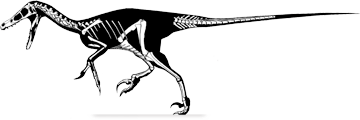
Virtually complete, though removed in two slabs, this exquisitely-preserved raptor from Linhe, catchily christened Linheraptor exquisitus, sports features typical of dromaeosaurids, the dinosaurs informally known as "raptors", such as an elongated skull, curved neck, and long tail. The second toe of each hind foot sports a sickle-shaped claw for subduing prey, assumed by many to be small ceratopsians. But its limb proportions and lightweight build suggest Linheraptor would have no problems chasing down swifter critters.
 Behind Tsaagan, Mahakala, and two species of Velociraptor, Linheraptor is the fifth dromaeosaurid to be named from similarly-aged Asian formations and the first nearly complete one to be found in the Gobi since 1972. Distinct features of its skull hint at an affinity with Tsaagan mangas — "the White Monster" — and the pair may represent a unique lineage of Asian dromaeosaurids sandwiched between the oldest forms, such as those from Early Cretaceous China and the younger, Late Cretaceous forms, such as Velociraptor. But not everyone agrees.
Senter in 2011 and Turner, Makovicky and Norell in 2012 all found Linheraptor to be a junior synonym of Tsaagan mangas. In 2015, however, Xu et al. highlighted a whopping 61 differences between the two, but, to be fair, they were mostly found on the skull of Linheraptor that was previously unprepared and lay hidden beneath bone-obscuring rock matrix.
Virtually complete, though removed in two slabs, this exquisitely-preserved raptor from Linhe, catchily christened Linheraptor exquisitus, sports features typical of dromaeosaurids, the dinosaurs informally known as "raptors", such as an elongated skull, curved neck, and long tail. The second toe of each hind foot sports a sickle-shaped claw for subduing prey, assumed by many to be small ceratopsians. But its limb proportions and lightweight build suggest Linheraptor would have no problems chasing down swifter critters.
Behind Tsaagan, Mahakala, and two species of Velociraptor, Linheraptor is the fifth dromaeosaurid to be named from similarly-aged Asian formations and the first nearly complete one to be found in the Gobi since 1972. Distinct features of its skull hint at an affinity with Tsaagan mangas — "the White Monster" — and the pair may represent a unique lineage of Asian dromaeosaurids sandwiched between the oldest forms, such as those from Early Cretaceous China and the younger, Late Cretaceous forms, such as Velociraptor. But not everyone agrees.
Senter in 2011 and Turner, Makovicky and Norell in 2012 all found Linheraptor to be a junior synonym of Tsaagan mangas. In 2015, however, Xu et al. highlighted a whopping 61 differences between the two, but, to be fair, they were mostly found on the skull of Linheraptor that was previously unprepared and lay hidden beneath bone-obscuring rock matrix.
(Exquisite Linhe Plunderer)Etymology
Linheraptor is derived from "Linhe" (the district of Inner Mongolia where the specimen was discovered), and the Greek "sauros" (lizard).
The species epithet, exquisitus, means "exquisite, excellent, fine, or sought-after" in Latin, and refers to the exquisite preservation of its holotype fossils.
Along with Linhenykus and Linhevenator, Linheraptor forms a trifecta of dinosaurs from Linhe to be named after, well, Linhe. Mark our words, there will be a Linhesaurus and a Linhedromaeus soon, and then palaeontologists will have the full set of common dinosaur suffixes and have to get creative with their names after that.
Discovery
The Linhe plunderer was discovered in the Wulansuhai Formation's "Gate Locality" (previously part of the Djadokhta Formation), Bayan Mandahu Village, Inner Mongolia, China, by Jonah Choiniere during a joint Institute of
Vertebrate Paleontology and Paleoanthropology (IVPP) and Long Hao Institute of Geology and Paleontology expedition to the Gobi in 2008. The holotype (IVPP V 16923, prepared by Xiang Lishi) is an almost complete skeleton recovered in two blocks; one containing most of the body and the other containing the tail.
Preparators
Xiang Lishi.
 Zootaxa, 2403(2403): 1-9.


