









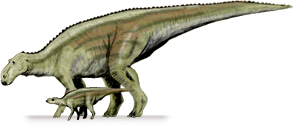
Pronunciation: MAY-ah-SOR-uh
Meaning: Good mother lizard
Author/s: Horner and Makela (1979)
Synonyms: None known
First Discovery: Montana, USA
Acta Ordinal: #273
Maiasaura peeblesorum
Until the 1970s, dinosaurs had a terrible reputation as not-very-bright, sluggish grunters who just lazed around waiting to go extinct. However, the discovery of Deinonychus started something of a dinosaur renaissance by proving that members of the theropod branch were agile, warm-blooded, intelligent predators. Not to be outdone, Maiasaura flew the flag for vegetarians and showed that some members of the ornithopod branch had strong maternal instincts, and were good housekeepers to boot.
The first known fossil of Maiasaura was a single skull discovered by Marion (Trexler) Brandvold in 1978. But within a few short years, the discoveries had snowballed into "Egg Mountain": a Montana breeding ground full of volcano-shaped nests with up to twenty kilo-weight eggs apiece and a clean sweep of growth stages from embryo to geriatric. The nests were neatly arranged in rows with just enough room for a sentinel adult to march between, and contained fossilised evidence to prove that Maiasaura — meaning "good mother lizard" — were indeed good mothers. Even the fathers. Possibly.
Fossil remains within some nests did not belong to hatchlings but to young juveniles, suggesting the offspring were altricial (nest bound) for some time after they emerged from their shells.|1| The leg joints of the typically short-snouted, large-eyed, cutesy kids had not properly formed, so they could not fend for themselves. And yet their teeth sported wear patterns that only arrive with chewing. Food was being delivered to them by molly-coddling adults.
For the colossally-proportioned, thick-nosed, duck-billed parents — nine meters long, two meters high, and a couple of tons in weight, brooding would be a dangerous game, so they didn't bother. In a manner still observed in some modern birds and crocodiles, the crucial task of incubation was left to the soft plant matter used to pack and cover the nests, which warmed the eggs during fermentation, just like a steaming, stinking, compost heap. After that, it was power-eating ahoy, and palaeontologists reckon Maiasaura grew from the size of a rabbit to the size of a deer in around a year, at which point they were strong enough to find their own food.
The first known fossil of Maiasaura was a single skull discovered by Marion (Trexler) Brandvold in 1978. But within a few short years, the discoveries had snowballed into "Egg Mountain": a Montana breeding ground full of volcano-shaped nests with up to twenty kilo-weight eggs apiece and a clean sweep of growth stages from embryo to geriatric. The nests were neatly arranged in rows with just enough room for a sentinel adult to march between, and contained fossilised evidence to prove that Maiasaura — meaning "good mother lizard" — were indeed good mothers. Even the fathers. Possibly.
Fossil remains within some nests did not belong to hatchlings but to young juveniles, suggesting the offspring were altricial (nest bound) for some time after they emerged from their shells.|1| The leg joints of the typically short-snouted, large-eyed, cutesy kids had not properly formed, so they could not fend for themselves. And yet their teeth sported wear patterns that only arrive with chewing. Food was being delivered to them by molly-coddling adults.
For the colossally-proportioned, thick-nosed, duck-billed parents — nine meters long, two meters high, and a couple of tons in weight, brooding would be a dangerous game, so they didn't bother. In a manner still observed in some modern birds and crocodiles, the crucial task of incubation was left to the soft plant matter used to pack and cover the nests, which warmed the eggs during fermentation, just like a steaming, stinking, compost heap. After that, it was power-eating ahoy, and palaeontologists reckon Maiasaura grew from the size of a rabbit to the size of a deer in around a year, at which point they were strong enough to find their own food.
(The Peeble's good mother lizard)Etymology
Maiasaura combines the Greek terms "maia" (good mother or nurse) and "saura" (feminine form of the masculine "sauros", meaning "lizard").
The species epithet,
peeblesorum, honours the Peebles family: the ranchers who (1) owned the land that Marion Brandvold found the first baby specimen in the 1980s, and (2) became understandably miffed at the number of thieving trespassers that the publicity attracted.
Discovery
The first fossils of Maiasaura were discovered in the Two Medicine Formation of Montana in 1978 by Marion (Trexler) Brandvold who died on Thursday June 5th, 2014, at the ripe old age of 102.
The holotype (PU 22405) is a skull.
Diet
Fossilised coprolites (poop) from one particular site in the Two Medicine
Formation were attributed to Maisaura and studied in 2007 by Karen Chin who concluded that they contained a surprisingly high percentage of rotting conifer wood. Accidental ingestion as Maisaura nibbled on the leaves and fine twigs of a terminal tree were ruled out, as there were no identifiable twigs present. But why expend precious energy deliberately chewing lumps of wood that hold little to no nutritional value for vertebrates? Well, it wasn't the rotting wood they were after, but the resources contained within. Fungus and tiny creepy-crawlies make rotting wood their home, and would have provided nutritious tit-bits to keep the coprolite producers going, perhaps
through the winter season when grasses and foliage were in short supply.


