
MASSOSPONDYLUS
an omnivorous massospondylid sauropodomorph dinosaur from the Early Jurassic of South Africa.
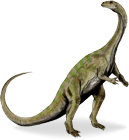
Pronunciation: mas-o-SPON-di-lus
Meaning: Longer vertebrae
Author/s: Owen (
1854)
Synonyms: See
below
First Discovery: Harrismith, South Africa
Acta Ordinal: #11
Massospondylus carinatus
(Longer vertebrae, keeled)Etymology
Massospondylus is derived from the Greek "masson" (longer) and "spondylos"' (vertebra), so named "because the vertebrae are proportionately longer than those of the extinct crocodile called
Macrospondylus" (Owen, 1854). Its name is sometimes misinterpreted as coming from the Latin "
massa" (hump, lump, or mass). The
species epithet,
carinatus, means "keeled" in Latin.
ZooBank registry:
urn:lsid:zoobank.org:act:6340401E-323B-4ED1-B315-87EAD2DE483F.
Discovery
The first
Massospondylus remains were collected from a surface outcrop of the Upper Elliot Formation at Farm Beauchef Abbey, near the town of Harrismith, South Africa, by government surveyor Joseph Millard Orpen in 1853.
Although no
holotype was designated, the only fossils that Owen assigned to
Massospondylus with any conviction is the syntype series of five vertebrae (numbered 331–335) from a collection of some 55 fossils (331-386), which he thought belonged to an extinct carnivorous reptile akin to modern lizards such as Iguanas. He also thought they came from the tail when they actually belonged to the neck (Seeley, 1895).
Richard Lydekker identified them as dinosaurian in 1888, based in part on supposed specimens from India.
These remains and more were blown to buggery in 1941 when their home—The Hunterian Museum, Royal College of Surgeons, London—was hit by a WWII bombing raid, which, in hindsight, is no bad thing. The fossils, and thus surviving illustrations and plaster casts that were based on them, were inadequate for diagnosing a genus and species, certainly for a critter that anchors an entire family.
In 2010, Yates and Barrett petitioned the ICZN to boot the lousy type series from its perch and install a new name-bearer, and the neotype (new type) they nominated is a peach: the skeleton and skull of a particularly fine specimen affectionately known as "Big Momma", from
Farm Bormansdrift, Mekoatlengsnek, in the Clocolan District of the Free State Province,
catalogued as BP/1/4934, and housed in the Bernard Price Institute for Palaeontological Research at the University of the Witwatersrand, Johannesburg, South Africa.
Estimations
Timeline:
Era: Mesozoic
Epoch: Early Jurassic
Stage: Simemurian-Pliensbachian
Age range: 196-189 mya
Stats:
Est. max. length: 4.5 meters
Est. max. hip height: ?
Est. max. weight: 200 Kg
Diet: Herbivore
Other Species
Name-bearer aside, seven other species of
Massospondylus have been named, but only
Massospondylus kaalae (Barrett, 2009) is today considered valid.
Massospondylus browni (Seeley, 1895)
Massospondylus hislopi (Lydekker, 1890)
Massospondylus rawesi (Lydekker, 1890)
Massospondylus harriesi (Broom 1911)
Massospondylus schwarzi (Haughton, 1924)
Massospondylus huenei (Cooper, 1981)
Massospondylus kaalae (Barrett 2009)
• ?
Aetonyx palustris (Broom, 1911) — Upper Elliot Formation, Orange Free State, South Africa.
• ?
Aristosaurus erectus (E.C.N. van Hoepen, 1920) — Clarence Formation, Orange Free State, South Africa.
• ?
Dromicosaurus gracilis (Hoepen, 1920) — Karoo Sequence, Stormberg Beds, South Africa.
• ?
Gryponyx (Broom, 1912) — Lesotho, Orange Free State, South Africa.
• ?
Gyposaurus (Broom, 1911) — Clarence Formation, Orange Free State, South Africa.
• ?
Hortalotarsus (Harry Seeley, 1894) — Clarence Formation, Eastern Cape, Cape Province, South Africa. Destroyed by farmers who thought it was a "bushman" who would wreak havoc with their future generation's religious beliefs!
•
Massosaurus (O.P. Hay, 1910) — Upper Elliot Formation, Orange Free State, South Africa. A mispelling of
Massospondylus.
• ?
Leptospondylus capensis (Owen, 1895) — Upper Elliot Formation, Orange Free State, South Africa. Destroyed in World War II.
• ?
Pachyspondylus orpenii (Owen,
1854) — Upper Elliot Formation, Orange Free State, South Africa. Along with
Leptospondylus capensis, Owen named
Pachyspondylus orpenii based on tail vertebrae that he plucked from 56 bones that arrived from the farm Beauchef Abbey, but only did so because they differed in form compared to the
Massospondylus syntype vertebrae which were part of the same haul. As pointed out by Seeley (1895), they only differed because Owen had misidentified the syntype vertebra as being from the tail when they were actually from the neck, and there's a decent chance that all three represent one individual. They were all destroyed in World War II.
•
Thecodontosaurus dubius (Haughton, (1924) — Clarence Formation, Orange Free State, South Africa. May be a specimen of
Massospondylus kaalae.
There are whispers on the paleontological grapevine that Fabien Knoll's 2010 genus
Ignavusaurus may also be synonymous with
Massospondylus.
References
• Owen R (1854) "
Descriptive catalogue of the Fossil organic remains of Reptilia and Pisces contained in the Museum of the Royal College of Surgeons of England".
London pp. 80, 97
• Lydekker R (1890) "Note on certain vertebrate remains from the Nagpur district".
Records of the Geological
Survey of India, 23: 21-24.
• Seeley HG (1895) "
XII.—On the type of the genus Massospondylus and on some Vertebrae and limb-bone of M. (?) browni".
Annals and Magazine of Natural History, 15(85): 102–125. DOI: 10.1080/00222939508677852
• Hay OP (February 15th, 1910) "On the manner of locomotion of the dinosaurs, especially
Diplodocus, with remarks on the origin of the birds".
Proceedings of the Washington academy of sciences, Vol. XII, No. 1, Page 1-25.
• Broom R (1911) "On the dinosaurs of the Stormberg, South Africa".
Annals of the South African Museum 7 (4): 291-308.
• Haughton SH (1924) "
The fauna and stratigraphy of the Stormberg Series".
Annals of the South African Museum, 12: 323-497.
• Cooper MR (1980) "The prosauropod dinosaur
Massospondylus carinatus Owen from Zimbabwe: its biology, mode of life and phylogenetic significance".
Occasional Papers of the National Museums and Monuments of Rhodesia, Series B, Natural Sciences. 6(10): 689–840.
• Attridge J, Crompton AW and Jenkins FA Jr. (1985) "
The southern Liassic prosauropod Massospondylus discovered in North America".
Journal of Vertebrate Paleontology, 5(2): 128-132. DOI: 10.1080/02724634.1985.10011850
• Glut DF (2000) "
Massospondylus" in "
Dinosaurs: The Encyclopedia: Supplement 1".
Jefferson, North Carolina: McFarland & Co. p. 258.
• Galton PM and Upchurch P (2004) "Prosauropoda". Page 232–258 in Weishampel, Dodson and Osmolska (eds.) "
The Dinosauria: Second Edition".
• Yates AM (2005) "Furcula-like clavicles in the prosauropod dinosaur
Massospondylus".
Journal of Vertebrate Paleontology, 25(2): 466-468. DOI: 10.1671/0272-4634(2005)025[0466:FCITPD]2.0.CO;2
• Bonnan MF and Sentee P (2007) "Were the basal sauropodomorph dinosaurs
Plateosaurus and
Massospondylus habitual quadrupeds?".
The Palaeontological Association. Special Papers in Palaeontology, 77(77): 139-155.
• Yates AM and Barrett PM (2010) "
Massospondylus carinatus Owen 1854 (Dinosauria: Sauropodomorpha) from the Lower Jurassic of South Africa: Proposed conservation of usage by designation of a neotype".
Palaeontologia Africana. 45: 7–10.
• Reisz RR, Evans DC, Sues H-D and Scott D (2010) "Embryonic Skeletal Anatomy of the Sauropodomorph Dinosaur Massospondylus from the Lower Jurassic of South Africa".
Journal of Vertebrate Paleontology, 30(6): 1653-1665. DOI: 10.1080/02724634.2010.521604
• Reisz RR, Evans DC, Roberts EM, Sues H-D and Yates AM (2012) "Oldest known dinosaurian nesting site and reproductive biology of the Early Jurassic sauropodomorph
Massospondylus".
Proceedings of the National Academy of Sciences of the United States of America. 109(7): 2428–2433. DOI: 10.1073/pnas.1109385109
• Brett-Surman MK, Holtz TR Jr and Farlow JO (2012) "
The Complete Dinosaur".
• Chinsamy-Turan A (2013) "
Famous Dinosaurs of Africa".
• Barrett PM, Chapelle K, Staunton CK, Botha J and Choiniere J (2019) "Postcranial osteology of the neotype specimen of
Massospondylus carinatus Owen, 1854 (Dinosauria: Sauropodomorpha) from the upper Elliot formation of South Africa".
Palaeontologia Africana 53(2019): 114-178.
• Mooney ED, Maho T, Rowe DCT, Scott D and Reisz RR (2025)
"
Massospondylus embryos and hatchling provide new insights into early sauropodomorph ontogeny".
Swiss Journal of Palaeontology, 144: 44.
DOI: 10.1186/s13358-025-00382-5.
Time stands still for no man, and research is ongoing. If you spot an error, or want to expand, edit or add a dinosaur, please use
this form. Go
here to contribute to our FAQ.
All dinos are GM free, and no herbivores were eaten during site construction!
To cite this page:
Atkinson, L.
"
MASSOSPONDYLUS :: from DinoChecker's dinosaur archive".
‹
http://www.dinochecker.com/dinosaurs/MASSOSPONDYLUS›. Web access: 06th Oct 2026.









