









Pronunciation: MEG-a-lo-SOR-us
Meaning: Great lizard
Author/s: Buckland (1824)
Synonyms: None known
First Discovery: Oxford, England
Acta Ordinal: #1
Megalosaurus bucklandi
Some 336 years ago, as of 2012, a large bone was unearthed in a limestone quarry near Oxford, England, and after much puzzling, professor Robert Plot concluded that it was the partial femur of a Roman war elephant. Soon after, he changed his mind and thought it belonged to a giant human, like those in the bible, which was perfectly plausible at the time. However, it was the analysis of Richard Brookes almost a century later which brought this lump of bone its first scientific name—"Scrotum humanum"—because he thought it resembled a pair of human testicles (see etymology).
To be fair, Brookes had no idea what he was dealing with: it did look like the goolies of a male, albeit a rather well-endowed one, after all. But in 1824, William Buckland, armed with more morsels from the same quarry and the knowledge of French palaeontologist George Cuvier, deduced that this bone was the partial femur of a gigantic reptile-like critter that he named Megalosaurus—the great lizard. Owen's "Dinosauria" was still 18 years away at this point, so Megalosaurus wasn't recognised as a dinosaur until then. Heck, three more years had passed before it received a full binomen: the two-part name required to cement a critter as scientifically valid.
Gideon Mantell honoured Buckland when he added the epithet bucklandii to Megalosaurus in 1827, a full year after Ferdinand von Ritgen had chosen "conybeari", but the latter was never taken seriously by scientists of the time. In a world dominated by upper-class scholarly gents, the opinion of an obstetrician specialising in the care of women during pregnancy, childbirth and the postnatal period was deemed unworthy of meddling in such matters. And the fact that he never provided a sniff of a description or diagnosis didn't help his cause. Germany's historical infatuation with England's shabby-chic national treasures is one of life's great mysteries, considering they have Lagerstätte full of beautifully preserved critters like Archaeopteryx.
Along with Iguanodon and Hylaeosaurus, Megalosaurus became a lynchpin of Richard Owen's Dinosauria, and much public exposure followed. A Benjamin Waterhouse Hawkins-created statue showcased at Crystal Palace, London, in 1851, built under the guidance of Owen, who believed that Megalosaurus was a mammal-like amphibious quadruped with a hunchback, generated a public awareness that dinosaurs had existed (despite creationist claptrap to the contrary). However, it was many more years before anyone realised not all dinosaurs were, well, mammal-like amphibious quadrupeds with hunchbacks.
For all its infamy, Megalosaurus was misunderstood. But being the only known theropod dinosaur for many decades, it became a "catch-all" taxon, and what a lot of catching it had to do. Remains were thrown in its general direction from all places and times as new species were raised willy-nilly, sometimes based on nothing more than a tooth or claw, and eventually, it contained more species than any other non-avian dinosaur genus, most of which had no right to be there. But it's not all grim news.
Some of today's best-known dinosaurs began their life after death as species of Megalosaurus but were reclaimed as scientists went hammer and tongs to clear up the mess. And after the dust had settled, only one species of Megalosaurus remained: Megalosaurus bucklandii, the old school original, which is now anchored by a lower jaw from Stonesfield because the femur end that looked like a nutsack, aka "the Cornwell bone", is long lost, and bone fragments from the same quarry found by different folk, in different digs at different times, can't be assigned to it with any certainty.
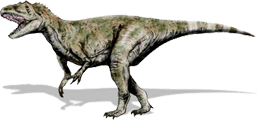
Megalosaurus is still poorly represented fossil-wise, but palaeontologists have painted a rough picture of what it looked like by comparing its known bones to those of more complete relatives. It was probably about eight metres long and weighed close to a couple of tons. It walked on two stout hindlimbs with three forward-facing weight-bearing toes, its horizontal and heavily-muscled torso was balanced by a strong tail, and its forelimbs were short, though very robust, and carried three digits. Proportionately, its head was large with a rather robust lower jaw, and it sported long curved teeth designed to rent prey asunder.
To be fair, Brookes had no idea what he was dealing with: it did look like the goolies of a male, albeit a rather well-endowed one, after all. But in 1824, William Buckland, armed with more morsels from the same quarry and the knowledge of French palaeontologist George Cuvier, deduced that this bone was the partial femur of a gigantic reptile-like critter that he named Megalosaurus—the great lizard. Owen's "Dinosauria" was still 18 years away at this point, so Megalosaurus wasn't recognised as a dinosaur until then. Heck, three more years had passed before it received a full binomen: the two-part name required to cement a critter as scientifically valid.
Gideon Mantell honoured Buckland when he added the epithet bucklandii to Megalosaurus in 1827, a full year after Ferdinand von Ritgen had chosen "conybeari", but the latter was never taken seriously by scientists of the time. In a world dominated by upper-class scholarly gents, the opinion of an obstetrician specialising in the care of women during pregnancy, childbirth and the postnatal period was deemed unworthy of meddling in such matters. And the fact that he never provided a sniff of a description or diagnosis didn't help his cause. Germany's historical infatuation with England's shabby-chic national treasures is one of life's great mysteries, considering they have Lagerstätte full of beautifully preserved critters like Archaeopteryx.
Along with Iguanodon and Hylaeosaurus, Megalosaurus became a lynchpin of Richard Owen's Dinosauria, and much public exposure followed. A Benjamin Waterhouse Hawkins-created statue showcased at Crystal Palace, London, in 1851, built under the guidance of Owen, who believed that Megalosaurus was a mammal-like amphibious quadruped with a hunchback, generated a public awareness that dinosaurs had existed (despite creationist claptrap to the contrary). However, it was many more years before anyone realised not all dinosaurs were, well, mammal-like amphibious quadrupeds with hunchbacks.
For all its infamy, Megalosaurus was misunderstood. But being the only known theropod dinosaur for many decades, it became a "catch-all" taxon, and what a lot of catching it had to do. Remains were thrown in its general direction from all places and times as new species were raised willy-nilly, sometimes based on nothing more than a tooth or claw, and eventually, it contained more species than any other non-avian dinosaur genus, most of which had no right to be there. But it's not all grim news.
Some of today's best-known dinosaurs began their life after death as species of Megalosaurus but were reclaimed as scientists went hammer and tongs to clear up the mess. And after the dust had settled, only one species of Megalosaurus remained: Megalosaurus bucklandii, the old school original, which is now anchored by a lower jaw from Stonesfield because the femur end that looked like a nutsack, aka "the Cornwell bone", is long lost, and bone fragments from the same quarry found by different folk, in different digs at different times, can't be assigned to it with any certainty.
Megalosaurus is still poorly represented fossil-wise, but palaeontologists have painted a rough picture of what it looked like by comparing its known bones to those of more complete relatives. It was probably about eight metres long and weighed close to a couple of tons. It walked on two stout hindlimbs with three forward-facing weight-bearing toes, its horizontal and heavily-muscled torso was balanced by a strong tail, and its forelimbs were short, though very robust, and carried three digits. Proportionately, its head was large with a rather robust lower jaw, and it sported long curved teeth designed to rent prey asunder.
(Buckland's Great Lizard)
Etymology
The name Megalosaurus is derived from the Greek "megas" (great, large) alluding to its great size, and the Greek "sauros" (lizard). It was initially considered to be somewhere in the region of 60 feet in length which is probably twice its actual size. The
species epithet, bucklandii, (assigned by Gideon Mantell in 1827) honors William Buckland who coined Megalosaurus in 1824. Funnily enough, Ferdinand von Ritgen assigned the epithet "conybeari" in 1826 but no-one took a blind bit of notice. As mentioned above, the first fossil that scientists suspect belonged to Megalosaurus is a lump of femur that Richard Brookes named "Scrotum humanum" in 1763, and thus became the first non-bird dinosaur to recieve a "proper" scientific binomen. This caused serious concern for modern paleontologists, so much so that William A.S. Sarjeant petitioned the ICZN to supress the name in the 1990s. But the petition was rejected by then-executive secretary P.K. Tubbs, not only because he considered the name nothing more than the label of an illustration and an historical curiosity but also because the bone is long lost and was too incomplete to assign to anything anyway.


