









Pronunciation: MIEK-ro-RAP-tor
Meaning: Tiny plunderer
Author/s: Xu, Zhou and Wang (2000)
Synonyms: Cryptovolans pauli (Czerkas, 2002)
First Discovery: Liaoning Province, China
Acta Ordinal: #478
Microraptor zhaoianus
The first remains of Microraptor came from Liaoning Province and formed the "dromaeosaur" part of Archaeoraptor liaoningensis — an infamous multi-part hoax, including glued-together bits of at least two birds — that was smuggled illegally out of China and named unofficially by Chris Sloan in 1998. Soon after, this dinosaur and everyone associated with it were chastised by seething Smithsonian ornithologist Storrs Olsen who took umbrage with it being labelled a "missing link" to his beloved birds. So he cemented the name Archaeoraptor himself, based on the part least likely to be one. If he hadn't chosen a museum newsletter in which to "officially" publish this name, been less dismissive of the evidence linking birds to dinosaurs, or actually made an effort to describe its remains, palaeontologists may have taken him more seriously. However, he had, wasn't and didn't, so they didn't either, and Xu Xing later renamed this specimen Microraptor, which has found global acceptance.
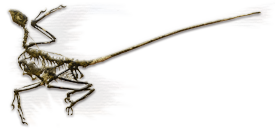
Microraptor was slight of build, fully feathered and sported four wings (one on each of its arms and legs), but it wasn't a bird and may not have been able to fly like one. Some palaeontologists reckon the position of its shoulder joint prevented the upper arm from being raised above the back, hampering the full stroke required for flapping flight. And a suggested biplane-like posture with outstretched leg "wings" positioned at a lower level would be impossible without dislocating its thighs at the hip. Instead, they suspect, Microraptor probably hoisted themselves into trees with their long claws and glided to a second destination in a u-shaped curve by swan-diving off with legs in an orthodox vertical position beneath the body, then used their hind "wings" and broad-feathered tail for lift and balance. But that is merely one of the many theories. Other experts are adamant that Microraptor had acquired the full set of prerequisites for full, flap-powered flight.
Regardless of their mode of airborne transit, what seems clear is that the feathered legs of Microraptor would have hampered its movement on the ground, so it was likely arboreal: it lived in trees. Based on gut contents from several specimens, including fragments of small lizards and tree-perching birds, these "small plunderers" were long thought to be pure carnivores who ate whatever critters lived in the canopies. However, fossilized fish scales were found within the largest known specimen of Microraptor, which suggests they hunted, or maybe scavenged, fish too.
Microraptor was slight of build, fully feathered and sported four wings (one on each of its arms and legs), but it wasn't a bird and may not have been able to fly like one. Some palaeontologists reckon the position of its shoulder joint prevented the upper arm from being raised above the back, hampering the full stroke required for flapping flight. And a suggested biplane-like posture with outstretched leg "wings" positioned at a lower level would be impossible without dislocating its thighs at the hip. Instead, they suspect, Microraptor probably hoisted themselves into trees with their long claws and glided to a second destination in a u-shaped curve by swan-diving off with legs in an orthodox vertical position beneath the body, then used their hind "wings" and broad-feathered tail for lift and balance. But that is merely one of the many theories. Other experts are adamant that Microraptor had acquired the full set of prerequisites for full, flap-powered flight.
Regardless of their mode of airborne transit, what seems clear is that the feathered legs of Microraptor would have hampered its movement on the ground, so it was likely arboreal: it lived in trees. Based on gut contents from several specimens, including fragments of small lizards and tree-perching birds, these "small plunderers" were long thought to be pure carnivores who ate whatever critters lived in the canopies. However, fossilized fish scales were found within the largest known specimen of Microraptor, which suggests they hunted, or maybe scavenged, fish too.
(Zhao's Little Plunderer)Etymology
Microraptor is derived from the Greek "mikros" (small) and the Latin "raptor" (plunderer, snatcher, thief).
The species epithet, zhaoianus (JOW-ee-AY-nus), honours Chinese palaeontologist Zhao Xijin.
ZooBank registry: urn:lsid:zoobank.org:act:3DD13702-B988-4137-935A-516440F9701D.
Discovery
The first fossils of Microraptor were discovered in the Jiufotang Formation of Liaoning, China, which is embarrassingly rich in fossilized remains of birds, bird-like dinosaurs and flying pteradactyls, but lacking much of anything else. The holotype (IVPP V 12330) consists of partial skull, hind and forelimbs, various vertebrae, bits of pelvis, slab-feather impressions, and other odds and sods.


