









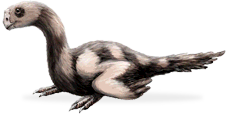
Pronunciation: MIEK-ro-VEN-uh-tuh
Meaning: Small hunter
Author/s: Ostrom (1970)
Synonyms: Megadontosaurus
First Discovery: Montana, USA
Acta Ordinal: #226
Microvenator celer
Microvenator is the oldest known oviraptorosaur from North America, and while its name (meaning small hunter) is apt given the size of its holotype, the holotype is the only known specimen, and it's a juvenile. It would have packed on the pounds as it neared adulthood and perhaps measured some three meters from beak to tail-tip. The latest research by Junchang Lü and colleagues suggests its legs, like those of other oviraptorosaurs, wouldn't have changed much proportionately, though, unlike its name, which hasn't always been what it is now.
In 1933 Barnum Brown discovered a small, partial skeleton along with some oversized teeth in Montana's Cloverly Formation, which he affectionately referred to as "Megadontosaurus ferox" (Fierce large-toothed lizard). Illustrations were made, but the remains were never officially described, nor the name published, and when John Ostrom reviewed them in 1970, he realised that the teeth, plus Brown's equally unofficial "Daptosaurus agilis" (Agile devouring lizard), belonged to Deinonychus and what was left was given a brand new name: Microvenator celer. Ostrom tentatively assigned a single tooth (YPM 5366) from the Yale Peabody Museum collections to Microvenator too, but oviraptorosaurs are mostly toothless so it probably belongs to something else.
 Unofficial and therefore inverted-comma-enclosed dinosaur names are a recurring issue with critters from the Cloverly, mainly because Brown—a "hands-on" fieldwork kind of guy—wasn't a big fan of paperwork and didn't get around to publishing them. He also tagged "Peltosaurus" (now known as Sauropelta) and "Tenantosaurus" (now known as Tenontosaurus), and they're infinitely better represented than Microvenator, which will remain something of an enigma until an adult specimen is found.
In 1933 Barnum Brown discovered a small, partial skeleton along with some oversized teeth in Montana's Cloverly Formation, which he affectionately referred to as "Megadontosaurus ferox" (Fierce large-toothed lizard). Illustrations were made, but the remains were never officially described, nor the name published, and when John Ostrom reviewed them in 1970, he realised that the teeth, plus Brown's equally unofficial "Daptosaurus agilis" (Agile devouring lizard), belonged to Deinonychus and what was left was given a brand new name: Microvenator celer. Ostrom tentatively assigned a single tooth (YPM 5366) from the Yale Peabody Museum collections to Microvenator too, but oviraptorosaurs are mostly toothless so it probably belongs to something else.
Unofficial and therefore inverted-comma-enclosed dinosaur names are a recurring issue with critters from the Cloverly, mainly because Brown—a "hands-on" fieldwork kind of guy—wasn't a big fan of paperwork and didn't get around to publishing them. He also tagged "Peltosaurus" (now known as Sauropelta) and "Tenantosaurus" (now known as Tenontosaurus), and they're infinitely better represented than Microvenator, which will remain something of an enigma until an adult specimen is found.
(Swift Small Hunter)
Etymology
Microvenator is derived from the Greek "mikros" (small) and the Latin "venator" (hunter).
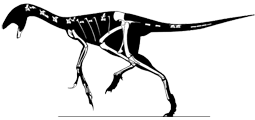
The species epithet, celer, means "swift, quick or rapid" in Latin, as in accelerate (the Latin "velox" means the same thing). The tibia-femur ratio (longer tibia than femur) suggests Microvenator was a swift runner.
Discovery
The remains of Microvenator were discovered in the Cloverly Formation at Billings, Wheatland County, Montana, USA, by Barnum Brown in 1933.
The holotype (AMNH 3041) consists of bits of the skull, a partial hip, some vertebrae and some bones from the arms, legs, hands and feet.


