Pronunciation: moo-SOR-us
Meaning: Mouse Lizard
Author/s: Bonaparte and Vince (1979)
Synonyms: None known
First Discovery: Santa Cruz, Argentina
Acta Ordinal: #281
Mussaurus patagonicus
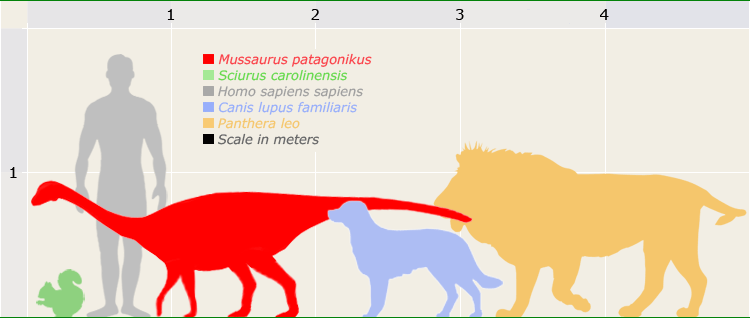
When Jose Bonaparte discovered what he believed to be the first remains of an all new critter during a trip to the Laguna Colorada Formation of Santa Cruz in the 1970s, he promptly named them Mussaurus (rat lizard) because they were small, the largest being less than 40cm long. As it happens, his transliteration was off; "mus" actually means "mouse" in Latin, and they did sport rounded snouts and huge soppy eyes that could be described as mouse-like. But they were just hatchlings, seven in total, discovered in a "nest" along with a couple of eggs, and their features are typical of juveniles who cunningly use their cuteness to guarantee parental care.
By process of elimination, some paleontologists jumped to the conclusion that Mussaurus was merely a baby version of fellow sauropodomorph Plateosaurus, which is well-represented by numerous adult specimens from El Tranquilo, and the fact that they were nothing alike was simply because, well, kids and adults never are. A slight oversight on their part was that fully grown Mussaurus specimens had already been found in this exact area between 1962 and 1968 but, funnily enough, when Rodolfo Casamiquela described them in 1977 he thought they belonged to a new but un-named species of... Plateosaurus.
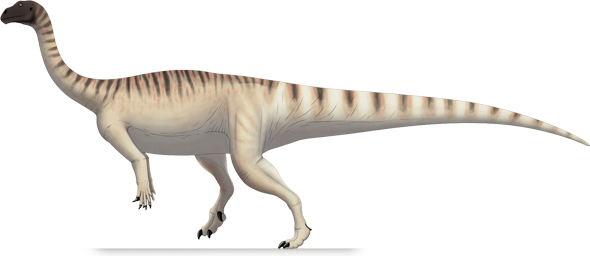
Mussaurus has short and high tail vertebrae which are absent in any currently known sauropodomorph but present in the Mid-Triassic La Rioja thecodont Lagosuchus which has been mooted as a possible ancestor of the Saurischia, and a skull with some characters similar to those found in a Late Jurassic macronarian sauropod known as Camarasaurus. Because they sport different features and their bone count ammounts to less, the troublesome youngsters were chopped from Otero and Pol's latest analysis altogether, but based on information garnered from the grown ups Mussaurus appears to dwell somewhere between the massospondylids and true sauropods on the sauropodomorph branch of the dinosaurian family tree.
By process of elimination, some paleontologists jumped to the conclusion that Mussaurus was merely a baby version of fellow sauropodomorph Plateosaurus, which is well-represented by numerous adult specimens from El Tranquilo, and the fact that they were nothing alike was simply because, well, kids and adults never are. A slight oversight on their part was that fully grown Mussaurus specimens had already been found in this exact area between 1962 and 1968 but, funnily enough, when Rodolfo Casamiquela described them in 1977 he thought they belonged to a new but un-named species of... Plateosaurus.
Mussaurus has short and high tail vertebrae which are absent in any currently known sauropodomorph but present in the Mid-Triassic La Rioja thecodont Lagosuchus which has been mooted as a possible ancestor of the Saurischia, and a skull with some characters similar to those found in a Late Jurassic macronarian sauropod known as Camarasaurus. Because they sport different features and their bone count ammounts to less, the troublesome youngsters were chopped from Otero and Pol's latest analysis altogether, but based on information garnered from the grown ups Mussaurus appears to dwell somewhere between the massospondylids and true sauropods on the sauropodomorph branch of the dinosaurian family tree.
(Mouse lizard from Patagonia)Etymology
Mussaurus is derived from the Latin "mus" (mouse) and the Greek "sauros" (lizard), so named for the tiny size and mouse-like features of the first known specimens. However, adult individuals have since been discovered which renders "mouse lizard" something of a misnomer.
The species epithet,
patagonicus, refers to its discovery in Patagonia.
Discovery
The holotype of Mussaurus (an almost complete juvenile skeleton catalogued as PVL 4068) was discovered during Jose Bonaparte-led Universidad Nacional de Tucumán and Fundación Miguel Lilloby joint expeditions at "Estancia Cañadon Largo" [Cañadon Largo farm] in the Laguna Colorada Formation (El Tranquilo Group) of Santa Cruz Province, Argentina, in the 1970s, along with several other juvenile specimens. However, adult specimens had already been discovered in the same area between 1962 and 1968 by Rodolfo M. Casamiquela who described them in 1980, but he thought they belonged to Plateosaurus, and so did everyone else for the next quarter century. By 2005, the likes of Pol and Powell, and Salgado and Bonaparte, began to suspect that Casamiquela's specimens may actually represent adult Mussaurus, and their suspicions were confirmed with the discovery of yet more adults at the same locality.
Although the Laguna Colorada Formation was long thought to be Late Triassic (Norian) in age, high-precision U-Pb dating of zircon crystals in the sediment by Diego Pol and colleagues in 2021 dragged it into the Early Jurassic (Sinemurian).