







Pronunciation: NAN-oh-tie-RAN-us
Meaning: Dwarf Tyrant
Author/s: Bakker et al. (1988)
Synonyms: See below
First Discovery: Montana, USA
Acta Ordinal: #343
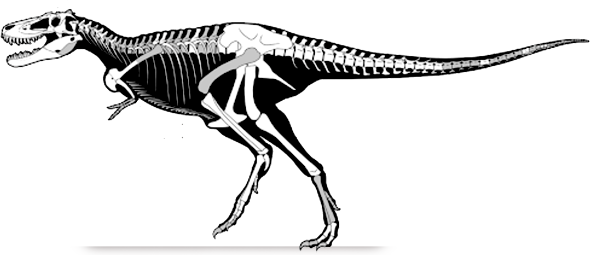
Nanotyrannus lancensis
Initially identified as a species of Gorgosaurus (Gorgosaurus lancensis) by Charles Whitney Gilmore four years after its 1942 discovery, then informally tagged "Clevelanotyrannus" by Phil Currie in 1987, Nanotyrannus was formally christened by Robert Bakker, Michael Williams and Currie in 1988, based only on a skull from Montana's Hell Creek.
"The skull bones are fused", they said, "therefore, it represents an adult specimen". But palaeontologists were split: was this truly a full-grown "pygmy tyrant", or merely a juvenile specimen of the region's most famous carnivore, Tyrannosaurus rex?
In 2001, a more complete specimen dubbed "Jane" entered the fray—and stirred the pot with gusto. Jane had longer legs, a much more slender build and a higher tooth count (60-62 compared to 44-52) than an adult T. rex, and a small, enigmatic pit in the quadratojugal—a bone involved in jaw articulation. But it was her arms that truly defied expectations: her hands were almost as long as the rest of the arm combined, and not just proportionately bigger and longer than those of T. rex—they were actually bigger and longer than the hands of a full-grown T. rex. Microscopic analysis of her thighbone cross-section revealed annual growth rings, like those in trees, showing she was 11 years old at death. Given that T. rex reach adulthood at around 20 years of age, it would take a monumental growth spurt for "Jane" to double her length and pack on another six tons. Yet every noted difference was dismissed as juvenile variation by naysayers, including subtle distinctions in braincase anatomy revealed by CT scans and 3D reconstructions of the name-bearing skull. A consensus regarding the validity of Nanotyrannus remained elusive. Even two of the three original authors were riddled with doubt.
Perhaps the status of Nanotyrannus could have been settled, one way or the other, by a third specimen from Hell Creek. Assumed to have died as her pack attacked the as-yet-unidentified, tooth-peppered ceratopsian corpse that she lay beside, the catchily nicknamed "Bloody Mary" is near somatically mature, shares defining features with the holotype, and is almost complete from nose to tail tip. Unfortunately, it was discovered by private collectors and had been hawked for many years as 50% of "the duelling dinosaurs" to drum up interest for auction, and because it wasn't under the ownership of a Museum, most palaeontologists wouldn't touch it with a bargepole—and couldn't, even if they wanted to. In the meantime, Joshua Schmerge and Bruce Rothschild revisited "Jane" and made a breakthrough when they studied the neovascular dentary groove—a pore-lined channel in the lower jaw—of 92 theropod dinosaurs and found Nanotyrannus to be a valid stand-alone critter, allied with the albertosaurines rather than tyrannosaurines. Predictably, palaeontologists were queuing up to disagree. But something else was simmering in the background.
That something was a legal maelstrom. The "Dueling Dinosaurs"—a fossil tableau frozen in combat, with "Bloody Mary" poised against her horned prey—became the flashpoint of a courtroom saga that threatened to redraw the boundaries of palaeontology itself. Years earlier, the land had changed hands: sold by the Seversons to the Murrays, with the Seversons retaining two-thirds of the rights to any minerals buried beneath. When the fossils were unearthed, the question ignited—were these ancient bones mere remnants of the surface, or mineral treasures of the deep? The dispute surged through lower courts and finally reached the Montana Supreme Court, where the verdict landed like a thunderclap in 2020: fossils are not minerals under state law. The ruling affirmed the Murrays' ownership and sent ripples through the scientific world. Had the decision gone the other way, future fossil finds could have been locked behind mineral deeds and auction blocks. Instead, the path was cleared. For Nanotyrannus, it meant that the most complete specimen yet—perhaps the final arbiter of its identity—was no longer shackled by legal ambiguity. The North Carolina Museum of Natural Sciences stepped forward, and at last, the fossil was claimed not by lawyers or collectors, but by science.
In 2001, a more complete specimen dubbed "Jane" entered the fray—and stirred the pot with gusto. Jane had longer legs, a much more slender build and a higher tooth count (60-62 compared to 44-52) than an adult T. rex, and a small, enigmatic pit in the quadratojugal—a bone involved in jaw articulation. But it was her arms that truly defied expectations: her hands were almost as long as the rest of the arm combined, and not just proportionately bigger and longer than those of T. rex—they were actually bigger and longer than the hands of a full-grown T. rex. Microscopic analysis of her thighbone cross-section revealed annual growth rings, like those in trees, showing she was 11 years old at death. Given that T. rex reach adulthood at around 20 years of age, it would take a monumental growth spurt for "Jane" to double her length and pack on another six tons. Yet every noted difference was dismissed as juvenile variation by naysayers, including subtle distinctions in braincase anatomy revealed by CT scans and 3D reconstructions of the name-bearing skull. A consensus regarding the validity of Nanotyrannus remained elusive. Even two of the three original authors were riddled with doubt.
Perhaps the status of Nanotyrannus could have been settled, one way or the other, by a third specimen from Hell Creek. Assumed to have died as her pack attacked the as-yet-unidentified, tooth-peppered ceratopsian corpse that she lay beside, the catchily nicknamed "Bloody Mary" is near somatically mature, shares defining features with the holotype, and is almost complete from nose to tail tip. Unfortunately, it was discovered by private collectors and had been hawked for many years as 50% of "the duelling dinosaurs" to drum up interest for auction, and because it wasn't under the ownership of a Museum, most palaeontologists wouldn't touch it with a bargepole—and couldn't, even if they wanted to. In the meantime, Joshua Schmerge and Bruce Rothschild revisited "Jane" and made a breakthrough when they studied the neovascular dentary groove—a pore-lined channel in the lower jaw—of 92 theropod dinosaurs and found Nanotyrannus to be a valid stand-alone critter, allied with the albertosaurines rather than tyrannosaurines. Predictably, palaeontologists were queuing up to disagree. But something else was simmering in the background.
That something was a legal maelstrom. The "Dueling Dinosaurs"—a fossil tableau frozen in combat, with "Bloody Mary" poised against her horned prey—became the flashpoint of a courtroom saga that threatened to redraw the boundaries of palaeontology itself. Years earlier, the land had changed hands: sold by the Seversons to the Murrays, with the Seversons retaining two-thirds of the rights to any minerals buried beneath. When the fossils were unearthed, the question ignited—were these ancient bones mere remnants of the surface, or mineral treasures of the deep? The dispute surged through lower courts and finally reached the Montana Supreme Court, where the verdict landed like a thunderclap in 2020: fossils are not minerals under state law. The ruling affirmed the Murrays' ownership and sent ripples through the scientific world. Had the decision gone the other way, future fossil finds could have been locked behind mineral deeds and auction blocks. Instead, the path was cleared. For Nanotyrannus, it meant that the most complete specimen yet—perhaps the final arbiter of its identity—was no longer shackled by legal ambiguity. The North Carolina Museum of Natural Sciences stepped forward, and at last, the fossil was claimed not by lawyers or collectors, but by science.
(Dwarf Tyrant from the Lance)Etymology
Nanotyrannus is derived from the Greek "nanos" (dwarf) and "tyrannos" (tyrant) alluding to its small adult size. The species epithet, lancensis, is derived from "Lance" (referring to its discovery in the upper Lance formation which is now known as the Hell Creek Formation) and the Latin "-ensis" (from).
Discovery
The first known remains of Nanotyrannus were discovered in 1942 by Dr. David Hosbrook Dunkle, then curator at the Cleveland Museum of Natural History, near Sand Creek in Carter County, Montana, within what is now recognized as the Hell Creek Formation.
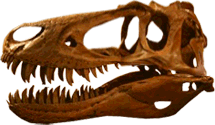
The holotype (CMNH 7541, currently housed at the Cleveland Museum of Natural History) is a skull which was initially described by Charles W. Gilmore in 1946 as Gorgosaurus lancensis, but was later renamed Nanotyrannus by Robert Bakker, Phil Currie, and Michael Williams in 1988.
"Jane" (BMRP 2002.4.1), a remarkably complete juvenile tyrannosaur skeleton, was discovered in 2001 by field crew members Carol Tuck and Bill Harrison during a Burpee Museum expedition to the Hell Creek Formation in southeastern Montana. Although the specimen’s sex remains unknown, it was affectionately nicknamed "Jane" in honour of museum benefactor Jane Solem. With over 50% of the skeleton preserved, including a nearly complete skull, "Jane" has been central to the debate over whether Nanotyrannus represents a distinct genus or a juvenile Tyrannosaurus rex. This specimen was assigned to Nanotyrannus as a second species—Nanotyrannus lethaeus—in 2025.
The "Dueling Dinosaurs" fossil block, which includes Nanotyrannus (NCSM 40000) and a Triceratops horridus? (NCSM 40001) preserved in apparent combat, was discovered in 2006 by commercial fossil hunters Clayton Phipps, Chad O’Connor, and Mark Eatman. The discovery occurred on private land in Garfield County, Montana, also within the Hell Creek Formation. The specimen remained in private hands for over a decade due to legal disputes before being acquired by the North Carolina Museum of Natural Sciences in 2020.
Preparators
L. Herzog, E. Lund, J. Anné, A. Knowles, C. Simon, M. Mers and E. Mulready (NCSM 40000).


