
ORNITHOMIMUS
a plant-eating ornithomimid theropod dinosaur from the Late Cretaceous of North America.

Pronunciation: or-NITH-o-MY-mus
Meaning: Bird mimic
Author/s: Marsh (
1890)
Synonyms: Dromiceiomimus? (Russell, 1972)
First Discovery: Denver, Colorado, USA
Acta Ordinal: #74
Ornithomimus velox
When Othniel Charles Marsh named Ornithomimus velox in 1890, he did so from a handful of limb bones—a three-toed foot and several manual elements—collected the previous year from the late-Maastrichtian Denver Formation of Colorado. Fragmentary though they were, these remains inspired the name "swift bird-mimic" and led Marsh to describe the foot as that of a "typical ornithopod", noting its close correspondence to the foot of a young ostrich. In the same paper, Marsh also named two other species—Ornithomimus tenuis and Ornithomimus grandis—and erected the family Ornithomimidae, recognising these forms as a distinct group from the outset—even if he hadn't yet realised their true affinities.
Only after John Bell Hatcher uncovered a far more complete skeleton from the Lance Formation of Wyoming—named Ornithomimus sedens by Marsh in 1892—did he realise that Ornithomimus was not an ornithopod at all but a theropod, based mainly on the general characteristics of its pelvis, "observed hitherto among dinosaurs, only in the genus Ceratosaurus".
Because the Ornithomimus holotype is so limited, its anatomy is inferred from better-preserved relatives. These comparisons reveal an animal far more bird-like than Marsh imagined: long arms with elongate metacarpals and fingers; hollow bones; and a head with large eyes, a relatively enlarged brain, and toothless jaws tipped with a keratinous beak. The overall silhouette—long-legged, long-armed, lightly built—was unmistakably ostrich-like, echoing Marsh’s original comparison with striking fidelity. Exquisitely preserved specimens of related ornithomimids show complex, vaned feathers on the arms and tail, plumage that likely characterised the entire family, even if it's not preserved in the fossils of every specimen.
(Speedy Bird Mimic)Etymology
Ornithomimus is derived from from the Greek "Ornith" (bird) and "mimos" (mimic), in reference to its bird-like feet. But it isn't the same bird mimic as
Avimimus.
The
species epithet,
velox, means "speedy" in Latin.
Zoobank registry:
urn:lsid:zoobank.org:act:92CAA3E6-6985-4C1D-99A8-7E7EC5827D24.
Discovery
The first confirmed
Ornithomimus velox remains were discovered at Beaver Creek Valley in the Denver Formation, Jefferson County, Colorado, by George Lyman Cannon on June 30, 1889.
The
holotype (Syntypes: YPM 542 and YPM 548) is a partial lower hind limb and foot, and a partial forelimb.
Preparators
M. Fox prepared YPM 542 and 548 out of the matrix more than a century after Marsh's original description.
Estimations
Timeline:
Era: Mesozoic
Epoch: Late Cretaceous
Stage: Campanian-Maastrichtian
Age range: 80-66 mya
Stats:
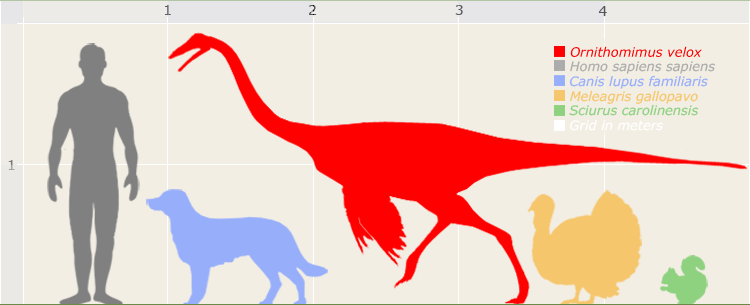
Est. max. length: 4 meters
Est. max. hip height: 1.2 meters
Est. max. weight: 180 Kg
Diet: Omnivore
Ornithomimus edmontonicus
Ornithomimus edmontonicus was named by Lawrence Lambe in 1917 based on CMN 8632, a partial skeleton from the Horseshoe Canyon Formation of Alberta, and became the best-known species of the genus thanks to numerous, far more complete specimens discovered throughout the early 20th century. These include beautifully preserved skeletons from the same formation that later revealed quill knobs and feather impressions, making
Ornithomimus edmontonicus the first feathered dinosaur identified in the Western Hemisphere. For decades it served as the anatomical template for
Ornithomimus as a whole, though its taxonomic history is tangled: several species once placed in
Struthiomimus or
Dromiceiomimus—including
Ornithomimus brevitertius,
Ornithomimus samueli,
Ornithomimus ingens, and
Ornithomimus currellii—were ultimately folded into
Ornithomimus edmontonicus by a combination of Dale Russell in 1972 and Peter Makovicky and colleagues in 2004. Today it stands, alongside
Ornithomimus velox, as one of only two widely accepted species of
Ornithomimus.
Dubious and re-assigned species
Over the decades,
Ornithomimus ballooned into a taxonomic catch-all before being pared back again, with many species later reassigned or synonymised as anatomical understanding improved.
Ornithomimus tenuis
Ornithomimus tenuis is based on USNM 5814, fragmentary fossils found by John Bell Hatcher in 1888 near "Cow Island" in the Judith River Formation of Blaine County, Montana, which seem to belong to a tyrannosauroid of some ilk.
Ornithomimus grandis
Ornithomimus grandis was named by O.C. Marsh in 1890 based on a foot bone, now lost, that John Bell Hatcher discovered at "Cow Creek" in the Eagle Sandstone Formation of Fergus County, Montana, in 1888.
Ornithomimus grandis was synonymised with the dubious
Deinodon horridus by Matthew and Brown in 1922, but it may actually be the very first specimen of a certain critter we now know as
Tyrannosaurus rex.
Ornithomimus sedens
O. C. Marsh was convinced that
Ornithomimus was a "typical Ornithopoda" until USNM 4736—a partial skeleton that J. B. Hatcher and A. L. Sullins found in the Lance Formation of Niobrara County, Wyoming, in 1891—showed this not to be the case. Marsh named these remains
Ornithomimus sedens a year later, and declared
Ornithomimus in general to belong to Theropoda, though USNM 4736 was not figured, or that number actually published, until Charles Whitney Gilmore's 1920 re-description, and it's been bounced between
Ornithomimus (
Ornithomimus sedens) and
Struthiomimus (
Struthiomimus sedens) for over a century since.
Ornithomimus minutus
Ornithomimus minutus was named in tandem with
Ornithimimus sedens, based on YPM 1049, a foot bone (metatarsus)
found by O. A. Peterson in the Lance Formation of Niobrara County, Wyoming. It spent a while as
Dromaeosaurus minutus (?) but seems to belong to an alvarezsaurid, possibly
Mononykus.
Ornithomimus altus
Ornithomimus altus was named in 1902 by Lawrence Lambe, based on CMN 930, hindlimbs found in 1901 in the Oldman Formation of Alberta by Hatcher and Brown. It was a better specimen of this critter, discovered by Barnum Brown in 1914 at the same site, that prompted Henry Fairfield Osborn to move
Ornithomimus altus to a new subgenus
Struthiomimus (Ornithomimus) in 1916. Dale Russell made
Struthiomimus a standalone genus in 1972. Some of the remains that Russell assigned here (ROM 1790; a partial skull, a nearly complete pelvis, both hind limbs, foot bones, and part of a tail) were renamed
Rativates evadens by McFeeters
et al. in 2016.
Ornithomimus affinis
Ornithomimus affinis was plucked from a bunch of unassociated foot bones (USNM 5453, 5652, 5684, 5703, 5704, 6107, 6108, 8456) that John Bell Hatcher and Arthur Bibbins had discovered at several sites across the Arundel Formation of Maryland in 1888. These remains were used by Marsh to establish
Allosaurus medius in 1888. However, most of them were referred to
Dryosaurus grandis by Richard Swann Lull in 1911. In 1920, Gilmore realised the remains of
Dryosaurus grandis belonged to an ornithomimosaur, but, as an
Ornithomimus grandis had already been named by O.C. Marsh based on a foot bone from the Eagle Sandstone Formation, he settled on
Ornithomimus affinis instead. In 1972, Dale Russell assigned this material to
Archaeornithomimus as
Archaeornithomimus affinis.
Ornithomimus brevitertius
In 1930, Loris Russell renamed
Struthiomimus brevetertius (Parks 1926) into
Ornithomimus brevitertius.
Dale Russell assigned this material to
Dromiceiomimus (emu mimic) as
Dromiceiomimus brevitertius in 1972. But Peter Makovicky brushed it off as a junior synonym of
Ornithomimus edmontonicus in 2004.
Ornithomimus samueli
In 1930, Loris Russell renamed
Struthiomimus samueli (Parks 1928), which was based on ROM 840, a partial skeleton from RTMP Quarry 20 in the Dinosaur Park Formation, Steveville, Canada, into
Ornithomimus samueli. Dale Russell assigned this material to
Dromiceiomimus as Dromiceiomimus samueli in 1972. But Peter Makovicky brushed it off as a junior synonym of
Ornithomimus edmontonicus in 2004.
Ornithomimus mirandus
In 1920, Oliver Perry Hay renamed
Aublysodon mirandus (Leidy 1868) into
Ornithomimus mirandus even though Lawrence Lambe had already assigned its remains to
Struthiomimus in 1902. Because Othniel Charles Marsh had nominated a single tooth (ANSP 9535, collected by Ferdinand Vandeveer Hayden from the Judith River Badlands of Montana in 1854) as the
Aublysodon name-bearing specimen in 1892 and ornithomimids are toothless, it's safe to say that
Ornithomimus mirandus is a dubious name. So is
Aublysodon!
Ornithomimus elegans
In 1933, William Arthur Parks created
Ornithomimus elegans based on ROM 781, a foot from Alberta. In 1989, Phil Currie moved this foot, along with CMN 2690, a small lower jaw that Joël Cracraft had named
Caenagnathus sternbergi in 1971,
to
Elmisaurus elegans. Hans-Dieter Sues moved them both to
Chirostenotes elegans in 1997, which was highly contentious at the time. Nicholas Longrich renamed it
Leptorhynchos elegans in 2013.
Ornithomimus asiaticus
In 1933, Gilmore named
Ornithomimus asiaticus for material found in the Iren Dabasu Formation of Inner Mongolia by Roy Chapman Andrews in 1923.
In 1972, Dale Russell used this material to raise a new dinosaur,
Archaeornithomimus asiaticus.
AMNH 6565, a foot, is the lectotype.
Ornithomimus lonzeensis
Ornithomimus lonzeensis was initially named
Megalosaurus lonzeensis (Dollo, 1903) based on a single finger claw from Lonzee in Belgium that was first mentioned back in 1883. After a stint as "Ornithomimodorum gen. a" (von Huene, 1926), Oscar Kuhn assigned it to
Ornithomimus in 1962. Glut referred it to
Struthiomimus lonzeensis in 1997, but today, it's believed to be an abelisauroid.
Ornithomimus currellii
Ornithomimus currellii, based on ROM 851, a skeleton from the Horseshoe Canyon Formation of Munson Ferry, Canada, was originally known as
Struthiomimus currellii (Parks 1933). It was renamed in 1967 by Dale Rusell, who lumped it into
Ornithomimus edmontonicus
in 1972.
Ornithomimus ingens
Ornithomimus ingens—based on ROM 852, found 1.5 miles below Munson Ferry, Canada—was originally known as
Struthiomimus ingens (Parks 1933) until Dale Russel renamed it in 1967. Russel assigned it to
Dromiceiomimus (emu mimic) as
Dromiceiomimus brevitertius in 1972. But Peter Makovicky brushed it off as a junior synonym of
Ornithomimus edmontonicus in 2004.
Ornithomimus bullatus was originally known as
Gallimimus bullatus. It was moved to
Ornithomimus by Gregory S. Paul in 1988, but this found no support whatsoever. Even Paul himself doesn't use this name!
Ornithomimus antiquus
The consensus of many is that the first dinosaur
that would become
Ornithomimus was named
Coelosaurus antiquus (Antique Hollow Lizard), based on two shins from the Navesink Formation of New Jersey, by Joseph Leidy in 1865. Its remains were assigned to
Ornithomimus as
Ornithomimus antiquus by Horner and Baird in 1979, which, under normal circumstances, would have made
Ornithomimus a junior synonym of
Coelosaurus because the latter was named 25 years earlier. However, it transpired that the name
Coelosaurus had already been assigned to a single vertebra by Richard Owen in 1854. Furthermore, there's a growing theory that
Ornithomimus antiquus may not even be an ornithomimid.
References
• Marsh OC (1890) "
Description of new dinosaurian reptiles".
The American Journal of Science, s3(39): 81-86. (
Ornithomimus velox,
Ornithomimus tenuis,
Ornithomimus grandis.)
• Marsh OC (1892) "
Notice of new reptiles from the Laramie Formation".
American Journal of Science, 43: 449-453. (
Ornithomimus sedens,
Ornithomimus minutus.)
• Lambe L (1902) "New genera and species from the Belly River Series (mid-Cretaceous)".
Geological Survey of Canada, Contributions to Canadian Palaeontology, 3(2): 25-81. (
Ornithomimus altus.)
• Dollo L (1903) "Les dinosauriens de la Belgique".
Comptes Rendus de l’Académie des Sciences de Paris, 136: 565-567.
• Osborn HF (1917) "Skeletal adaptations of
Ornitholestes,
Struthiomimus,
Tyrannosaurus".
Bulletin of the American Museum of Natural History, v. 35, article 43.
• Gilmore CW (1920) "Osteology of the carnivorous Dinosauria in the United States National Museum with special reference to the genera Antrodemus (Allosaurus) and Ceratosaurus".
United States National Museum Bulletin, 110: l-154. (
Ornithomimus affinis.)
• Von Huene F (1926) "The carnivorous Saurischia in the Jura and Cretaceous formations, principally in Europe".
Revista del Museo de La Plata, 29: 35-167. ("Ornithomimidorum gen. a. / gen. b.")
• Russell LS (1930) "Upper Cretaceous dinosaur faunas of North America".
Proceedings of the American Philosophical Society, 69(4): 133-159. (
Ornithomimus brevitertius,
Ornithomimus samueli.)
• Hay OP (1930) "Second Bibliography and Catalogue of the Fossil Vertebrata of North America".
Carnegie Institution of Washington. 390(II): 1-1074. (
Ornithomimus mirandus.)
• Parks WA (1933) "New species of dinosaurs and turtles from the Upper Cretaceous formations of Alberta".
University of Toronto Studies, Geological Series, 34: 1-33. (
Ornithomimus elegans.)
• Gilmore CW (1933) "On the dinosaurian fauna of the Iren Dabasu Formation".
Bulletin of the American Museum of Natural History, 67: 23-78. (
Ornithomimus asiaticus.)
• Sternberg CM (1933) "A new Ornithomimus with complete abdominal cuirass".
The Canadian Field-Naturalist, 47(5): 79-83. (
Ornithomimus edmontonicus.)
• Kuhn O (1965) "Saurischia (Supplementum 1)". In: Fossilium Catalogus 1. Animalia. 109: 1-94. (
Ornithomimus lonzeensis.)
• Baird D and Horner JR (1979) "
Cretaceous dinosaurs of North Carolina".
Brimleyana, 2: 1-28.
• Glut D (1997) "
Dinosaurs: The Encyclopedia".
• Farlow JO (2001) "
Acrocanthosaurus and the maker of Comanchean large-theropod footprints". Page 408-427 in Tanke, Carpenter, Skrepnick and Currie (eds.) "
Mesozoic Vertebrate Life: New Research Inspired by the Paleontology of Philip J. Currie."
• Makovicky PJ, Kobayashi Y and Currie PJ (2004) "Ornithomimosauria". In Weishampel, Dodson and Osmólska (eds.) "
The Dinosauria: Second Edition".
• Weishampel DB (2004) "
Another Look at the Dinosaurs of the East Coast of North America".
Colectivo Arqueológico-Paleontológico Salense (ed.): Actas de las III Jornados sobre Dinosaurios y su Entorno. 129-168. Salas de los Infantes, Burgos, España.
• Barrett PM (2005) "The diet of ostrich dinosaurs (Theropoda: Ornithomimosauria)".
Palaeontology, 48(2): 347-358. DOI: 10.1111/j.1475-4983.2005.00448.x.
• Zelenitsky DK, Therrien F, Erickson GM, DeBuhr CL, Kobayashi Y, Eberth DA and Hadfield F (2012) "Feathered Non-Avian Dinosaurs from North America Provide Insight into
Wing Origins".
Science, 338(6106): 510–514. DOI: 10.1126/science.1225376.
• Van der Reest AJ, Wolfe AP and Currie PJ (2015) "A densely feathered ornithomimid (Dinosauria: Theropoda) from the Upper Cretaceous Dinosaur Park Formation, Alberta".
Cretaceous Research, 58: 108-117. DOI: 10.1016/j.cretres.2015.10.004.
• Claessens LPAM and Loewen MA (2016) "A redescription of
Ornithomimus velox Marsh, 1890 (Dinosauria, Theropoda)".
Journal of Vertebrate Paleontology, 36(1). DOI: 10.1080/02724634.2015.1034593.
Time stands still for no man, and research is ongoing. If you spot an error, or want to expand, edit or add a dinosaur, please use
this form. Go
here to contribute to our FAQ.
All dinos are GM free, and no herbivores were eaten during site construction!
To cite this page:
Atkinson, L.
"
ORNITHOMIMUS :: from DinoChecker's dinosaur archive".
‹
http://www.dinochecker.com/dinosaurs/ORNITHOMIMUS›. Web access: 25th Oct 2026.









