
PARASAUROLOPHUS
a plant-eating lambeosaurine dinosaur from the Late Cretaceous of Canada.
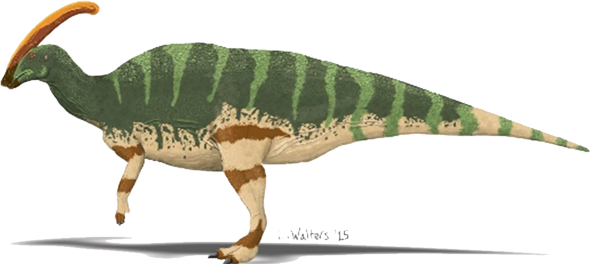
Pronunciation: pah-ra-SOR-oh-LO-fus
Meaning: Near crested lizard
Author/s: Parks (
1922)
Synonyms: None known
First Discovery: Alberta, Canada
Acta Ordinal: #132
Parasaurolophus walkeri
Etymology
Parasaurolophus is derived from the Greek "para" (near), "sauros" (lizard) and "lophos" (crest) because of its once-thought affinity with
Saurolophus due to their superficially similar crests. They aren't as closely related as Parks—the coining author—initially thought.
The
species epithet,
walkeri, honors Sir Byron Edmund Walker, founder of the Royal Ontario Museum and first chairman of the board of trustees.
ZooBank registry:
urn:lsid:zoobank.org:act:A287F206-E5B2-48D1-B5EF-86B25B48FA97.
Discovery
The first fossils of
Parasaurolophus were discovered near Sand Creek along the Red Deer River in the Dinosaur Park Formation, Judith River Group, Alberta, Canada, by Mr. L. W. Dippell during a University of Toronto expedition in 1920.
The
holotype (ROM 768, housed at the Royal Ontario Museum) consists of a skull and skeleton, lacking most of the tail and the hind legs from the knee down.
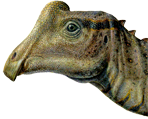
A juvenile specimen (RAM 14000), discovered by Kevin Terris at Grand Staircase-Escalante National Monument, southern Utah, in 2009, is the smallest and most complete specimen yet described. Affectionately known as "Joe", this individual was just 2.5 m in body length (25% of the adult body length) at death, with a skull measuring 246 mm long and a femur 329 mm long.
Estimations
Timeline:
Era: Mesozoic
Epoch: Late Cretaceous
Stage: Campanian
Age range: 80-73 mya
Stats:
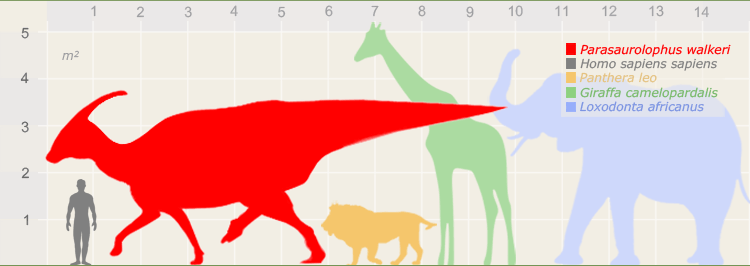
Est. max. length: 10 meters
Est. max. hip height: 3.5 meters
Est. max. weight: 2.5 tons
Diet: Herbivore
Other species
Parasaurolophus tubicen (Wiman, 1931)
Collected by Charles H. Sternberg in 1921 in what was thought to be the Naashoibito Member of the Ojo Alamo Formation but which turned out to be the De-na-zin Member of the Kirtland Formation,
Parasaurolophus tubicen was the first lambeosaurine to be named and described from the San Juan Basin of New Mexico, but it didn't cause much of a stir. Its holotype skull (PMU 24921, formerly R1250) was sent to Sweden's Museum of Evolution at Uppsala University where it was eventually named and described by their professor of paleontology Carl Wiman in 1931. Since then, a second skull (NMMNH P-25100), a partial skeleton (SMP VP-1344), a juvenile humerus and a hatchling, which are all from the De-na-zin, have been assigned to
Parasaurolophus tubicen, mainly because it's the only lambeosaurine known from this stratigraphic unit. It differs from
Parasaurolophus walkeri in being from younger strata and having a spectacularly complex network of tubes within its long head crest.
Parasaurolophus cyrtocristatus (Ostrom, 1961)
Parasaurolophus cyrtocristatus is based on a partial skull and skeleton (FMNH P27393) that C. H. Sternberg found in the Hunter Wash Member at Coal Creek in the lower part of the Kirtland Formation in 1923, but it had to wait 28 years before John Ostrom named and described it in 1961. Two more specimens were discovered in the Kaiparowits Formation of Utah, by Jim Jensen in 1971 and J. Howard Hutchison in 1995, which made
Parasaurolophus cyrtocristatus the oldest species of
Parasaurolophus. It was long thought that it was not as closely related to
Parasaurolophus walkeri as is
Parasaurolophus tubicen because it had a shorter head crest, but a spectacularly-preserved skull from the same site as the holotype, which was discovered in 2017 by Smithsonian Ecology Fellow Erin Spear, Ph.D., while exploring the badlands of northwestern New Mexico as part of a Denver Museum of Nature and Science team, showed that
P. cyrtocristatus and
P. tubicen are more closely related to each other than either are to
P. walkeri.
References
• Parks WA (1922) "
Parasaurolophus walkeri, a new genus and species of crested trachodont dinosaur".
University of Toronto Studies. Geological Series no. 13: 5-32.
• Wiman C (1931) "
Parasaurolophus tubicen, n. sp. aus der Kreide in New Mexico".
Nova Acta Regia Societas Scientarum Upsaliensis, series 4 (in German). 7(5): 1-11.
• Ostrom JH (1961) "A New Species of Hadrosaurian Dinosaur from the Cretaceous of New Mexico".
Journal of Paleontology, 35(3): 575-577.
• Sullivan RM and Williamson TE (1996) "A new skull of
Parasaurolophus (long-crested form) from New Mexico: external and internal (CT scans) features and their functional implications".
Journal of Vertebrate Paleontology, 16: 68A (Abstract).
• Sandia National Laboratories (1997-12-05) "Scientists Use Digital Paleontology to Produce Voice of
Parasaurolophus Dinosaur".
Sandia National Laboratories and New Mexico MNHS collaboration.
• Sullivan RM and Williamson TE (1999) "
A new skull of Parasaurolophus (Dinosauria: Hadrosauridae) from the Kirtland Formation of New Mexico and a revision of the genus".
New Mexico Museum of Natural History and Science, Bulletin 15.
• Williamson TE (2000) "
Review of Hadrosauridae (Dinosauria, Ornithischia) from the San Juan Basin, New Mexico".
In Lucas and Heckert (eds.) "Dinosaurs of New Mexico". New Mexico Museum of Natural History and Science, Bulletin 17: 191-213.
• Horner JR, Weishampel DB and Forster CA (2004) "Hadrosauridae". In Weishampel, Dodson and Osmólska (eds.) "
The Dinosauria: Second Edition".
University of California Press.
• Farke AA, Chok DJ, Herrero A, Scolieri B, Werning S (2013) "
Ontogeny in the tube-crested dinosaur Parasaurolophus (Hadrosauridae) and heterochrony in hadrosaurids".
PeerJ 1: e182.
• Lucas SG and Sullivan RM (2015) "Cretaceous Vertebrates of New Mexico".
New Mexico Museum of Natural History and Science, Bulletin 68.
• Senter P and Robins JH (December 16, 2015) "Resting Orientations of Dinosaur Scapulae and Forelimbs: A Numerical Analysis, with Implications for Reconstructions and Museum Mounts".
PLoS ONE, 10(12): e0144036.
DOI: 10.1371/journal.pone.0144036.
• Prieto-Márquez A, Dalla Vecchia FM, Gaete R, and Galobart À (2013) "
Diversity, Relationships, and Biogeography of the Lambeosaurine Dinosaurs from the European Archipelago, with Description of the New Aralosaurin Canardia garonnensis".
PLoS ONE 8(7): e69835. [defines Parasaurolophini.]
• Gates TA, Evans DC, Sertich JJW (2021) "Description and rediagnosis of the crested hadrosaurid (Ornithopoda) dinosaur
Parasaurolophus cyrtocristatus on the basis of new cranial remains".
PeerJ 9:e10669. DOI: 10.7717/peerj.10669
Time stands still for no man, and research is ongoing. If you spot an error, or want to expand, edit or add a dinosaur, please use
this form. Go
here to contribute to our FAQ.
All dinos are GM free, and no herbivores were eaten during site construction!
To cite this page:
Atkinson, L.
"
PARASAUROLOPHUS :: from DinoChecker's dinosaur archive".
‹
http://www.dinochecker.com/dinosaurs/PARASAUROLOPHUS›. Web access: 21st Oct 2026.









