









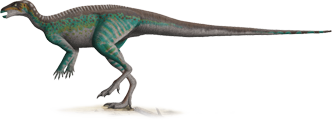
Pronunciation: PAHRK-so-SOR-us
Meaning: Parks' lizard
Author/s: C. M. Sternberg (1937)
Synonyms: Thescelosaurus warreni
First Discovery: Alberta, Canada
Acta Ordinal: #181
Parksosaurus warreni
Parksosaurus is a basal ornithopod—specifically one of the small, primitive, two-legged, herbivorous ornithopods known as "hypsilophodonts"—and hails from Alberta's Edmonton Formation. However, it hasn't always been known by its current name, "Hypsilophodontidae" has been disbanded due to a lack of members, and the Edmonton is now the Horseshoe Canyon Formation. Science just won't stand still!
The remains that would become Parksosaurus were discovered in 1922, and they weren't in good shape. The critter they belonged to had died on its left side, most of the right side had been destroyed before burial, the head had been separated from its body and was missing the beak, and the neck and hands were completely lost. Still, there was enough left to catch the eye of William Parks, who assigned it to Thescelosaurus in 1926 based on a similar overall shape and size, but to a second species—Thescelosaurus warreni—based on a shorter thigh-to-shin ratio and longer toes.
Upon revisiting Thescelosaurus whilst coining a new species—Thescelosaurus edmontonensis, which is now thought to be a more robust, possibly different sex version of Thescelosaurus neglectus—Charles Sternberg noticed enough unique features in Parks' specimen to justify a name change. He coined Parksosaurus in an abstract in 1937, followed by a more thorough comparison to Thescelosaurus three years later. Then it was ignored until 1973 when it featured in Peter Galton's revision of "hypsilophodonts", after which it promptly returned to obscurity.
Despite being one of the few non-hadrosaurid ornithopods known from the end-Cretaceous of North America, Parksosaurus didn't get another sniff of the limelight until 1992 when George Olshevsky amended its epithet from warreni to warrenae (see etymology), and even this utterly important event hardly raised an eyebrow. The problem is, Parksosaurus just isn't "trending" and never has been because it doesn't eat meat or have feathers or horns, or any other weird and wonderful appendage that we know of. It's a bit like tofu: you can make a meal of it if you have to, but at the end of the day, it's still bean curd and more exciting dishes require less effort.
The remains that would become Parksosaurus were discovered in 1922, and they weren't in good shape. The critter they belonged to had died on its left side, most of the right side had been destroyed before burial, the head had been separated from its body and was missing the beak, and the neck and hands were completely lost. Still, there was enough left to catch the eye of William Parks, who assigned it to Thescelosaurus in 1926 based on a similar overall shape and size, but to a second species—Thescelosaurus warreni—based on a shorter thigh-to-shin ratio and longer toes.
Upon revisiting Thescelosaurus whilst coining a new species—Thescelosaurus edmontonensis, which is now thought to be a more robust, possibly different sex version of Thescelosaurus neglectus—Charles Sternberg noticed enough unique features in Parks' specimen to justify a name change. He coined Parksosaurus in an abstract in 1937, followed by a more thorough comparison to Thescelosaurus three years later. Then it was ignored until 1973 when it featured in Peter Galton's revision of "hypsilophodonts", after which it promptly returned to obscurity.
Despite being one of the few non-hadrosaurid ornithopods known from the end-Cretaceous of North America, Parksosaurus didn't get another sniff of the limelight until 1992 when George Olshevsky amended its epithet from warreni to warrenae (see etymology), and even this utterly important event hardly raised an eyebrow. The problem is, Parksosaurus just isn't "trending" and never has been because it doesn't eat meat or have feathers or horns, or any other weird and wonderful appendage that we know of. It's a bit like tofu: you can make a meal of it if you have to, but at the end of the day, it's still bean curd and more exciting dishes require less effort.
Discovery
The remains of Parksosaurus were discovered in the Horseshoe Canyon Formation (then known as the Edmonton Formation) near Rumsey Ferry on the Red Deer River of Alberta, Canada, in 1922.
The holotype (ROM 804) includes most of the left pectoral girdle, the left arm minus the hand, a few ribs, a damaged left pelvis and part of the right, the left leg with a few toes, vertebrae from the back, hip, and tail, and a number of tail-sheathing ossified tendons.


