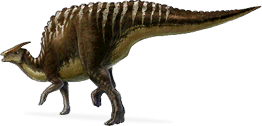
SAUROLOPHUS
a plant-eating saurolophine hadrosaurid dinosaur from the Late Cretaceous of Canada.
Pronunciation: sor-OL-o-fuss
Meaning: Crested lizard
Author/s: Barnum Brown (
1912)
Synonyms: None known
First Discovery: Alberta, Canada
Acta Ordinal: #105
Saurolophus osborni
(Osborn's Crested Lizard)Etymology
Saurolophus is derived from the Greek "sauros" (lizard) and "lophos" (crested).
The
species epithet,
osborni, honours Henry Fairfield Osborn.
Discovery
The first remains of
Saurolophus were discovered by Barnum Brown and Peter Kaisen in the Horseshoe Canyon Formation (previously known as the Edmonton Formation), Edmonton Group, near Tolman Ferry, Red Deer River, Alberta, Canada, in 1911. The
holotype (AMNH 5220) is a nearly complete skeleton, and a skull, 100cm long.
Estimations
Timeline:
Era: Mesozoic
Epoch: Late Cretaceous
Stage: Campanian-Maastrichtian
Age range: 73-66 mya
Stats:
Est. max. length: 12 meters
Est. max. hip height: 4 meters
Est. max. weight: 5 tons
Diet: Herbivore
Other Species
Saurolophus angustirostris (PIN 551/8) was discovered during 1946-49 I. A. Efremov-led Polish-Mongolian expeditions to Mongolia's Gobi Desert (Nemegt Formation) and named by Anatoly Rozhdestvensky in 1952. It is the best represented species of
Saurolophus, being known from at least 15 specimens of infants to adults, some with skin impressions, from a single bone bed that became known as “the Dragon's Tombâ€. Its skull is around 20% longer than that of
Saurolophus osborni and has a more up-turned tip of the snout. Remains now known as
Barsboldia were once assigned here.
Saurolophus kryschtofovici (Riabinin, 1930) is based on a fragmentary hip bone which was discovered in the Village of Jiayin, Tsagayan Group, Tsagayanskaya Svita, Heilongjiang, China. Most paleontologists consider it to be a junior synonym of
Saurolophus angustirostris though, funnily enough, it was named first.
Saurolophus morrisi is known from
holotype "LACM/CIT 2852", a partial skeleton and skull from the Moreno Formation in the Panoche-Tumey Hills of Fresno County, California, and referred specimen LACM/CIT 2760, a partial skeleton from the Moreno Formation in San Benito County, California, which were excavated by Chester Stock in 1939 and 1940. William J. Morris referred them to
Saurolophus sp. in 1973. However, in 2010 Bell and Evans argued that the holotype skull was no different to that of
Edmontosaurus.
In 2013, Prieto-Márquez and Wagner went to great lengths to prove that Morris was right in the first place and named
Saurolophus morrisi in his honor. Then they renamed it
Augustynolophus in 2014!
Baby Saurolophus
In 2015, Leonard Dewaele
et al. described perinatal specimens of
Saurolophus angustirostris, associated with eggshell fragments, likely from a riverbank nest that was carried away by flood water during the wet summer season. The skull length of these babies is around 5% that of adult
S. angustirostris specimens, making them the earliest known development stage of this giant hadrosaur.
References
• Brown B (1912) "
A crested dinosaur from the Edmonton Cretaceous".
Bulletin of the the American Museum of Natural History, 31(14): 131-136.
• Brown B (1913) "The skeleton of
Saurolophus, a crested duck-billed dinosaur from the Edmonton Cretaceous".
Bulletin of the American Museum of Natural History, 32(19): 387-393.
• Riabinin AN (1930) "On the age and fauna of the dinosaur beds on the Amur River".
Mémoir, Société Mineral Russia, 59: 41–51. [Names Saurolophus kryschtofovici.]
• Lull RS and Wright NE (1942) "Hadrosaurian Dinosaurs of North America".
Geological Society of America Special Paper, 40: 1-242.
• Maryanska T and Osmólska H (1981) "Cranial anatomy of
Saurolophus angustirostris with comments on the Asian Hadrosauridae (Dinosauria)".
Palaeontologia Polonica, 42: 5-24.
• Glut DF (1997) "
Dinosaurs: The Encyclopedia".
• Horner JR, Weishampel DB and Forster CA (2004) "Hadrosauridae". Page 438–463 in Weishampel, Dodson and Osmólska (eds.) "
The Dinosauria: Second Edition".
• Prieto-Márquez A and Wagner JR (2011) "
Saurolophus morrisi, a new species of hadrosaurid dinosaur from the Late Cretaceous of the Pacific coast of North America".
Acta Palaeontologica Polonica, 58(2): 255-268. DOI: 10.4202/app.2011.0049.
• Bell PR (2011) "
Cranial Osteology and Ontogeny of Saurolophus angustirostris from the Late Cretaceous of Mongolia with Comments on Saurolophus osborni from Canada".
Acta Palaeontologica Polonica, 56: 703-722. DOI: 10.4202/app.2010.0061.
• Bell PR (2012) "
Standardized Terminology and Potential Taxonomic Utility for Hadrosaurid Skin Impressions: A Case Study for Saurolophus from Canada and Mongolia".
PLoS ONE, 7(2): e31295. DOI: 10.1371/journal.pone.0031295.
• Prieto-Marquez A, Wagner JR, Bell PR, Chiappe LM (2014) "The late-surviving 'duck-billed' dinosaur
Augustynolophus from the upper Maastrichtian of western North America and crest evolution in Saurolophini".
Geological Magazine, 152(02). DOI: 10.1017/S0016756814000284.
• Dewaele L, Tsogtbaata K, Barsbold R, Garcia G, Stein K, Escuillié F and Godefroit P (2015) "
Perinatal Specimens of Saurolophus angustirostris (Dinosauria: Hadrosauridae), from the Upper Cretaceous of Mongolia".
PLoS ONE, 10(10): e0138806. DOI: 10.1371/journal.pone.0138806.
Time stands still for no man, and research is ongoing. If you spot an error, or want to expand, edit or add a dinosaur, please use
this form. Go
here to contribute to our FAQ.
All dinos are GM free, and no herbivores were eaten during site construction!
To cite this page:
Atkinson, L.
"
SAUROLOPHUS :: from DinoChecker's dinosaur archive".
‹
http://www.dinochecker.com/dinosaurs/SAUROLOPHUS›. Web access: 25th Oct 2026.