









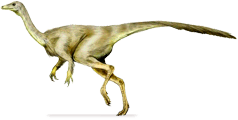
Pronunciation: STROOTH-ee-o-MIEM-us
Meaning: Ostrich mimic
Author/s: Osborn (1917)
Synonyms: Ornithomimus altus
First Discovery: Alberta, Canada
Acta Ordinal: #123
Struthiomimus altus
 Unlike the ridiculously-named Struthiosaurus (the "ostrich lizard" that's an armoured, four-legged, nodosaurid ankylosaur), Struthiomimus (the "Ostrich mimic") actually boasts some similarities to its namesake. It has long legs, a small toothless skull, and the ability to outrun most things, just like the modern Ostrich (Struthio). However, so does a dinosaur called Ornithomimus, and that's exactly where Struthiomimus spent the best part of two decades, having been assigned there as Ornithomimus altus by Lawrence Lambe in 1902.
(Lofty ostrich mimic)Etymology
Struthiomimus is derived from the Greek "strouthion" (ostrich) and "mimos" (mimic) because the shape of its head, neck and legs are similar to those of a modern ostrich. The species epithet, altus, means "lofty" (or tall) in Latin.
Discovery
The holotype of Struthiomimus (NMC 930—a partial skeleton) was discovered in the Oldman Formation (Belly River Group), Steveville, Alberta, Canada, by Lawrence Lambe in 1901.


