









Pronunciation: tel-MAT-o-SOR-us
Meaning: Swamp lizard
Author/s: Nopcsa (1900)
Synonyms: See etymology
First Discovery: Hunedoara, Romania
Acta Ordinal: #84
Telmatosaurus transsylvanicus
Transylvania gets some bad press, being, as it is, full of vampires, werewolves and the like. Of course, it isn't full of real vampires and werewolves, only in books and movies. But a particular part of it, previously an island known as Hateg (pronounced "Hat-zeg"), did have its fair share of weird and wonderful critters.
Telmatosaurus couldn't suck your blood, even if it wanted to. It lacked fangs... and probably lips... and was a vegetarian. But it did manage to dodge all advanced hadrosaurid upgrades by hiding in the swampy woodlands of a European archipelago during the Late Cretaceous, yet still managed to survive right up to the K-Pg extinction. It was also fully grown but only a fraction the size of its mainland relatives, which prompted Nopcsa, who described its remains, to come up with a theory he called "insular dwarfism": an island's inhabitants would become miniaturized over generations to minimize pressure on limited resources.
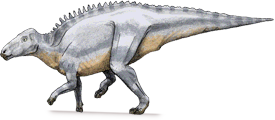
Size aside, Telmatosaurus follows the same basic body plan of other hadrosaurs such as Maiasaura; primarily bipedal but adopting a quadrupedal stance to feed and rest, a long tail stiffened with interwoven bony struts for counterbalance, and a somewhat long and horse-like skull with a narrow snout which is toothless at the tip, beaked, and lacking flamboyant decor such as a crest. Both upper and lower jaws are packed with hundreds of teeth arranged in batteries which, combined with well-developed jaw muscles, would have made light work of the toughest vegetation.
Nests discovered near the village of Tustea in the late 1980s contain what appear to be hadrosaurid embryos or hatchlings (possibly Telmatosaurus) alongside probable titanosaurian sauropod eggs (possibly Magyarosaurus). It's unlikely that different species shared the same nesting site willingly, so perhaps flash flooding swept sauropod eggs into a hadrosaurid site or hadrosaurid hatchlings into a sauropod site, or maybe the hatchlings and the eggs have been misidentified, and they actually represent the same species. Palaeontologists are reluctant to speculate on the owner of said eggs until identifiable embryos are discovered inside of them rather than alongside, and given the past controversies caused by mistaken identity (think Oviraptor, the "egg snatcher" that wasn't) who can blame them.
Telmatosaurus couldn't suck your blood, even if it wanted to. It lacked fangs... and probably lips... and was a vegetarian. But it did manage to dodge all advanced hadrosaurid upgrades by hiding in the swampy woodlands of a European archipelago during the Late Cretaceous, yet still managed to survive right up to the K-Pg extinction. It was also fully grown but only a fraction the size of its mainland relatives, which prompted Nopcsa, who described its remains, to come up with a theory he called "insular dwarfism": an island's inhabitants would become miniaturized over generations to minimize pressure on limited resources.
Size aside, Telmatosaurus follows the same basic body plan of other hadrosaurs such as Maiasaura; primarily bipedal but adopting a quadrupedal stance to feed and rest, a long tail stiffened with interwoven bony struts for counterbalance, and a somewhat long and horse-like skull with a narrow snout which is toothless at the tip, beaked, and lacking flamboyant decor such as a crest. Both upper and lower jaws are packed with hundreds of teeth arranged in batteries which, combined with well-developed jaw muscles, would have made light work of the toughest vegetation.
Nests discovered near the village of Tustea in the late 1980s contain what appear to be hadrosaurid embryos or hatchlings (possibly Telmatosaurus) alongside probable titanosaurian sauropod eggs (possibly Magyarosaurus). It's unlikely that different species shared the same nesting site willingly, so perhaps flash flooding swept sauropod eggs into a hadrosaurid site or hadrosaurid hatchlings into a sauropod site, or maybe the hatchlings and the eggs have been misidentified, and they actually represent the same species. Palaeontologists are reluctant to speculate on the owner of said eggs until identifiable embryos are discovered inside of them rather than alongside, and given the past controversies caused by mistaken identity (think Oviraptor, the "egg snatcher" that wasn't) who can blame them.
Etymology
Telmatosaurus is derived from the Greek "telmat" (swamp, marsh) and "sauros" (lizard) because of its presumed swamp-dwelling habits. The species epithet, transsylvanicus, refers to its discovery in Transylvania.
Synonyms and previous names
Nopcsa initially named this dinosaur Limnosaurus, but that name had already been assigned to a crocodilian by Othniel Charles Marsh in 1872. It was renamed Telmatosaurus in 1903, unbeknownst to Barnum Brown, who used the same remains to anchor Hecatasaurus in 1910. In 1915 Nopcsa moved Telmatosaurus to Orthomerus (as Orthomerus transsylvanicus) on the strength of a matching femur, but the name was revived in the 1980s when Orthomerus was tagged undiagnostic. Somewhat ironically, Marsh's Limnosaurus was later reclassified as Pristichampsus.
Discovery
 The first fossil of Telmatosaurus was a partial skull (BMNH B.3386) discovered by peasants in what turned out to be the Sânpetru Formation, near the village of Sânpetru (then Szentpéterfalva), Hunedoara (then Hunyad) in the Hateg Basin, Romania, which was presented to Ilona Nopsca: the daughter of their master. This skull inspired her brother, Farenc (Franz) Nopcsa, to take up a career in palaeontology because, after showing it to a rather unhelpful university professor, he was told to study it himself! So he did.
Nopcsa didn't actually nominate this skull as the Telmatosaurus holotype, but when Weishampel said he had in 1993, he inadvertently designated an official lectotype.
Disease
 In 2016, researchers from the Babes-Bolyai University (Romania), the Northeast Ohio Medical University (USA), Johns Hopkins University (USA), the University of Bucharest (Romania) and the University of Southampton (UK) studied a weird growth on the lower jaw of a sub-adult Telmatosaurus using the Micro-CT scanning facilities of SCANCO Medical AG in Switzerland and identified it as ameloblastoma. Ameloblastomas—tumourous, benign, non-cancerous growths—are known to afflict the jaws of humans and other mammals, and some modern reptiles too. And while fossil evidence suggests duck-billed dinosaurs, or hadrosaurs, are a sickly bunch more prone to tumours than other dinosaurs, Telmatosaurus currently sports the only growth of this type in the entire fossil record.
 [English translation by David Weishampel.]


