
TRICERATOPS
a plant-eating chasmosaurine ceratopsian dinosaur from the Late Cretaceous of North America.
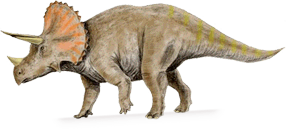
Pronunciation: tri-SEH-ruh-tops
Meaning: Three-horned face
Author/s: Marsh (
1889)
Synonyms: See
below
First Discovery: Wyoming, USA
Acta Ordinal: #70
Triceratops horridus
Triceratops is a ceratopsian, specifically a chasmosaurine ceratopsian, and a culmination of eighty-five million years of evolution. It was the biggest of its kind and more than capable of dealing death to the carnivorous death-dealers. But it reigned for a mere million or so years before being wiped out during the K-Pg extinction, which just goes to show; size and strength count for nothing when a six-mile-wide meteorite lands in your back yard. The horsemen of the apocalypse were an unforgiving lot, even way back in the Late Cretaceous.
The first specimen now attributed to
Triceratops was discovered in Denver, Colorado, in 1887 by local school teacher and geologist George Cannon, and forwarded to O.C. Marsh who assumed its remains—a couple of horn cores attached to a lump of skull roof—belonged to a huge Pliocene-aged bison that he named
Bison alticornis. To be fair, a horned dinosaur had never been discovered so Marsh had nothing to compare it to. And even the following year when he named more horn cores
Ceratops, he thought they were spikes akin to those found on the tail of
Stegosaurus and still believed
Bison was, well, a huge Pliocene-aged bison.
It took the 1888 discovery of a third partial skull by Cowboy Edmund B. Wilson and its collection by John Bell Hatcher from Wyoming's Laramie Formation to convince Marsh that horned dinosaurs existed, and although it was initially assigned to
Ceratops as a second species (
Ceratops horridus) it was bumped out by
Bison (which was renamed
Ceratops alticornis) and became the official name-bearing specimen of
Triceratops horridus in 1889.
(Rough three-horned face)Etymology
Triceratops is derived from the Greek "tri" (three), "ceras" (horn) and "ops" (face) because of the three horn on its face. Simples.
The
species epithet,
horridus, means "rough" or "rugose" and refers to the coarse texture of the bone surface.
ZooBank registry:
urn:lsid:zoobank.org:act:2DD57D91-DA07-4BDF-AD6B-031ACEAFDA40.
Discovery
The
holotype of
Triceratops horridus (a skull catalogued as YPM 1820) was discovered at Buck Creek on Johnson Brothers Ranch, in the Laramie Formation of Wyoming, by Cowboy Edmund B. Wilson and collected by John Bell Hatcher in 1888.
Estimations
Timeline:
Era: Mesozoic
Epoch: Late Cretaceous
Stage: Maastrichtian
Age range: 67-66 mya
Stats:
Est. max. length: 9 meters
Est. max. hip height: 3 meters
Est. max. weight: 6 tons
Diet: Herbivore
Agathaumas? "Great wonder" (Cope, 1872)
Polyonax? "Master Over Many" (Cope, 1874)
Bison "Bison" (Marsh, 1887)
Torosaurus? "Perforated lizard" (Marsh, 1891)
Sterrholophus "Solid crest" (Marsh, 1891)
Claorhynchus? "Broken beak" (Cope, 1892)
Ugrosaurus "Ugly lizard" (Cobabe and Fastovsky, 1987)
Nedoceratops? "Insufficient horn face" (Ukrainsky, 2007)
Eotriceratops? "Dawn
Triceratops" (Wu
et al., 2007)
Diceratus? "Two-horned" (Mateus, 2008)
Ojoceratops? "Ojo (Alamo) Horn face" (Sullivan and Lucas, 2010)
Tatankaceratops? "Bison horn face" (Ott and Larson, 2010)
Triceratops prorsus

Named by O. C. Marsh in 1990,
Triceratops prorsus is the only other species of
Triceratops that is currently considered valid. It differs from
Triceratops horridus in having a shallower snout, and is geologically younger, which may be a rare example of something known as "anagenisis": an ancestor evolving directly into a descendant.
Triceratops brevicornus (Lull, 1905) is possibly a junior synonym.
Dubious and doubtful species
Triceratops sylvestris (Kuhn, 1936). Originally known as
Agathaumas sylvestris (E. D. Cope, 1872).
Triceratops mortuarius (Kuhn, 1936). Originally known as
Polyonax mortuarius (E. D. Cope, 1874).
Triceratops alticornis. Named for USNM 4739, (a pair of horncores attached to a skull roof) discovered by G. L. Cannon in the Denver Formation, near Denver, Colorado, in 1887. These remains were initially thought to belong to a pliocene Bison that O. C. Marsh named
Bison alticornis in 1887. After a stint as
Ceratops alticornis (Marsh 1888) it was assigned to
Triceratops by Lull
et al. in 1907.
Triceratops galeus (O. C. Marsh, 1889). Named for USNM 2410 from the Denver Formation, near Brighton, Colorado, USA.
Triceratops flabellatus (O. C. Marsh, 1889).
Named for YPM 1821, a skull from Buck and Lance Creeks in the Lance Formation of Wyoming. Synonymous with
Triceratops horrridus.
Triceratops serratus
(O. C. Marsh, 1890). Known from Middle Fork, Dry Creek, in the Laramie Formation of Wyoming. Synonymous with
Triceratops horrridus.
Triceratops sulcatus (O. C. Marsh, 1890). Named for USNM 4276.
Triceratops elatus (O. C. Marsh, 1891). Named for USNM 1201
from Lance Creek in the Lance Formation, Niobrara County, Wyoming.
Synonymous with
Triceratops horrridus.
Triceratops calicornis (O. C. Marsh, 1898). Named for a partial skull from Lance Creek in the Lance Formation of Wyoming. Synonymous with
Triceratops horrridus.
Triceratops obtusus (O. C. Marsh, 1898). Named for USNM 4720, a skull collected in 1890 by J. B. Hatcher at U-L Ranch, Lance Creek, in the Lance Formation of Niobrara County, Wyoming.
Synonymous with
Triceratops horrridus.
Triceratops hatcheri is based on USNM 2412, a skull collected by J.B. Hatcher in the
Lance Formation of Niobrara County, Wyoming. It was named
Diceratops hatcheri in 1905 by R. S. Lull who had second thoughts in 1933 and assigned it to
Triceratops as "Triceratops (
Diceratops)" along with the remains of
Triceratops obtusus. It is now known as
Nedoceratops, though Mateus tried to change the pre-occupied name
Diceratops to
Diceratus... a year too late! Some paleontologists believe this is a growth stage of
Triceratops horridus.
Triceratops brevicornus (Lull, 1905). Named for YPM 1834 from Lightning Creek in the Lance Formation of Wyoming, which now resides at the Bayerische Staatssammlung für Paläontologie und Geologie in Munich as BSP 1964 I 458.
Synonymous with
Triceratops prorsus?
Triceratops ingens (Lull, 1915). Named for YPM 1828, mentioned without description.
Triceratops maximus (Barnum Brown, 1933). Named for AMNH 5040, eight vertebrae (five from the neck and three from the back), found by Mr. P.C. Kaisen in the Hell Creek Formation near a spring on Rock Creek, Garfield County, Montana, on July 25th, 1909. Found exposed on the surface and trampled by cattle for years, these remains cannot be assigned to
Triceratops with any certainty.
Triceratops eurycephalus (Schlaikjer 1935). Named for MCZ 1102, a nearly complete skull from Horse Creek in the Lance Formation, Goshen County, Wyoming.
Triceratops albertensis (Sternberg, 1949). Named for NMC 8862, an incomplete skull from Red Deer River in the Scollard Formation of Drumheller, Alberta.
References
• Marsh OC (1887) "
Notice of new fossil mammals".
American Journal of Science s3-34(202): 323-331 (coins Bison alticornis). DOI: 10.2475/ajs.s3-34.202.323.
• Marsh OC (1888) "
A new family of horned Dinosauria, from the Cretaceous".
American Journal of Science s3-36(216): 477-478. DOI: 10.2475/ajs.s3-36.216.477.
• Marsh OC (1889) "
Notice of gigantic horned Dinosauria from the Cretaceous".
American Journal of Science 3-38 (224): 173-176. DOI: 10.2475/ajs.s3-38.224.173.
• Lull RS, Hatcher JB and Marsh OC (1907) "
The Ceratopsia".
Monographs of the United States Geological Survey, 49: 1-198
• Brown B and Kaisen PC (1933) "
A Gigantic Ceratopsian Dinosaur, Triceratops Maximus, New Species".
American Museum novitates; no. 649.
• Weishampel DB and White NM "
The Dinosaur Papers (1676-1906)".
• Carpenter K and Currie PJ (1992) "
Dinosaur Systematics: Approaches and Perspectives".
• Dodson P, Forster CA and Sampson SD (2004) "Ceratopsidae" in Weishampel, Dodson and Osmólska "
The Dinosauria: Second Edition".
• Dodson P (1998) "
The Horned Dinosaurs: a Natural History".
• Lull RS (1933) "
A revision of the Ceratopsia or horned dinosaurs".
Memoirs of the Peabody Museum of Natural History, volume 3, part 3.
• Carpenter K (2006) "'
Bison'
alticornis and O.C. Marsh's early views on ceratopsians". In Carpenter (ed.) "
Horns and Beaks: Ceratopsian and Ornithopod Dinosaurs".
• Scannella J and Horner JR (2010) "
Torosaurus Marsh, 1891, is Triceratops Marsh, 1889 (Ceratopsidae: Chasmosaurinae): synonymy through ontogeny".
Journal of Vertebrate Paleontology 30(4): 1157-1168. DOI: 10.1080/02724634.2010.483632.
• Longrich NR and Field DJ (2012) "
Torosaurus is not Triceratops: ontogeny in chasmosaurine ceratopsids as a case study in dinosaur taxonomy".
 PLoS ONE 7(2): e32623. DOI: 10.1371/journal.pone.0032623.
• Erickson GM, Sidebottom MA, Kay DI, Turner KT, Ip N, Norell MA, Sawyer WG, Krick BA (2015) "
Wear biomechanics in the slicing dentition of the giant horned dinosaur Triceratops".
Science Advances, 1(5): e1500055. DOI: 10.1126/sciadv.1500055.
• Scannella JB and Fowler DW (2009) "Anagenesis in
Triceratops: evidence from a newly resolved stratigraphic framework for the Hell Creek Formation".
Pp. 148–149 in 9th North American Paleontological Convention Abstracts. Cincinnati Museum Center Scientific Contributions 3.
• D’Anastasio R, Cilli J, Bacchia F, Fanti F, Gobbo G and Capasso L (2022)
"Histological and chemical diagnosis of a combat lesion in
Triceratops".
Scientific Reports 12:3941. DOI: 10.1038/s41598-022-08033-2.
• de Rooij J, Lucassen SAN, Furer C, Schulp AS and Sander PM (2023) "Exploring the ceratopsid growth record: a comprehensive osteohistological analysis of
Triceratops (Ornithischia: Ceratopsidae) and its implications for growth and ontogeny".
Cretaceous Research: 105738.
DOI: 10.1016/j.cretres.2023.105738.
• Mallon J, Roloson M, Bamforth E, Scannella JB, and Ryan MJ (2025) "The Canadian fossil record supports anagenesis in
Triceratops (Ornithischia, Ceratopsia)".
Canadian Journal of Earth Sciences (advance online publication). DOI: 10.1139/cjes-2024-0170.
• Tada S, Tsuihiji T, Ishikawa H, Wakimizu N, Kawabe S and Sakane K (2026)
"Nasal soft-tissue anatomy of
Triceratops and other horned dinosaurs".
The Anatomical Record (advance.
DOI: 10.1002/ar.70150.
Time stands still for no man, and research is ongoing. If you spot an error, or want to expand, edit or add a dinosaur, please use
this form. Go
here to contribute to our FAQ.
All dinos are GM free, and no herbivores were eaten during site construction!
To cite this page:
Atkinson, L.
"
TRICERATOPS :: from DinoChecker's dinosaur archive".
‹
http://www.dinochecker.com/dinosaurs/TRICERATOPS›. Web access: 21st Oct 2026.









