









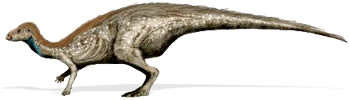
Pronunciation: VAL-do-SOR-us
Meaning: Wealden lizard
Author/s: Galton (1975)
Synonyms: Dryosaurus canaliculatus
First Discovery: Isle of Wight, UK
Acta Ordinal: #255
Valdosaurus canaliculatus
Typical of dinosaurs discovered in the 1800s, the fossils that would eventually become Valdosaurus have led palaeontologists a merry dance for many a year. It all began in 1868 when Reverend Fox discovered two thigh bones on the Isle of White, and assigned them to what Richard Owen had described as a juvenile version of Gideon Mantell's Iguanodon two decades earlier. In 1869 Huxley renamed that combined specimen Hypsilophodon, and so it remained for over a century. Then Galton removed Fox's thighs and managed to rename them twice in two years; first as a new species of Dryosaurus -- Dryosaurus canaliculatus (1975)» and then Valdosaurus (1977).»
Since then Valdosaurus has been bombarded with fragmentary remains from far and wide including bones from Niger that became Valdosaurus nigeriensis in 1982. With the assigned remnants spiralling out of control, Peter Galton performed a critical re-evaluation and fossilectomy in 2009, having concluded that no "Valdosaurus" remains from outside of England actually belong to Valdosaurus.» Many bones were reassigned to other modestly-sized dryosaurids, and some were abandoned altogether. Most notably though, Valdosaurus nigeriensis — that Galton had coined himself, by the way — was renamed again and became Elrhazosaurus (the lizard from Erlhaz).
Since then Valdosaurus has been bombarded with fragmentary remains from far and wide including bones from Niger that became Valdosaurus nigeriensis in 1982. With the assigned remnants spiralling out of control, Peter Galton performed a critical re-evaluation and fossilectomy in 2009, having concluded that no "Valdosaurus" remains from outside of England actually belong to Valdosaurus.» Many bones were reassigned to other modestly-sized dryosaurids, and some were abandoned altogether. Most notably though, Valdosaurus nigeriensis — that Galton had coined himself, by the way — was renamed again and became Elrhazosaurus (the lizard from Erlhaz).
(Wealden lizard with a small channel)Etymology
Valdosaurus is derived from the Latin "valdus" ("Wealden", referring to the Early Cretaceous Wealden deposits in which its fossils were found) and the Greek "sauros" (lizard).The species epithet, canaliculatus, means "with a small channel" in Latin, and refers to the distinct groove between the condyles (two bulbs that form the "knuckle") of the lower femur (thighbone).
Discovery
The holotype of Valdosaurus is a pair of thigh bones — BMNH R184 and R185, incorrectly cited as R185 and R186 in Galton & Taquet, 1982 — which were discovered in the Wealden deposits of the Wessex Formation near Cowleaze Chine on the Isle of Wight by Reverend William Darwin Fox in 1868. However, Richard Owen had described what turned out to be a pair of Valdosaurus thighbones (BMB 004297-004300, in the Holmes collection from the Hakesbourne Pit near Rusper) way back in 1842, but he assigned them to Iguanodon.
They were referred to Valdosaurus canaliculatus by Blows in 1998, in the same paper he erroneously invented Valdosaurus dextrapoda.»In 2011, Barret et al. described four more specimens from the Isle of White (BELUM K17051 from Brook Chine, and IWCMS 2007-4, MIWG-6438 and MIWG-6879 from in or around Chilton Chine), which substantially increased the anatomical details of Valdosaurus, not least because they all include matching thighs that are attached to other leg bones.
Five years later, Barrett described the most complete Valdosaurus specimen yet; a partially crushed skeleton (IWCMS 2013.175), discovered by Mr Nick Chase in October 2012 at Compton Bay on the southwest coast of the Isle of Wight, which includes a series of back vertebrae, an almost complete tail, hip material and most of both hind limbs.


