




Pronunciation: vuhl-KAYN-o-don
Meaning: Volcano tooth
Author/s: Raath (1972)
Synonyms: None known
First Discovery: Mashonaland, Zimbabwe
Acta Ordinal: #234
Vulcanodon karibaensis
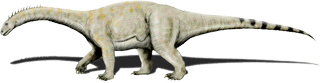
Compared to its later relatives Vulcanodon was small. It only measured six meters in length and weighed a paltry couple of tons. It's a miracle it managed to survive. But survive it did, for at least a couple of million years after the Triassic extinction — not the "Great Dying" that tried its best to wipe out life on earth at the start of the Triassic, but the one at the end. That one wasn't nearly as brutal.
A combination of modest size, clawed feet, primitive hips, and discovery in earliest Jurassic sediments convinced scientists that Vulcanodon was a prosauropod. As did some small serrated teeth discovered in nearby volcanic rock that fit with the old theory that non-sauropod sauropodomorphs (aka prosauropods) were carnivorous. But a barrel body, column-like legs, and strengthened weight-bearing feet were so out of sync' with this notion that paleontologists simply brushed them off as deformities. How little they knew.
As it happens, the teeth belonged to a scavenging theropod (it's too late to change the name though) and as well as being the only dinosaur represented by decent remains from Zimbabwe, Vulcanodon is now widely regarded as one of the earliest known and least derived "proper" sauropods, but not one of the eusauropods... which are the "true" sauropods. Go figure.
Vulcanodon proved that sauropods weren't always colossal, but they evolved from much smaller creatures that gradually supersized, probably by power-eating copious amounts of foliage that flourished in oxygen rich Jurassic air.
The fact that its fossils have only ever been discovered at a single site in a single country is rather surprising as footprints found in Lesotho and tagged "Deuterosauropodopus" have been attributed to a meandering Vulcanodon.
Vulcanodontidae (containing Vulcanodon and Tazoudasaurus) and its sister group — Eusauropoda — are collectively known as Gravisauria ("heavy lizards") though some are much heavier than others, and others aren't particularly heavy.
A combination of modest size, clawed feet, primitive hips, and discovery in earliest Jurassic sediments convinced scientists that Vulcanodon was a prosauropod. As did some small serrated teeth discovered in nearby volcanic rock that fit with the old theory that non-sauropod sauropodomorphs (aka prosauropods) were carnivorous. But a barrel body, column-like legs, and strengthened weight-bearing feet were so out of sync' with this notion that paleontologists simply brushed them off as deformities. How little they knew.
As it happens, the teeth belonged to a scavenging theropod (it's too late to change the name though) and as well as being the only dinosaur represented by decent remains from Zimbabwe, Vulcanodon is now widely regarded as one of the earliest known and least derived "proper" sauropods, but not one of the eusauropods... which are the "true" sauropods. Go figure.
Vulcanodon proved that sauropods weren't always colossal, but they evolved from much smaller creatures that gradually supersized, probably by power-eating copious amounts of foliage that flourished in oxygen rich Jurassic air.
The fact that its fossils have only ever been discovered at a single site in a single country is rather surprising as footprints found in Lesotho and tagged "Deuterosauropodopus" have been attributed to a meandering Vulcanodon.
Vulcanodontidae (containing Vulcanodon and Tazoudasaurus) and its sister group — Eusauropoda — are collectively known as Gravisauria ("heavy lizards") though some are much heavier than others, and others aren't particularly heavy.
Etymology
Vulcanodon is derived from the Latin "Vulcanus" (the Roman god of fire) and the Greek "odon" (tooth) because what were once thought to be its teeth were discovered sandwiched between two lava flows. We now know the teeth don't belong to Vulcanodon but the name stands.
The species epithet, karibaensis, combines "Kariba" (for Lake Kariba Island) with the Latin "ensis" (from).
Discovery
The remains of Vulcanodon were discovered in the "Vulcanodon Beds Formation" on Lake Kariba Island 126/127, Mashonaland North, Zimbabwe, by Mr. B.A. Gibson.
The holotype (QG24, housed at the Queen Victoria Museum Salisbury, Zimbabwe) includes pelvis, hindlimb, foot, forearm and tail bones.


