





Pronunciation: zah-rah-PEL-tuh
Meaning: Hedgehog shield
Author/s: Arbour et al. (2014)
Synonyms: None known
First Discovery: Hermiin Tsav, Mongolia
Acta Ordinal: #900
Zaraapelta nomadis
If Zaraapelta — meaning hedgehog shield — really was a hedgehog, and if partial skulls were reliable yardsticks for reconstructing entire individuals based on better-represented relatives, it would be like no hedgehog you've ever seen. At roughly six meters in length and over two tons in weight, it wouldn't have to worry about getting squished by careless drivers. Nor would it give a hoot that its presence in the Barun Goyot Formation coaxed its authors into yet another Mongolian ankylosaur fossil-shunting extravaganza.
As well as naming Zaraapelta, Arbour et al found that Tarchia kielanae is valid after all which rendered Tarchia gigantea redundant, that Dyoplosaurus giganteus (which is what Tarchia gigantea was initially known as) is dubious, and that some of its remains (PIN 3142/ 250) actually belong to Saichania chulsanensis. Their analysis also outed Minotaurasaurus as a junior synonym of Tarchia kielanae, which is no bad thing. The fossil's owner promised repatriation if anyone could prove that it was taken without a permit, and since the study of its rock matrix hints strongly at a Mongolian provenance, and as Mongolia don't allow their fossils to be exported ever, Vilayanur Ramachandran should be on his way to the post office any time now.
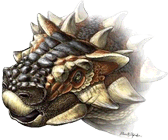
Zaraapelta is based entirely on a skull that's missing the snout, and while most ankylosaurid skulls may look the same to the untrained eye, this one, like those of other species, boasts its own unique features. Robust horns with a prominent groove and weird texture adorn its rear, an elaborate pattern of knobs and lumps encircle its eyes, and the whole thing has a somewhat prickly, name-prompting appearance. We can't even begin to imagine how irresistibly alluring this combination must have been to the opposite sex.
As well as naming Zaraapelta, Arbour et al found that Tarchia kielanae is valid after all which rendered Tarchia gigantea redundant, that Dyoplosaurus giganteus (which is what Tarchia gigantea was initially known as) is dubious, and that some of its remains (PIN 3142/ 250) actually belong to Saichania chulsanensis. Their analysis also outed Minotaurasaurus as a junior synonym of Tarchia kielanae, which is no bad thing. The fossil's owner promised repatriation if anyone could prove that it was taken without a permit, and since the study of its rock matrix hints strongly at a Mongolian provenance, and as Mongolia don't allow their fossils to be exported ever, Vilayanur Ramachandran should be on his way to the post office any time now.
Zaraapelta is based entirely on a skull that's missing the snout, and while most ankylosaurid skulls may look the same to the untrained eye, this one, like those of other species, boasts its own unique features. Robust horns with a prominent groove and weird texture adorn its rear, an elaborate pattern of knobs and lumps encircle its eyes, and the whole thing has a somewhat prickly, name-prompting appearance. We can't even begin to imagine how irresistibly alluring this combination must have been to the opposite sex.
(Nomadic expedition's hedgehog shield)Etymology
Zaraapelta is derived from the Mongolian "zaraa" (hedgehog) in reference to the spiky appearance of its skull, and the Greek "pelta" (shield) in reference to the armour plates found on all ankylosaurs. The species epithet, nomadis,
is derived from the Latin "nomas" (nomad) in reference to Nomadic Expeditions, the Mongolian travel company that has supported palaeontological fieldwork in the Gobi Desert for many years.
ZooBank registry: urn:lsid:zoobank.org:act:A26B3342-E35A-4AEF-8E5B-579AB91AC6A6.
Discovery
The remains of Zaraapelta were discovered in the Baruungoyot (Barun goyot) Formation at Hermiin Tsav, Gobi
Desert, Mongolia, by Robert Gabbard during a Phil Currie-led expedition to the Gobi in 2000.
The holotype (MPC D100/1338) is a partial skull missing the snout.


