Pronunciation: JOO-chang-tie-RAN-us
Meaning: Zhucheng tyrant
Author/s: Hone et al. (2011)
Synonyms: None known
First Discovery: Shandong Province, China
Acta Ordinal: #783
Zhuchengtyrannus magnus
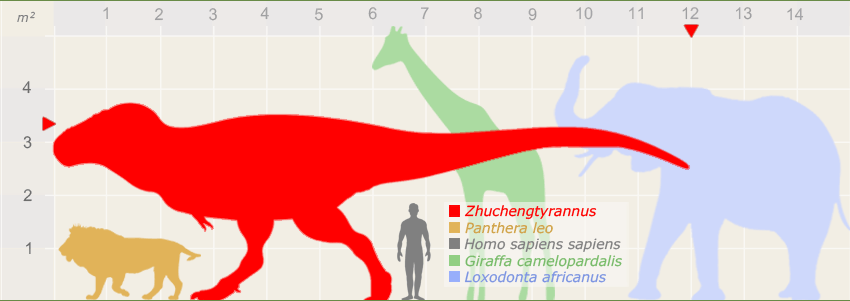
Zhuchengtyrannus, or "ZT" as it's affectionately known to its name-coining authors, was similar in size and stature to average-sized specimens of the North American tyrannosaurine, Tyrannosaurus. But it sported a combination of unique features not seen in any of its closest relatives, which, funnily enough, mainly involve things that aren't there.
Everything below its partial lower jaw (dentary) is missing, and most of its outstanding features are the size, shape, and position of holes (fenestrae) in a partial upper jaw bone (maxilla) that represents the other 50% of its remains. It also lacks a joint-strengthening flange where its toothy upper jaw bone meets the rest of the skull, and a palate bone that covers the roots of its rear teeth, which eliminates the possibility of its fossils belonging to another tyrannosaurine, China's Tarbosaurus. But what it does have, which all of its relatives lack, is a sort of bony shelf on its upper jaw and an odd notch on one of said fenestrae.
Zanjiazhuang quarry has yielded many tons of disjointed dinosaurian remnants, but Zhuchengtyrannus can't lay claim to them because proof of ownership is currently lacking. Amongst those remains, another pair of jaw bones (ZCDM V0030 and ZCDM V0032) seem unique again, and may belong to a second, as yet unnamed tyrannosaurid. Some 1970s-discovered "Tyrannosaurus-like teeth" with unique serrations that run all the way to the base of the crown, plus a later assigned toe, were actually blessed with a name by Hu et al. in 2001, but it doesn't get much attention. That dinosaur is called Tyrannosaurus zhuchengensis, and likelihood dictates that it owns at least some of the above-mentioned remains, perhaps all of them, or maybe none. But nothing good ever comes of naming critters on the strength of teeth, and they should never have been christened in the first place, according to most experts.
Based on what's known of its jaws, Zhuchengtyrannus was a deep-snouted tyrannosaurine in the mould of Tyrannosaurus, Tarbosaurus and Lythronax. A like-for-like comparison of known parts suggests it may sit among the top six carnivorous dinosaurs of all time, size-wise.
Everything below its partial lower jaw (dentary) is missing, and most of its outstanding features are the size, shape, and position of holes (fenestrae) in a partial upper jaw bone (maxilla) that represents the other 50% of its remains. It also lacks a joint-strengthening flange where its toothy upper jaw bone meets the rest of the skull, and a palate bone that covers the roots of its rear teeth, which eliminates the possibility of its fossils belonging to another tyrannosaurine, China's Tarbosaurus. But what it does have, which all of its relatives lack, is a sort of bony shelf on its upper jaw and an odd notch on one of said fenestrae.
Zanjiazhuang quarry has yielded many tons of disjointed dinosaurian remnants, but Zhuchengtyrannus can't lay claim to them because proof of ownership is currently lacking. Amongst those remains, another pair of jaw bones (ZCDM V0030 and ZCDM V0032) seem unique again, and may belong to a second, as yet unnamed tyrannosaurid. Some 1970s-discovered "Tyrannosaurus-like teeth" with unique serrations that run all the way to the base of the crown, plus a later assigned toe, were actually blessed with a name by Hu et al. in 2001, but it doesn't get much attention. That dinosaur is called Tyrannosaurus zhuchengensis, and likelihood dictates that it owns at least some of the above-mentioned remains, perhaps all of them, or maybe none. But nothing good ever comes of naming critters on the strength of teeth, and they should never have been christened in the first place, according to most experts.
Based on what's known of its jaws, Zhuchengtyrannus was a deep-snouted tyrannosaurine in the mould of Tyrannosaurus, Tarbosaurus and Lythronax. A like-for-like comparison of known parts suggests it may sit among the top six carnivorous dinosaurs of all time, size-wise.
(Great Tyrant from Zhucheng)Etymology
Zhuchengtyrannus is derived from "Zucheng" (the city where it was discovered) and the Greek "tyrannos" (tyrant).
The species epithet, magnus, means "great" in Latin and refers to its large size.
By the by, replacing the "u" of Zhucheng with an "i" would give an anagram of Chengzhi, the given name of Hu Cheng-Zhi, the Chinese palaeontologist who described the first dinosaur from the Zhucheng area, Shantungosaurus, back in 1973.
Discovery
 Currently, the only known fossils of Zhuchengtyrannus were discovered at Zanjiazhuang quarry, near the transition between the Xingezhuang Formation and the overlying Hongtuya Formation (Wangshi Group) but firmly in the latter, Zhucheng City, Shandong Province, China, in 2008, by a construction crew digging the foundations for a museum in which to house fossils of dinosaurs previously discovered in the same area.
As well as Zhuchengtyrannus, Zanjiazhuang quarry has yielded the hadrosaurid Shantungosaurus giganteus (Hu, 1973) in the form of its synonym Huaxiaosaurus aigahtens (Zhao, 2011), the ceratopsid
Sinoceratops zhuchengensis (Xu et al. 2010), the saltasaurid sauropod
Zhuchengtitan zangjiazhuangensis (Mo et al. 2017), and the ankylosaur Sinankylosaurus zhuchengensis (Wang et al. 2020), while the possible
Zhuchengtyrannus synonym Tyrannosaurus zhuchengensis,
the leptoceratopsids Ischioceratops zhuchengensis (He et al. 2015) and Zhuchengceratops inexpectus (Xu et al. 2010), Shantungosaurus giganteus and its synonym Zhuchengosaurus maximus (Zhao et al. 2007), and the caenagnathid Anomalipes zhaoi (Yu et al. 2018), were found in the nearby Longgujian and Kugou quarries.
The holotype (ZCDM V0031) is a near complete maxilla (tooth bearing bone of the upper jaw) and a dentary (tooth bearing bone of the lower jaw). Most of the teeth are present.
Currently, the only known fossils of Zhuchengtyrannus were discovered at Zanjiazhuang quarry, near the transition between the Xingezhuang Formation and the overlying Hongtuya Formation (Wangshi Group) but firmly in the latter, Zhucheng City, Shandong Province, China, in 2008, by a construction crew digging the foundations for a museum in which to house fossils of dinosaurs previously discovered in the same area.
As well as Zhuchengtyrannus, Zanjiazhuang quarry has yielded the hadrosaurid Shantungosaurus giganteus (Hu, 1973) in the form of its synonym Huaxiaosaurus aigahtens (Zhao, 2011), the ceratopsid
Sinoceratops zhuchengensis (Xu et al. 2010), the saltasaurid sauropod
Zhuchengtitan zangjiazhuangensis (Mo et al. 2017), and the ankylosaur Sinankylosaurus zhuchengensis (Wang et al. 2020), while the possible
Zhuchengtyrannus synonym Tyrannosaurus zhuchengensis,
the leptoceratopsids Ischioceratops zhuchengensis (He et al. 2015) and Zhuchengceratops inexpectus (Xu et al. 2010), Shantungosaurus giganteus and its synonym Zhuchengosaurus maximus (Zhao et al. 2007), and the caenagnathid Anomalipes zhaoi (Yu et al. 2018), were found in the nearby Longgujian and Kugou quarries.
The holotype (ZCDM V0031) is a near complete maxilla (tooth bearing bone of the upper jaw) and a dentary (tooth bearing bone of the lower jaw). Most of the teeth are present.