









Pronunciation: tah-POO-yah-SOR-us
Meaning: Tapuia lizard
Author/s: Zaher et al. (2011)
Synonyms: None known
First Discovery: Minas Gerais, Brazil
Acta Ordinal: #777
Tapuiasaurus macedoi
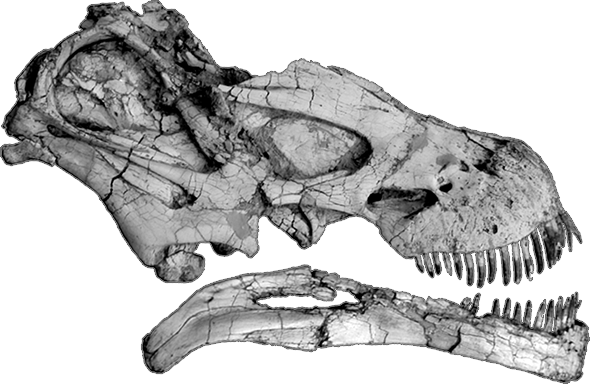
Titanosaurs were, in life, robustly built animals, with some reaching colossal sizes that place them among the largest creatures ever to set foot on planet Earth. Yet their fossil skulls are notoriously fragmentary, so most of what we know about them comes from skeletal remains rather than heads. Tapuiasaurus flipped that pattern somewhat, with its body fossils adding little to the broader titanosaurian story, not least because they're not yet fully prepared, and the focus instead being on its skull, which is beautiful... in a Xenomorph to the Nostromo's murder-minded weirdy science officer called Ash kind of way.
Basically, it looks terrifying, and not like a placid plant-eating sauropod in the slightest. It is, however, as of 2016, among just three complete titanosaur skulls known from any time of anywhere in the world, and the only one from South America and the Early Cretaceous.
(Macedo's Tapuia Lizard)Etymology
Tapuiasaurus is a combination of "Tapuia" (a generic name from the Jâs
indigenous language used to designate tribes that inhabited
the inner regions of Brazil) and the Greek "sauros" (lizard).The species epithet, macedoi, honors Ubirajara Alves Macedo, who first discovered the deposits near Coração de Jesus. In a completely unrelated event, a maned compsognathid dinosaur from Brasil was named Ubirajara—which, in Tupi, means "lord of the spear"—in December 2020. ZooBank registry: urn:lsid:zoobank.org:act:9430DEDA-7C76-482B-8A23-912AC854836E.
Discovery
The first fossils of Tapuiasaurus were discovered in the Embira-Branca hills, Coração de Jesus city, in claystone of the Quiricó Formation (Sanfranciscana Basin), Minas Gerais, Brazil by Ubirajara Alves Macedo.The holotype (MZSP-PV 807) is a partial skeleton that consists of an almost complete skull and lower jaw, atlas, axis, five neck and five back vertebrae with ribs, a left sternal plate, a right coracoid (part of the shoulder assembly), a right humerus (upper arm), left radius and ulna (lower arm bones), metacarpals (hand bones), two femora (thighs), a left fibula (calf bone), and an almost complete left pes (foot).
A carnivorous dinosaur that would be named Spectrovenator ragei in September 2020 was discovered lurking beneath the holotype of Tapuiasaurus while it was being partially prepared in the field.
Preparator
Alberto B. Carvalho.


