



Pronunciation: SER-a-top-see-uh
Author: O.C. Marsh
Year: (1890)
Etymology: Horn faces (see etymology)
Locomotion: Bi and Quadrupedal (2 and 4 legs)
Synonyms: Ceratopia (Charig 1979) = spelling variant
[Sereno, 2005]Definition
The most inclusive clade including Triceratops horridus but not Heterodontosaurus tucki, Ankylosaurus magniventris, Hypsilophodon foxii, Pachycephalosaurus wyomingensis.
About
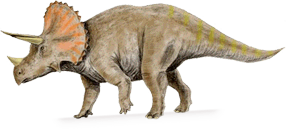
Ceratopsians began as small, two-legged dinosaurs with simple frills during the Early Jurassic, but over time they evolved into the large, horned giants of the Late Cretaceous. Their skulls became some of the most elaborate in the animal kingdom, with broad frills, sharp beaks, and horns that varied dramatically between species, and likely served multiple roles: defence, display, and communication within herds. Ceratopsians were powerful herbivores, using their strong jaws and shearing teeth to slice through tough, fibrous plants. In places like Late Cretaceous North America, they were among the most common large dinosaurs, shaping entire ecosystems through their feeding and social behaviour.
Click here to view Dinochecker's A-Z list of ceratopsians.
Etymology
Ceratopsia is derived from the Greek "keras" (horn), "ops" (face), and "ia" (neuter plural), named for the various shaped and sized horns on their noses and brows.
Relationships
References
• Lull RS (1933) "A revision of the Ceratopsia or horned dinosaurs". Peabody Museum of Natural History Memoirs, 3(3): 1-175.
• Dodson P (1998) "The Horned Dinosaurs: a Natural History".
• Carpenter K (2006) "Horns and Beaks: Ceratopsian and Ornithopod Dinosaurs".


