









Pronunciation: ang-KI-lo-SOR-us
Meaning: Stiff lizard
Author/s: Barnum Brown (1908)
Synonyms: None known
First Discovery: Montana, USA
Acta Ordinal: #95
Ankylosaurus magniventris
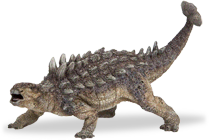
If you're looking for a shining example of evolution's knack of evening the odds for vegetarians, you need to look no further. Ankylosaurus was a large and cumbersome four-legged dinosaur with plates of armour from end to end (even on its eyelids) and a thunderous mace-like tail. It was armed and dangerous, a veritable tank some sixty-five million years before the US Army honoured William Tecumseh Sherman in their version. But its fortification came at a cost.
Being so heavily fused meant its name was a no-brainer — stiff lizard. But the flipside of being as tough as your average bomb shelter was that Ankylosaurus itself was a bit of a no-brainer too. With its small-ish, somewhat triangular, thick bone-laden skull minimizing brain space, there wasn't a lot of room for thinking, so instinct decided everything. Ripping through foliage with a beak-tipped mouth was about as thought-provoking as they got, though armour-plated jaws meant chewing was out of the question, and when threatened, their instincts screamed "swing for a home run!". As the largest and most heavily-armoured of its clan, Ankylosaurus was more than capable of turning the tables on carnivorous death dealers with a swish of its enormous-club-ended tail. Only predators who were desperately hungry, really brave or just plain daft would even contemplate tackling a live one.
The mind boggles at the potential implications of reproduction. But they must have managed it, and quite successfully too, as ankylosaurs have been around since their Mid-Jurassic cousin Gargoyleosaurus first raised his hideously ugly head. Since then, they have matched their carnivorous contemporary's super-sizing tendencies step for step, culminating in Ankylosaurus, the last living ankylosaurs, and it took an entire K/T extinction to stop them dead in their tracks.
Being so heavily fused meant its name was a no-brainer — stiff lizard. But the flipside of being as tough as your average bomb shelter was that Ankylosaurus itself was a bit of a no-brainer too. With its small-ish, somewhat triangular, thick bone-laden skull minimizing brain space, there wasn't a lot of room for thinking, so instinct decided everything. Ripping through foliage with a beak-tipped mouth was about as thought-provoking as they got, though armour-plated jaws meant chewing was out of the question, and when threatened, their instincts screamed "swing for a home run!". As the largest and most heavily-armoured of its clan, Ankylosaurus was more than capable of turning the tables on carnivorous death dealers with a swish of its enormous-club-ended tail. Only predators who were desperately hungry, really brave or just plain daft would even contemplate tackling a live one.
The mind boggles at the potential implications of reproduction. But they must have managed it, and quite successfully too, as ankylosaurs have been around since their Mid-Jurassic cousin Gargoyleosaurus first raised his hideously ugly head. Since then, they have matched their carnivorous contemporary's super-sizing tendencies step for step, culminating in Ankylosaurus, the last living ankylosaurs, and it took an entire K/T extinction to stop them dead in their tracks.
Etymology
Brown never provided an intended meaning for the name, but the closest derivation for Ankylosaurus is "ankulos" (Greek: bent, crooked) and "sauros" (Greek: lizard), which could be a reference to its "highly arched body cavity", similar, Brown thought, to that of Stegosaurus. However, he also referred to "skull plates coossified in a continuous sculptured shield", "rigid body frame" and "stiff backbone", which suggests he was thinking "ankylosis"—a medical term describing the stiffening of joints caused by bone fusion. The latter — meaning "stiff lizard" — is the popular choice. The species epithet, magniventris, from the Latin "magnus" (great) and "venter" (belly), is a reference to the animals great width. ZooBank registry: urn:lsid:zoobank.org:act:1E467A85-8055-4DCB-A07E-105202E2A4C6.
Discovery
The first fossils of Ankylosaurus were recovered from the Hell Creek Formation at the upper end of Gilbert Creek, Garfield County, Montana, USA, by Peter
Kaisen in 1906.
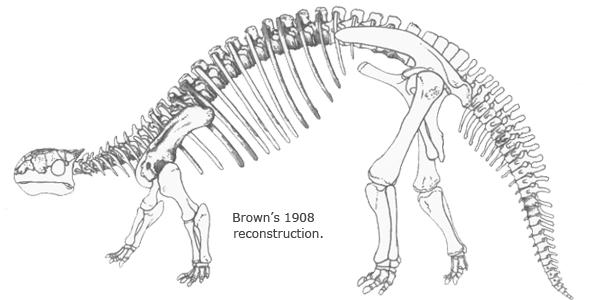
The Holotype (AMNH 5895 - housed at the American Museum of Natural History) consists of the top portion of skull, two teeth, five neck vertebrae, eleven back vertebrae, three tail vertebrae, a right scapulacoracoid, ribs, and dermal armor.
Ankylosaurus remains have also been discovered in Alberta's Scollard Formation (AMNH 5214, including a complete skull), Wyoming's Lance Formation (AMNH 5866, 75 osteoderms, originally thought to belong to "Dynamosaurus imperiosus", which is now known as Tyrannosaurus rex), Saskatchewan's Frenchman Formation and Wyoming's Ferris Formation.


