





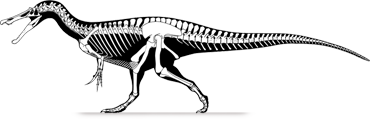
Pronunciation: eye-BEH-ro-SPY-nus
Meaning: Iberian spine
Author/s: Mateus et al. (2022)
Synonyms: None known
First Discovery: Setúbal, Portugal
Acta Ordinal: #1102
Iberospinus natarioi
(Natário's Iberian Spine)Etymology
Iberospinus is derived from "Ibero" (the Roman name for the Iberian Peninsula) and the Latin "spinus" (spine).
The species epithet, natarioi (nah-TAH-ree-oy), honours Carlos Carlos Natário, who discovered the holotype.
Zoobank registry: urn:lsid:zoobank.org:act:7641902A-10D4-42E6-8C49-F4EA6DE2DC95.
Discovery
The first remains of Iberospinus were discovered in the Papo Seco Formation at Praia de Aguncheiras (also known as Praia do Guincho), in the municipality of Sesimbra, Setúbal district, Portugal, by Carlos Natário in 1999.
The holotype (ML 1190) includes a partial lower jaw, at least four teeth, a partial right shoulder blade, a back vertebra, four rib fragments, a right pubis, two ankles, a toe claw, 15 tail vertebrae in various states of preservation and fragments of chevrons, most likely from a single individual, given that all specimens were found in a small (5 x 2 metres) area, are of the same size class and lack duplicate elements. Apart from two-thirds of the tail vertebrae and a few odds and ends found at the site in June 2020, most of the holotype material was described by Mateus et al. in 2011 and assigned to Baryonyx walkeri.
In 2017, Waskow and Mateus studied a rib of ML1190 and concluded that its owner reached sexual maturity at about 13–15 years of age and was about 23–25 years old when it died.
Preparators
Simão Mateus, João Marinheiro and Víctor López Rojas of Dinoparque Lourinhã, prepared the 2020 material.


