









Pronunciation: mah-SHEE-kah-SOR-us
Meaning: Vicious lizard
Author/s: Sampson, Carrano, Forster (2001)
Synonyms: None known
First Discovery: Mahajanga, Madagascar
Acta Ordinal: #505
Masiakasaurus knopfleri
So unique is Madagascar—an isolated island in the tropics, hundreds of miles from the nearest land—that more than 80% of its species are found nowhere else on earth. Being totally isolated since it broke away from India eighty-odd million years ago, its inhabitants were left to evolve without outside interference, and what a truly bizarre bunch its inhabitants have always been.
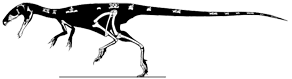
If dentists had been around in Late Cretaceous times, they would have made a decent living from Masiakasaurus. A long and low skull held serrated flesh-slicing teeth similar to those of other predatory dinosaurs in the rear of its jaws, but it had buck teeth at the front that a run-of-the-mill brace couldn't fix. A downward curve of the lower jaw forced its first four teeth—spoon-shaped and lightly serrated with hooked edges—more or less straight out on the horizontal with the socket of the front-most tooth lying below the rest of the lower jaw's bottom edge. And while its upper-front teeth have yet to be discovered, they were similarly forward-pointing, judging by the angle of the empty sockets, courtesy of an upwards curve at the front of the upper jaw. That design, coupled with its long slender arms, suggests Masiakasaurus wasn't built to tear flesh from large prey and may have been a specialist hunter of slippery fish. But such an arsenal would have been wasted on a purely piscivorous diet, so chances are it also consumed land-dwelling prey such as lizards and mammals, and maybe even fruits.
Its viscous-looking chompers prompted Scott Sampson to choose a name which means "Vicious lizard", and in doing so, he immediately conjured up images of a hulking brute that wreaked havoc in its ecosystem. But the truth is: this bizarre noasaurid ceratosaur was no bigger than a decent-sized dog. Madagascar's real vicious lizards were the bigger, nastier and more famous ceratosaurs known as Majungasaurus, who could and would eat absolutely anything, including each other. Possibly.
If dentists had been around in Late Cretaceous times, they would have made a decent living from Masiakasaurus. A long and low skull held serrated flesh-slicing teeth similar to those of other predatory dinosaurs in the rear of its jaws, but it had buck teeth at the front that a run-of-the-mill brace couldn't fix. A downward curve of the lower jaw forced its first four teeth—spoon-shaped and lightly serrated with hooked edges—more or less straight out on the horizontal with the socket of the front-most tooth lying below the rest of the lower jaw's bottom edge. And while its upper-front teeth have yet to be discovered, they were similarly forward-pointing, judging by the angle of the empty sockets, courtesy of an upwards curve at the front of the upper jaw. That design, coupled with its long slender arms, suggests Masiakasaurus wasn't built to tear flesh from large prey and may have been a specialist hunter of slippery fish. But such an arsenal would have been wasted on a purely piscivorous diet, so chances are it also consumed land-dwelling prey such as lizards and mammals, and maybe even fruits.
Its viscous-looking chompers prompted Scott Sampson to choose a name which means "Vicious lizard", and in doing so, he immediately conjured up images of a hulking brute that wreaked havoc in its ecosystem. But the truth is: this bizarre noasaurid ceratosaur was no bigger than a decent-sized dog. Madagascar's real vicious lizards were the bigger, nastier and more famous ceratosaurs known as Majungasaurus, who could and would eat absolutely anything, including each other. Possibly.
(Knopfler's Vicious Lizard)
Etymology
Masiakasaurus is derived from "masiaka" ("vicious" in Malagasy, the national language of Madagascar) and the Greek "sauros" (lizard).The species epithet (or specific name), knopfleri (NOP-fle-rie), is named for Dire Straits frontman and former journalist and teacher, Marc Knopfler. Apparently, the dig team found its bones whilst playing cassettes of the British rock band. Cassettes? Remember them?
Discovery
The first remains of Masiakasaurus, accounting for around 40% of the skeleton, were discovered in "Quarry 93-18" near the village of Berivotra in the Anembalemba Member of the Maevarano Formation, Mahajanga
Province, northwestern Madagascar, in 1995. More discoveries were made in 2011, meaning around 65% of the creature is now known.The holotype (UA 8680) is an almost complete right dentary (tooth-bearing bone of the lower jaw) with several teeth.


