









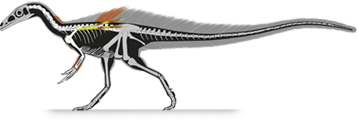
Pronunciation: yoo-BE-ruh-JAH-ruh
Meaning: Lord of the Spear
Author/s: Smyth et al. (2020)
Synonyms: None known
First Discovery: Ceará, Brazil
Acta Ordinal: #1070
Ubirajara jubatus
(Maned Lord of the Spear)Etymology
In Tupi, an Indigenous language spoken in the Brasilian region of Nova Olinda and Santana do Cariri, Ubirajara means "Lord of the spear", in reference to the long stiffened structures jutting out from the shoulder area.
The species epithet, jubatus, means "maned" in Latin.
ZooBank registry: urn:lsid:zoobank.org:act:9467530F-3807-4B95-BCE4-28776E811182.
Discovery
The remains of Ubirajara were discovered at a stone quarry in the Nova Olinda Member of the Crato Formation, between the regions of Nova Olinda and Santana do Cariri, Ceará State, in northeast Brasil's Araripe Basin.The holotype (SMNK PAL 29241) is a partially articulated, but incomplete skeleton preserving a near-complete series of neck vertebrae, a complete series of back vertebrae, an incomplete sacrum, ribs, shoulder girdle, forelimb, hands and associated soft tissues including elaborate display structures and claw sheaths. The specimen lies within a slab and counter slab of cream-coloured limestone, with both sides preserving bones and external moulds.
Controversy
The remains that would become Ubirajara were taken to Germany along with other scientific samples in 1995 in accordance with the decree law No. 4146 from the 4th of March 1942, with authorisation for the specimen's export granted on 1st February 1995 by an agent of the Crato office of the Departamento Nacional de Produção Mineral. Apparently.
However, scientists in Brasil were adamant that the specimen was taken without permission as no record of it's export actually existed at the DNPM. Furthermore, Brasilian law states that at least one Brasilian scientist must participate in the study of any fossils from Brasil, and that was not the case. Hence, the Sociedade Brasileira de Paleontologia (Brazilian Society of Paleontology) formally requested that publishers remove the Ubirajara paper from their website and withhold printed versions until a investigation on the legal status of the fossil was concluded.
In 2022, an inquiry by the Baden-Württemberg Ministry for Science, Research and Art, found that the State Museum of Natural History Karlsruhe (Staatliche Naturkundemuseum Karlsruhe) where the specimen is housed, had fibbed about the fossil's history, despite previously backing their claims of no wrong doing. In July 2022, Germany agreed to return the fossil to Brazil after a legitimate export permit could not be found.


