









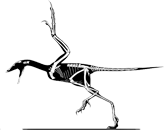
Pronunciation: WEL-un-hoh-FEE-ree-a
Meaning: for P. Wellnhofer
Author/s: Elzanowski (2001)
Synonyms: None known
First Discovery: Eichstätt, Germany
Acta Ordinal: #502
Wellnhoferia grandis
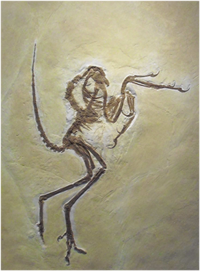 Wellnhoferia was initially announced as a specimen of Compsognathus by amateur collector and palaeontology buff Friedrich Müller in the 1960s before Peter Wellnhofer moved it in 1988. He thought, instead, it was the largest known specimen of "the earliest bird", and it's still affectionately referred to as "the Solnhofen Archaeopteryx", at least by some experts sometimes.
It was renamed Wellnhoferia in honour of Wellnhofer by Andrzej Elzanowski in 2001 when he noticed seemingly unique features in its tail and fourth toe that others had failed to see. However, to some palaeontologists, Wellnhoferia is still just the largest known specimen of Archaeopteryx lithographica, and size alone does not a distinct genus make.
(Wellnhofer's big one)Etymology
Wellnhoferia is named in honor of Peter Wellnhofer. The species epithet, grandis, means "big" or "great" (also "full grown") in Latin.
Discovery
The remains of Wellhoferia were discovered near Eichstätt, Germany, by Friedrich Müller. The exact locality is unknown, but it's likely from the Altmühl Valley.
The holotype (BSP 1999, housed at Bürgermeister-Müller-Museum in Solnhofen) is a complete skeleton, preserved on a stone slab. The Bürgermeister-Müller-Museum was founded in the late 1960s as a project of then-Bürgermeister Friedrich Müller (Bürgermeister, literally "town master" in Germany, is what would be called a Mayor in England), who wanted a museum to serve as a permanent home for his own collection of fossils from the area.


