









Pronunciation: BRAK-ee-TRAY-kel-oh-pan
Meaning: Short-necked Pan
Author/s: Rauhut, Remes, et al. (2005)
Synonyms: None known
First Discovery: Chubut, Argentina
Acta Ordinal: #568
Brachytrachelopan mesai
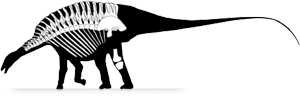
As a general rule of thumb, sauropod necks were roughly as long as their tails, or at least longer than their backs. This was especially true of the diplodocoids, including Supersaurus and Diplodocus, who ranked among the longest dinosaurs ever to walk the Earth. Yet within this family lurked a group of trend-buckers known as dicraeosaurids — the short-necked diplodocoids — and among them, Brachytrachelopan, whose pathetically short vertebrae gave it the shortest neck of all.
Why Mother Nature would create such a misproportioned creature while blessing other sauropods like the brachiosaurids, titanosaurs and diplodocids with progressively longer necks — either by increasing their number of vertebrae, elongating them, or both — is a bit of an enigma. What seems doubly unfair is that the structure of Brachytrachelopan's neural arches, which wouldn't allow its neck to be raised much higher than the angle at which it left the body, wouldn't allow it to be lowered much further than that either. So Brachytrachelopan was stuck browsing mid-lying vegetation, even though it couldn't compete for tender treetops with the larger contemporaneous Tehuelchesaurus anyway, and fossil evidence of smaller lush-grass-mowing herbivores in the Cañadón Calcáreo Formation is currently non-existent. One imagines Brachytrachelopan sympathising with Tantalus, forever teased by tantalising morsels just beyond its reach.
Funnily enough, low-browsing iguanodontian ornithopods, typically the the dominant moderately-sized herbivores in most Late Jurassic Formations, are completely absent from all areas where dicraeosaurids have been found, and vice versa. So it seems likely that these two groups of critters were occupying the same niche in their respective eco-systems.
Why Mother Nature would create such a misproportioned creature while blessing other sauropods like the brachiosaurids, titanosaurs and diplodocids with progressively longer necks — either by increasing their number of vertebrae, elongating them, or both — is a bit of an enigma. What seems doubly unfair is that the structure of Brachytrachelopan's neural arches, which wouldn't allow its neck to be raised much higher than the angle at which it left the body, wouldn't allow it to be lowered much further than that either. So Brachytrachelopan was stuck browsing mid-lying vegetation, even though it couldn't compete for tender treetops with the larger contemporaneous Tehuelchesaurus anyway, and fossil evidence of smaller lush-grass-mowing herbivores in the Cañadón Calcáreo Formation is currently non-existent. One imagines Brachytrachelopan sympathising with Tantalus, forever teased by tantalising morsels just beyond its reach.
Funnily enough, low-browsing iguanodontian ornithopods, typically the the dominant moderately-sized herbivores in most Late Jurassic Formations, are completely absent from all areas where dicraeosaurids have been found, and vice versa. So it seems likely that these two groups of critters were occupying the same niche in their respective eco-systems.
(Mesa's short-neck shepherd god)Etymology
Brachytrachelopan, is derived from the Greek "brachytrachelos" (short-necked) and "Pan" (the Greek God of shepherds). The name pays tribute to local farmer Daniel Mesa—honoured in the species epithet mesai—who stumbled upon the dinosaur’s remains weathering out of the ground while searching for his stray flock of sheep.
Pan himself was no stranger to the pastoral life. A woodland deity with the hindquarters, hooves, and horns of a goat, he wasn’t exactly temple material — perhaps due to his uncouth appearance or his famously unrestrained libido. Many of his would-be lovers resorted to transforming into trees or other inanimate objects just to escape his amorous pursuits. Still, Pan was the go-to god for fertility, frolic, and fornication — and a virtuoso on the pan pipes.
However, Pan's musical prowess fell short when he challenged Apollo — god of music and poetry — to a contest judged by the mountain god Tmolus. Apollo's lyre easily outshone Pan's rustic pipes, much to the chagrin of Pan's most ardent supporter, King Midas, who paid dearly for his poor taste: Apollo transformed his ears into those of a donkey, a permanent correction for his obviously faulty hearing.
Discovery
The first fossils of Brachytrachelopan were discovered in the Cañadón Calcáreo Formation of Argentina's Chubut Province, about 25 km north-northeast of Cerro Condor.
The holotype (MPEF-PV 1716 - housed at Museo Paleontologico Egidio Feruglio) consists of eight neck vertebrae, three hip vertebrae, twelve back vertebrae and ribs, a partial left thigh and left shin, and a hip bone (ilium).


